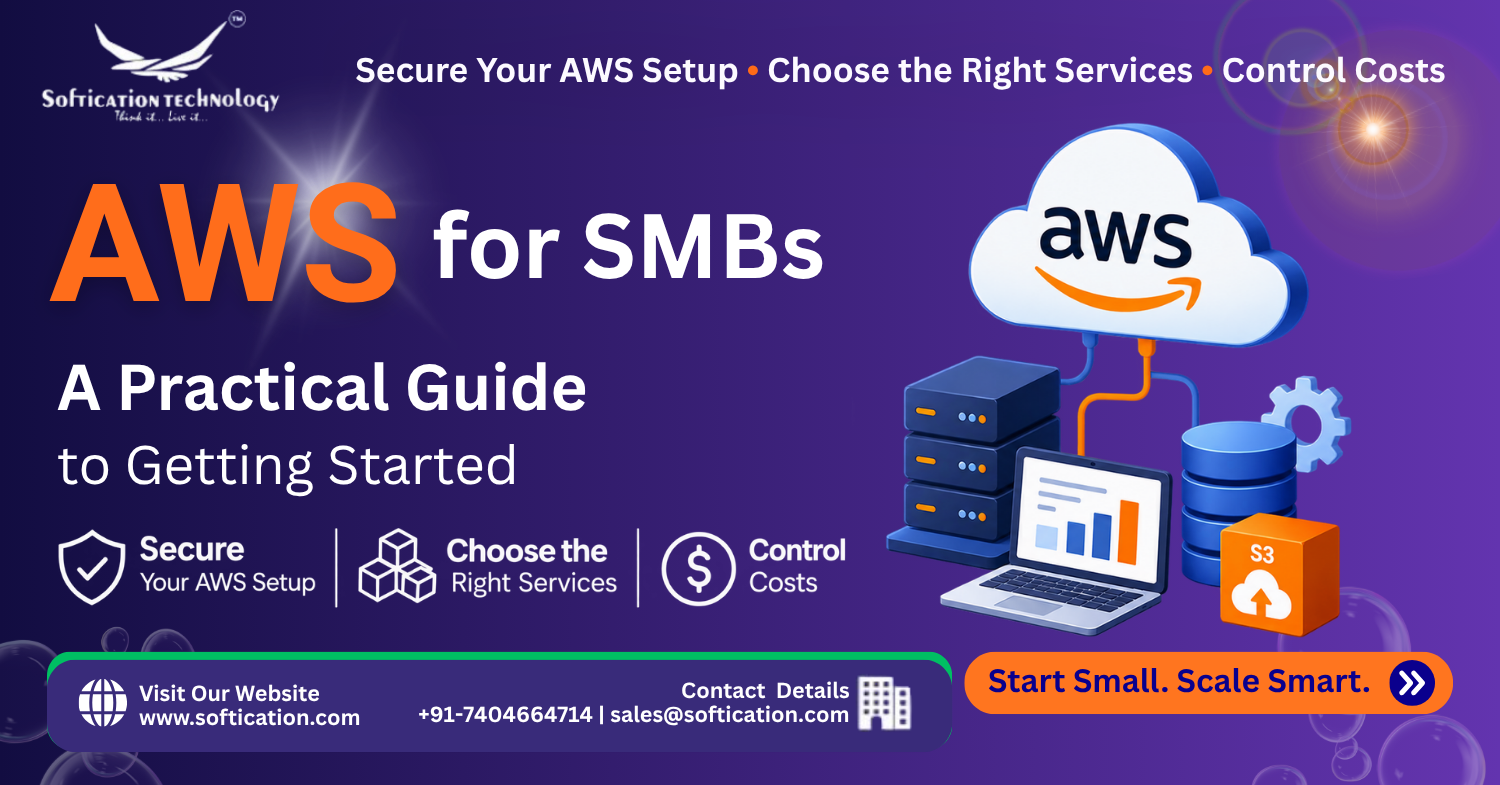
Getting started on AWS can feel overwhelming for a small or mid-sized business — over 200 services, unfamiliar terminology, and pricing that seems complicated until you understand the basics. This guide strips that down to a practical, step-by-step starting point: what to actually set up first, in what order, and what to deliberately ignore until you actually need it.
This is the practical companion to our broader AWS guide for startups and SMBs. If you've already read about AWS benefits and understand why AWS might be right for your business, this guide walks through actually getting set up — while our posts on cost optimization, common cost mistakes, Activate credits, and cloud management best practices go deeper on specific topics you'll encounter along the way.
Before You Start: What "Getting Started" Actually Requires
A common mistake for SMBs new to AWS is trying to learn the entire platform before touching anything. This isn't necessary, and it's not how most successful AWS setups actually happen. A more practical approach: set up a small, correct foundation first, then add services as specific, real needs arise — rather than trying to anticipate every future need upfront.
What you genuinely need to understand before starting: basic account setup and security, the handful of core services relevant to your specific use case (not all 200+), and enough cost awareness to avoid surprises. Everything else can be learned as it becomes relevant.
Step 1: Create Your AWS Account Correctly
Use a dedicated email address for the root account — not a personal or shared team email — since the root account has unrestricted access to everything in your AWS environment and should be tightly controlled.
Enable multi-factor authentication on the root account immediately. This is the single most important security step in initial setup, since the root account's permissions can't be restricted the way individual IAM user permissions can.
Set up billing alerts before creating any resources. Configure AWS Budgets with an alert threshold appropriate for your expected initial usage, so you're notified early if costs move outside expectations — far easier to set this up before you have anything running than to add it after an unexpected bill.
Apply for AWS Activate credits if you're a qualifying startup, before significant usage begins — credits generally can't be applied retroactively, so this is worth doing as one of your very first steps, covered in detail in our Activate credits guide.
Step 2: Set Up Basic Access Control
Even for a small team, avoid working directly from the root account for day-to-day tasks:
- Create individual IAM users (or better, use IAM Identity Center for centralized access management) for each team member who needs access
- Assign permissions based on what each person actually needs to do, rather than granting broad administrative access by default
- Enable MFA for any account with meaningful permissions, not just the root account
This takes relatively little time to set up correctly at small scale, and is significantly harder to untangle later once multiple people have been working with shared or overly broad access for months.
Step 3: Choose Your Core Services Based on Actual Need
Rather than exploring AWS's full service catalog, most SMBs get started productively with a small, focused set of services matched to their specific use case:
For a typical web application or SaaS product:
- EC2 or Elastic Beanstalk for application hosting (Elastic Beanstalk simplifies deployment for teams without deep infrastructure experience)
- RDS for a managed relational database, avoiding the need to self-manage database servers
- S3 for file and static asset storage
- CloudFront as a content delivery network, if serving static assets or media to users across different locations
For a business primarily needing file storage and basic compute:
- S3 for storage, with lifecycle policies to move older data to cheaper storage tiers automatically
- A smaller EC2 instance or Lightsail (AWS's simplified offering for straightforward workloads) for any needed compute
For event-driven or infrequent processing needs:
- Lambda for functions that run occasionally rather than continuously, avoiding the cost of an always-on server for infrequent tasks
Resist the urge to provision services "in case you need them later" — start with what your current, actual use case requires, and add services as specific needs materialize.
Step 4: Establish Basic Environment Separation
Even a small SMB benefits from separating a testing/staging setup from production, so changes can be verified before they affect real customers or business operations. This doesn't need to be elaborate — a separate, smaller set of resources mirroring production closely enough to catch obvious issues is sufficient at small scale, and can grow more sophisticated as the business does.
Step 5: Set Up Basic Monitoring
Before going live with any customer-facing service, put a small set of monitoring and alerts in place:
- CloudWatch alarms for basic health metrics (CPU, error rates, response times)
- Uptime monitoring for anything customer-facing, so you learn about problems before customers report them
- The billing alerts from Step 1, if not already configured
This doesn't need comprehensive coverage from day one — a handful of alerts on the metrics that would actually indicate a real problem is more valuable than attempting exhaustive monitoring before you understand what "normal" looks like for your specific workload.
Step 6: Plan for Cost From the Beginning
Cost awareness is far easier to build in from the start than to retrofit after spending has already grown unchecked. Beyond the billing alerts from Step 1:
- Review our guide on common AWS cost mistakes to understand the patterns to avoid from day one
- Right-size instances based on actual initial usage rather than anticipated future scale
- Understand which pricing model fits your workload — On-Demand for unpredictable usage, Reserved Instances for anything you know will run continuously — covered in depth in our cost optimization guide
Common Mistakes SMBs Make When Getting Started
Trying to learn everything before starting anything. AWS's scope can create analysis paralysis. Starting with a small, correct foundation and learning as you go is more productive than attempting comprehensive knowledge upfront.
Skipping security basics because the setup feels "too small to matter." Access control and MFA take relatively little time to set up correctly from the start, regardless of how small the initial deployment is, and are considerably more disruptive to add after the fact.
Over-provisioning based on anticipated future scale. It's tempting to provision for the business you hope to become rather than the one you currently are. Start appropriately sized for actual current needs, and scale as real usage data justifies it.
Not applying for available startup credits before usage begins. Applying for AWS Activate before significant spend accumulates captures value that's simply unavailable retroactively.
The Bottom Line
Getting started with AWS as an SMB doesn't require mastering the entire platform first — it requires setting up a small number of foundational practices correctly (secure account setup, basic access control, billing alerts, and a focused set of services matched to actual need) and then growing from there as real requirements emerge. This measured approach avoids both the paralysis of trying to learn everything upfront and the costly rework of skipping foundational steps that are far easier to establish early than to retrofit later. For the complete picture of AWS for startups and SMBs — costs, credits, and management — see our complete AWS guide.
FAQ: Getting Started With AWS for SMBs
What's the first thing I should do when setting up AWS for my business? Secure your root account with multi-factor authentication, set up billing alerts before creating any resources, and apply for AWS Activate credits if you're an eligible startup, since credits typically can't be applied retroactively to existing usage.
What AWS services does a small business actually need to get started? Most SMBs start productively with a small, focused set: EC2 or Elastic Beanstalk for hosting, RDS for a managed database, S3 for storage, and CloudFront for content delivery if serving media or static assets to users. Additional services should be added as specific needs arise, not provisioned speculatively.
Do I need a technical team to get started with AWS? Basic setup — account security, core service configuration, and billing alerts — is manageable for a small team or a single technical person, especially using simplified options like AWS Lightsail or Elastic Beanstalk. More complex architecture benefits from experienced guidance, but isn't required for initial setup.
How much does it cost to get started on AWS as a small business? Very early usage is often covered largely by the AWS Free Tier, with realistic costs starting around $0-$200 monthly for early-stage, low-traffic deployments, scaling as actual usage grows — see our complete AWS guide for a fuller cost breakdown by stage.
Should I set up separate environments for testing and production right away? Yes, even at small scale. A basic separation between a testing/staging setup and production prevents changes from directly affecting real customers, and is significantly easier to establish early than to add after production and testing have been mixed together for a while.