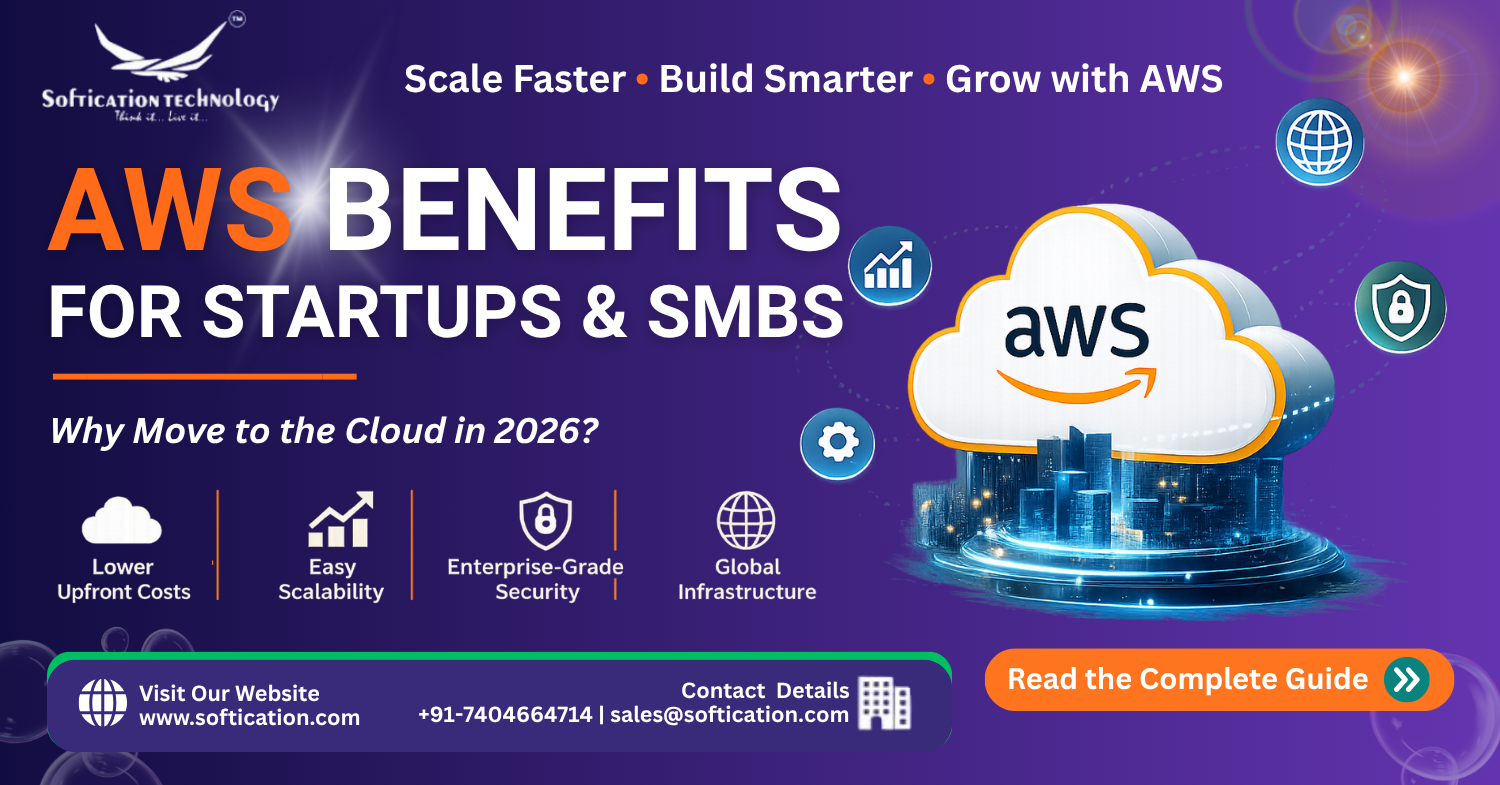
For a growing number of startups and small businesses, the question isn't whether to use cloud infrastructure anymore — it's which provider, and how to use it well. AWS remains the largest and most widely adopted option, but "largest" isn't a reason on its own. Here's what AWS actually delivers for startups and SMBs in 2026, in concrete, practical terms.
This post builds on our complete guide to AWS cloud services for startups and SMBs, which covers cost, management, and credits more broadly. Here, we focus specifically on the core benefits that make cloud migration worth considering in the first place.
1. Pay-As-You-Go Pricing Removes Large Upfront Costs
Traditional infrastructure requires buying or leasing physical servers sized for anticipated peak demand — a significant upfront cost that's hard to right-size accurately, especially for an early-stage business with limited traffic history to base projections on. AWS eliminates that upfront capital requirement. You provision what you need now and pay based on actual usage, adjusting as your business grows or contracts.
This matters most for startups specifically, where capital is scarce and future demand is genuinely uncertain. Paying for infrastructure as you grow into it, rather than paying upfront for capacity you might not need for another year, preserves runway during the phase of the business where that matters most.
2. Elastic Scalability Handles Unpredictable Growth
Startups experience growth patterns that are hard to predict — a product launch, a viral social post, or a feature getting picked up by a major customer can all cause sudden traffic spikes. Traditional infrastructure struggles with this: scaling up physical servers takes time, planning, and capital, often more of all three than a sudden demand spike allows for.
AWS's auto-scaling capabilities let infrastructure expand automatically in response to real-time demand, then scale back down once the spike passes — meaning you're not paying for peak capacity year-round just to handle occasional surges, and you're also not caught flat-footed when a surge does happen.
3. Global Infrastructure Supports International Growth
AWS operates data centers across multiple regions worldwide, which means a startup can serve customers in different geographies with low latency without building out physical infrastructure in each location. For businesses with international ambitions from early on, this removes what would otherwise be a significant infrastructure project each time the business expands into a new region — instead, it's largely a configuration decision within the same platform already in use.
4. A Mature Ecosystem Reduces What You Have to Build Yourself
AWS offers managed services covering databases, authentication, content delivery, machine learning, email sending, and dozens of other common infrastructure needs. For a startup, this means engineering time can go toward building the actual product rather than building and maintaining commodity infrastructure that a managed service already handles reliably.
This is a genuinely significant advantage for small teams specifically — a two-person engineering team building a startup MVP doesn't have the bandwidth to also build and maintain a highly available database cluster from scratch, but can reasonably configure and use a managed database service (RDS, DynamoDB) that AWS operates and maintains.
5. Security and Compliance Infrastructure Built In
AWS invests heavily in the security of its underlying infrastructure — physical data center security, network protection, and compliance certifications across a wide range of regulatory frameworks (SOC 2, HIPAA, PCI DSS, and others depending on the service). While security within your own AWS configuration is still your responsibility (a shared responsibility model, not a fully outsourced one), the underlying infrastructure security AWS provides would be prohibitively expensive for most startups to build and maintain independently.
For startups in regulated industries — healthcare, fintech, or any business handling sensitive customer data — this baseline compliance infrastructure meaningfully reduces the burden of achieving and maintaining necessary certifications.
6. Access to Advanced Technology Without Specialized Infrastructure
Machine learning, real-time data processing, advanced analytics — capabilities that would require significant specialized infrastructure and expertise to build independently are available as configurable AWS services. A startup building an AI-powered feature, for example, can access powerful compute resources and pre-built ML services without needing to build or maintain the underlying infrastructure that supports them.
This lowers the barrier to building genuinely sophisticated product features for teams that don't have deep infrastructure expertise in-house, since much of that expertise is effectively built into the managed service itself.
7. Startup-Specific Credit Programs Extend Runway
AWS Activate offers substantial credits specifically for eligible startups — commonly ranging from a few thousand dollars up to $100,000 depending on the qualifying track. For a pre-revenue or early-revenue startup, this can meaningfully offset infrastructure costs during the highest-risk period of the business, effectively extending runway without additional fundraising. We cover this program in more detail in our guide to AWS cloud services for startups.
8. Reliability and Uptime at a Level Difficult to Replicate Independently
AWS's infrastructure is built with redundancy across multiple physical locations, offering reliability levels that would be extremely costly for a small business to replicate with its own infrastructure. Services like Amazon S3 and EC2 offer high published availability targets backed by service-level agreements, giving startups access to enterprise-grade reliability without enterprise-level infrastructure investment.
Is AWS Right for Every Startup?
While the benefits above are real, AWS isn't automatically the right choice for every business at every stage. Very early-stage products with minimal, predictable traffic sometimes do fine on simpler, more limited hosting options at lower initial cost and complexity. AWS's advantages compound as a business scales, handles more unpredictable demand, or needs more sophisticated infrastructure — for a very early MVP validating basic product-market fit, the full breadth of AWS's ecosystem may be more than what's immediately necessary.
That said, because AWS's pay-as-you-go model means starting small doesn't require large upfront commitment, many startups choose to start on AWS from day one specifically so that scaling later doesn't require a disruptive infrastructure migration once growth actually happens.
The Bottom Line
AWS's core value for startups and SMBs isn't any single feature — it's the combination of eliminated upfront infrastructure costs, elastic scalability for unpredictable growth, a mature ecosystem that reduces what small teams need to build themselves, and startup-specific credit programs that make early adoption more affordable. For businesses anticipating growth or needing to move quickly without large infrastructure investment, these advantages compound meaningfully over time. For the full picture of what running on AWS actually involves — cost expectations, management practices, and how to access credits — see our complete AWS guide for startups and SMBs.
FAQ: AWS Benefits for Startups and SMBs
Why do startups choose AWS over traditional hosting? AWS eliminates large upfront infrastructure costs through pay-as-you-go pricing, offers elastic scalability for unpredictable growth, and provides a mature ecosystem of managed services that reduces what a small engineering team needs to build and maintain independently.
Is AWS cost-effective for small businesses? It can be, particularly because pay-as-you-go pricing means you're not paying for unused capacity, and AWS Activate credits can offset significant early costs for eligible startups. Cost-effectiveness depends heavily on proper architecture and ongoing cost management, though — see our guide on AWS cost optimization for specifics.
What are the main advantages of AWS for a growing business? Key advantages include elastic scalability to handle traffic spikes, global infrastructure for serving international customers with low latency, built-in security and compliance infrastructure, and access to advanced technology like machine learning without needing to build specialized infrastructure independently.
Does every startup need AWS from day one? Not necessarily. Very early-stage products with minimal, predictable traffic sometimes do fine on simpler hosting initially. However, many startups start on AWS early specifically because its pay-as-you-go model doesn't require large upfront commitment, avoiding a disruptive infrastructure migration later when growth accelerates.
What security benefits does AWS provide for startups? AWS provides robust underlying infrastructure security and a wide range of compliance certifications (SOC 2, HIPAA, PCI DSS, and others) that would be costly for most startups to build independently, though securing your own configuration within AWS remains your responsibility under AWS's shared responsibility model.