Ask any HR team what fills their day, and the answer is rarely strategy. It's questions. How many leave days do I have left? Can you send my payslip again? I need to update my bank details. Who approved my shift change? Each request is small. Together, they can consume most of an HR team's week.
If your HR staff spend more time answering routine requests than hiring, developing, and retaining people, the problem isn't workload. It's that employees have no way to help themselves. Here's what that costs your business, and what an employee self-service portal actually fixes.
The Problem: Every Routine Request Goes Through HR
In businesses without self-service, HR becomes the human interface for every piece of employee data and every simple transaction. Requests arrive by email, chat, phone, and in person, and each one needs someone to look something up, update a record, or forward a form. The same patterns appear again and again:
- Repetitive questions about leave balances, payslips, holidays, policies, and schedules that have the same answers every time
- Manual data updates for addresses, bank details, emergency contacts, and tax information, each requiring HR to key in changes
- Leave and time-off requests handled through email chains or paper forms, with approvals tracked informally
- Document requests such as employment letters, experience certificates, and tax forms, prepared manually each time
- Shift and availability changes communicated through managers and then relayed to HR or payroll
- No visibility for employees, who can't see their own records, so they ask HR to confirm what they could check themselves
- Requests lost or delayed when they arrive across different channels and no one owns tracking them
- Inconsistent answers, because information lives in people's heads or scattered files rather than a single source
None of this is high-value work, yet it takes skilled people's time and attention every single day.
The Business Consequence: Administrative Overload Has Real Costs
When HR is buried in routine requests, the cost spreads across the entire organization.
HR capacity drained by low-value work. Time spent answering repeat questions and updating records is time not spent on recruiting, retention, training, and employee relations.
Slow response times. Employees wait for answers to simple questions, and waiting creates frustration, especially for urgent issues like payslip errors or leave approvals.
Data errors from manual entry. Every time HR retypes information from an email or form into a system, there is a chance of mistakes, and errors in personal or bank details can cause payroll problems.
Poor employee experience. Employees now expect to manage their own information the way they manage their banking or shopping. Forcing them to email HR for basic tasks feels outdated and disorganized.
Manager time wasted. Managers spend time approving, forwarding, and chasing requests that a system could route and track automatically.
Compliance and audit gaps. Requests handled informally leave weak records of who requested what, who approved it, and when.
Scaling pain. Every new hire adds to the request volume, so HR headcount has to grow in step with the workforce instead of staying lean.
Higher turnover risk. Frustrating administrative experiences contribute to disengagement, particularly among hourly and frontline employees who need quick, reliable access to schedules and pay information.
A growing business that doesn't automate routine HR interactions is effectively paying skilled people to do work that software could handle.
Wondering how much time your HR team spends on routine requests? [Get a Free HR Workload Assessment →]
The Solution: An Employee Self-Service Portal
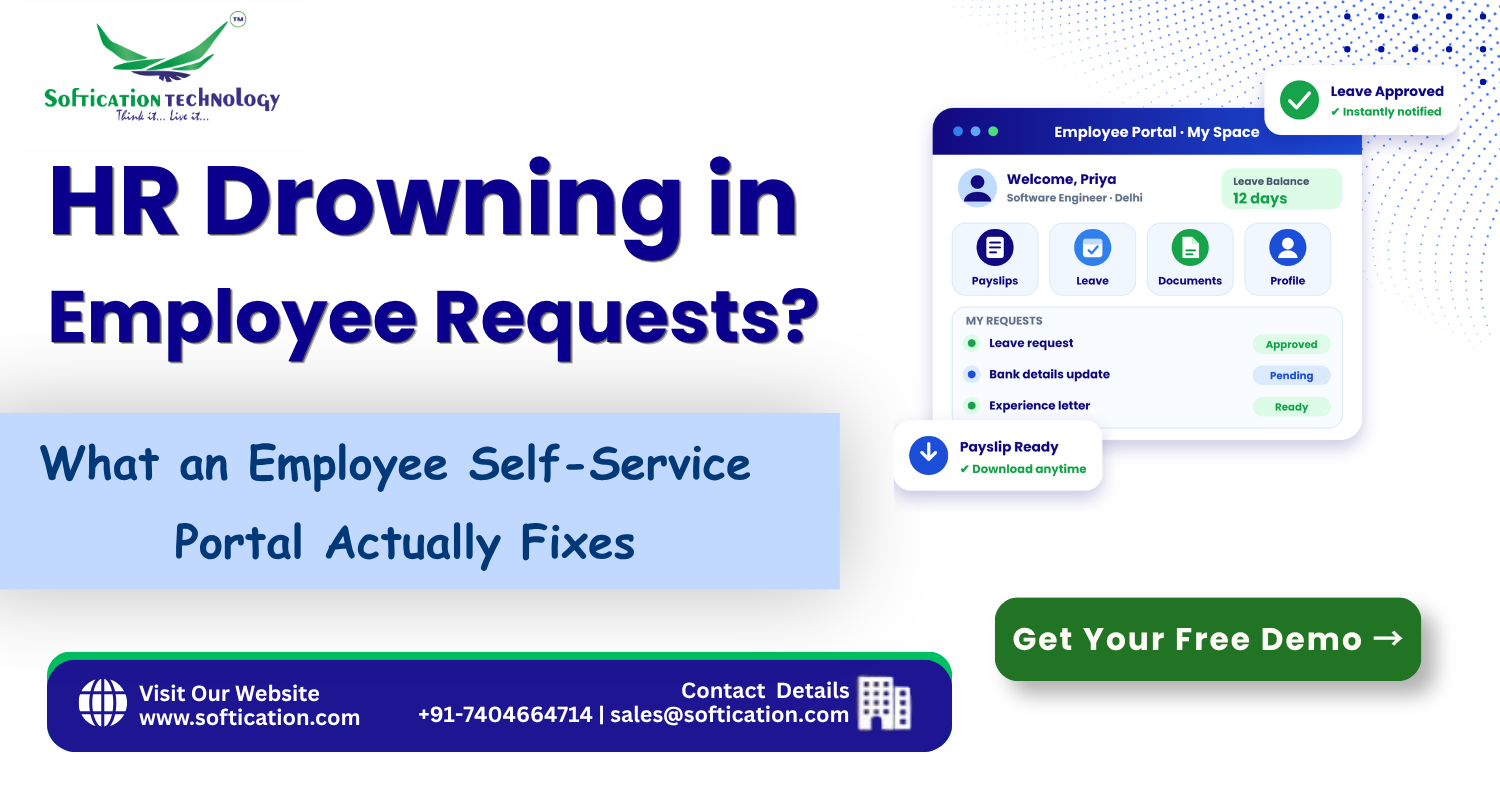
An employee self-service portal gives every employee a secure, easy place to view their information and complete routine tasks themselves, while routing anything that needs approval to the right person automatically. A well-built portal typically includes:
- Personal profile management, letting employees update contact details, bank information, and emergency contacts, with approval rules where needed
- Leave management, with balances, requests, approvals, and a team calendar in one place
- Payslips and tax documents, available to download any time without contacting HR
- Schedule and shift visibility, including shift swaps, availability updates, and open shift requests
- Attendance and timesheet access, so employees can view and correct their own records within defined rules
- Document requests and automated letters, generating employment verification and similar documents instantly
- Company policies and announcements, stored centrally so employees find consistent, current answers
- Workflow and approvals, routing each request to the right manager automatically, with reminders and a full record
- Mobile access, giving frontline and field employees the same convenience as office staff
- Role-based security, ensuring employees see only their own data and managers see only their teams
The goal isn't to remove the human side of HR. It's to remove the repetitive transactions so HR can focus on the work that actually needs a human.
SoftiCation's Capability: We Build Portals Around Your Processes and Systems
At SoftiCation, we build employee self-service portals that connect to the systems you already use and reflect how your organization actually works. Our capability includes:
- Custom employee self-service portal development, with web and mobile apps designed around your workforce and policies
- Leave, attendance, and shift management modules, including approval workflows tailored to your rules
- Integration with HRMS, payroll, and time tracking, so portal data is always accurate and updates flow both ways without manual re-entry
- Document generation and request automation, for payslips, employment letters, and other routine documents
- Configurable approval workflows, with routing, reminders, escalations, and complete audit trails
- Role-based access and security architecture, protecting sensitive employee and payroll data
- Mobile-first design for deskless and frontline employees, with simple, fast interfaces
- Notifications and announcements, keeping employees informed through email, SMS, or in-app messages
- Analytics on request volume and turnaround, helping HR see what employees ask most and where processes can improve
We build portals your employees will actually want to use, and your HR team will actually be relieved to have.
Want to see what a self-service portal built for your workforce would look like? [Talk to an HR Portal Specialist →]
Proof: What This Looks Like in Practice
Consider a growing company whose small HR team handled leave requests, payslip queries, personal detail changes, and document requests entirely through email and messaging. A large share of each week went to repetitive questions, leave approvals were tracked in spreadsheets, and employees often waited days for something as simple as a salary slip or a balance check. Occasionally, a manual update to bank details introduced an error that caused a payroll correction.
A self-service portal was built and connected to the company's existing HRMS and payroll systems. Employees could view and download payslips, check leave balances, submit and track leave requests, update contact details, and request standard documents, all from a web or mobile app. Approval workflows routed requests to the right managers automatically, with reminders and a clear record of every decision.
After launch, the volume of routine requests reaching HR dropped substantially, leave approvals were completed faster, and manual data entry errors decreased because employees entered their own information directly. HR staff reported having more time for recruiting, onboarding, and employee support, while employees appreciated being able to find answers and complete tasks on their own schedule.
This reflects the real value of self-service: it doesn't replace the HR team, it frees them from repetitive transactions and gives employees faster, more reliable access to their own information.
Ready to take the routine workload off your HR team? [Get Your Free Self-Service Portal Consultation →]
Is Your HR Team Buried in Requests Employees Could Handle Themselves?
If routine requests are consuming your HR team's time, slowing down responses, and introducing errors, a self-service portal addresses the root cause. It gives employees the access they expect and gives HR the capacity to focus on the people side of the work.
Get a Free Employee Self-Service Portal Consultation and find out exactly how a portal built around your processes, policies, and systems would work.
[Get Your Free Self-Service Portal Consultation →]
Or talk to us directly. We'll walk you through what's possible for your business. 📞 Call/WhatsApp us today to discuss your HR self-service needs.