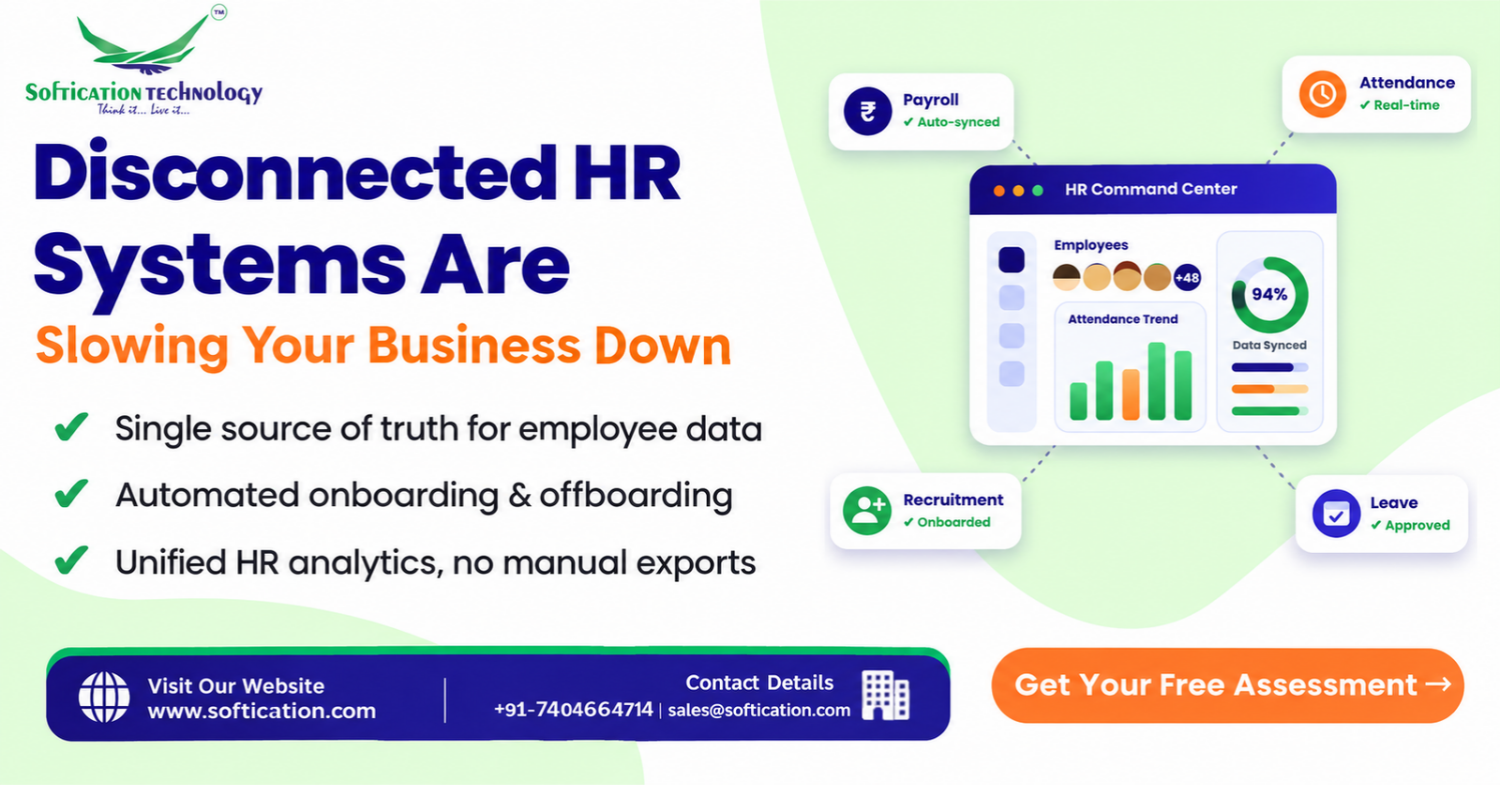
Most growing businesses don't set out to build a fragmented HR tech stack. It happens gradually. A recruiting tool gets added here, a payroll provider there, a separate attendance system, a spreadsheet for leave tracking, another tool for performance reviews. Each one made sense when it was adopted. Together, they form a patchwork of systems that don't talk to each other — and quietly slow down every HR process that depends on them.
If your HR team spends more time moving data between systems than actually working with people, the issue isn't workload. It's integration. Here's what disconnected HR systems are really costing you, and what proper HRMS integration looks like.
The Problem: HR Data Scattered Across Systems That Don't Communicate
In a typical growing business, employee data lives in multiple places at once: recruitment platform, onboarding forms, payroll, attendance and time tracking, leave management, performance tools, and often a central spreadsheet trying to tie it all together. When these systems aren't integrated, the same predictable problems keep surfacing:
- Duplicate data entry — the same employee information re-entered manually into several systems whenever someone joins, changes roles, or leaves
- Inconsistent employee records, where a change updated in one system never reaches the others, leaving conflicting versions of the same information
- Slow onboarding and offboarding, since account setup, payroll registration, and access changes must be triggered manually across multiple disconnected tools
- No single source of truth for employee data, making reporting a manual exercise of pulling and reconciling exports from different platforms
- Leave, attendance, and payroll that don't sync automatically, requiring manual reconciliation before every pay run
- Limited reporting capability, since cross-system questions (turnover by department, cost per hire against performance, absenteeism trends) require manually combining data from multiple sources
- Security and access gaps, when an employee's access isn't revoked consistently across every system at offboarding
- HR teams stuck on administrative work instead of strategic priorities like hiring, retention, and employee development
Each of these feels like a normal part of running HR. Collectively, they represent a significant and largely avoidable operational drag.
The Business Consequence: Fragmented HR Systems Cost Time, Accuracy, and Security
The impact of disconnected HR systems extends well beyond HR itself — it affects payroll accuracy, employee experience, compliance, and decision-making across the business.
Wasted HR hours. Time spent on manual data entry, reconciliation, and cross-checking between systems is time that could have gone toward recruiting, retention, and employee support — and it recurs every single pay period and every single hire.
Data errors with real consequences. When employee data is manually transferred between systems, errors are inevitable, and in HR those errors translate into incorrect pay, wrong benefits, or inaccurate compliance records.
Slower, inconsistent onboarding. New hires who wait days for accounts, access, or payroll setup form their first impression of the company from disorganized processes, which affects early engagement and retention.
Security risk at offboarding. If employee access isn't revoked consistently and immediately across every connected tool, former employees may retain access to sensitive systems or data longer than intended.
Poor visibility for leadership. Without integrated data, leaders make workforce decisions based on partial or outdated information, since pulling a complete picture requires manual effort that often doesn't happen frequently enough.
Compliance exposure. Inconsistent or incomplete employee records create risk during audits, wage disputes, or regulatory reviews, since there's no single reliable record showing a complete employment history.
Reduced employee experience. Employees dealing with slow HR responses, inconsistent information, or repeated requests for the same data across systems see the organization as disorganized, which affects engagement and trust.
Not sure how much disconnected systems are costing your HR team? [Get a Free HR Systems Assessment →]
The Solution: Integrated HRMS Architecture
The fix isn't replacing every tool you use — it's connecting them so data flows automatically instead of being moved manually. A properly integrated HRMS setup typically includes:
- A central employee data source of truth, where core employee information is maintained once and shared automatically with every connected system
- Automated data synchronization between recruitment, onboarding, payroll, attendance, leave, and performance systems
- Automated onboarding and offboarding workflows, triggering account creation, payroll registration, and access changes across every system from a single action
- Real-time attendance, leave, and payroll integration, ensuring time and absence data flows directly into pay calculations without manual reconciliation
- Unified reporting and analytics, pulling data from every connected system into dashboards that answer cross-functional questions without manual exports
- Role-based access control managed centrally, ensuring consistent, secure permissions across all connected tools
- Employee self-service portals, connected to the same underlying data, so employees can view and update their own information without routing every request through HR
- Audit-ready records, maintaining a complete, consistent employment history across all systems
The right integration turns a collection of separate tools into a single, coordinated HR system — without necessarily replacing the tools your team already knows how to use.
SoftiCation's Capability: We Connect Your HR Tools Into One Coordinated System
At SoftiCation, we specialize in integrating the HR systems businesses already use, as well as building custom HRMS components where off-the-shelf options fall short. Our capability includes:
- HRMS integration and API development — connecting recruitment, payroll, attendance, leave, and performance tools through reliable, secure data synchronization
- Custom HRMS development — building tailored modules (leave management, onboarding workflows, employee portals) when standard tools don't fit your processes
- Automated onboarding and offboarding workflow development — triggering consistent actions across every connected system from a single event
- Unified HR analytics dashboards — consolidating data from multiple sources into real-time reporting for HR and leadership
- Legacy HR system integration — connecting older, existing systems with modern tools without requiring a full platform replacement
- Employee self-service portal development — reducing HR's administrative workload while improving employee experience
- Security and access control architecture — centralizing permission management and ensuring consistent access revocation across all connected systems
- ERP and payroll integration — linking HR data with broader business systems for accurate, end-to-end workforce data flow
We build around the systems you already rely on, so integration improves your operations without disrupting them.
Want to see what an integrated HR system would look like for your business? [Talk to an HRMS Integration Specialist →]
Proof: What This Looks Like in Practice
Consider a growing company using separate tools for recruitment, payroll, attendance tracking, and leave management, with a master spreadsheet maintained manually by the HR team to keep employee records consistent. Onboarding a new hire required re-entering the same information across four different systems, and offboarding relied on a manual checklist that occasionally resulted in delayed access removal. Monthly payroll preparation required HR to reconcile attendance and leave data manually before it could be processed.
An integration layer was built connecting all four systems, with a central employee record serving as the single source of truth. Onboarding and offboarding workflows were automated so that a single action in the central system triggered account setup, payroll registration, and access changes across every connected tool. Attendance and leave data were synchronized directly with payroll, eliminating the manual reconciliation step, and a unified dashboard gave leadership real-time visibility into headcount, absenteeism, and turnover trends.
Following implementation, time spent on manual data entry and reconciliation dropped substantially, onboarding became noticeably faster and more consistent, and access removal at offboarding happened reliably across every system at once. HR staff reported being able to redirect meaningful time toward recruiting and employee support, instead of administrative data work, and leadership gained access to reporting that previously would have required hours of manual compilation.
This reflects the core value of HRMS integration: it doesn't replace the tools a business depends on, it connects them so they work as one system instead of several separate ones.
Ready to stop moving data between HR systems manually? [Get Your Free HRMS Integration Assessment →]
Are Disconnected HR Systems Holding Your Business Back?
If your HR team spends more time managing data between systems than managing people, the cost isn't just administrative — it affects payroll accuracy, onboarding quality, security, and the quality of decisions your leadership can make. Integration fixes the root cause, not just the symptoms.
Get a Free HRMS Integration Consultation and find out exactly how your current HR systems could be connected, and what a unified setup would look like for your business.
[Get Your Free HRMS Integration Consultation →]
Or talk to us directly — we'll walk you through the integration options for your current tools. 📞 Call/WhatsApp us today to discuss your HR systems integration needs.