Most businesses don't violate labor laws on purpose. They do it by accident: an employee crosses an overtime threshold nobody noticed, a mandatory break gets skipped during a busy shift, a rule that changed last year never made it into the payroll setup. The intent was fine. The consequences are the same.
Labor law violations tend to surface at the worst possible time: during an audit, a wage claim, or a disgruntled employee's complaint. By then, the cost of fixing the problem is far higher than the cost of preventing it would have been. Here's why violations happen, what they actually cost, and how to build overtime and compliance tracking directly into your systems so they stop being a surprise.
Note: Labor regulations vary widely by country, state, and industry. This article explains the systems approach; always confirm specific legal requirements with a qualified employment lawyer or compliance advisor.
The Problem: Compliance Depends on Manual Vigilance
In many businesses, labor law compliance is a matter of people remembering rules and checking numbers by hand. Managers watch hours manually, HR reviews timesheets after the fact, and payroll applies whatever rules were configured at some point in the past. That approach breaks down in predictable ways:
- Overtime goes unnoticed until after the fact, because hours are reviewed when the pay period closes rather than while they accumulate
- Break and rest requirements are tracked inconsistently, relying on employees and managers to remember and record them
- Rules differ by location, role, and employee type, and manual tracking can't keep up with the variations
- Regulations change, but system configurations and manager knowledge don't update automatically
- Time records are incomplete or editable without a trail, making it hard to prove what actually happened
- Scheduling ignores compliance, publishing shifts that already guarantee overtime or insufficient rest between shifts
- Minors, contractors, and special categories have different rules that are easy to mishandle in generic systems
- No central view of risk, so leadership can't see where violations are likely until something goes wrong
Each of these gaps seems small. Together they create a steady, invisible exposure that grows with every employee and every location.
The Business Consequence: Violations Cost Far More Than Prevention
Labor law violations are rarely a single-line expense. They tend to cascade into financial, legal, and reputational damage.
Back pay and penalties. Underpaid overtime or missed premiums often have to be repaid across every affected employee and pay period, and penalties may apply on top, depending on the jurisdiction.
Legal and audit costs. Defending a wage claim or responding to a labor audit consumes legal fees, management time, and internal resources, even when the case is eventually resolved favorably.
Repeated exposure. Fixing one violation without fixing the underlying process often means the same problem recurs, and repeat issues can draw closer scrutiny.
Reputation damage. Wage and hour disputes can become public, hurting both customer perception and the ability to recruit good people.
Employee trust and turnover. Employees who feel shorted on pay or denied breaks lose trust quickly, and many leave.
Operational disruption. Investigations and corrections pull HR, finance, and operations teams away from their normal work for weeks or months.
Uncontrolled overtime spend. Even when overtime is legal, unnoticed overtime blows through budgets, because nobody saw it building.
The most expensive part of a labor law violation is usually that it was preventable, and that nobody saw it coming.
Not sure where your compliance gaps might be? [Get a Free Labor Compliance Risk Review →]
The Solution: Compliance Rules Built Directly Into Your Systems
The most reliable way to avoid violations is to stop depending on memory and manual checks. Instead, build the rules into the systems that schedule, track, and pay your workforce, so compliance is enforced automatically. A well-designed compliance tracking system typically includes:
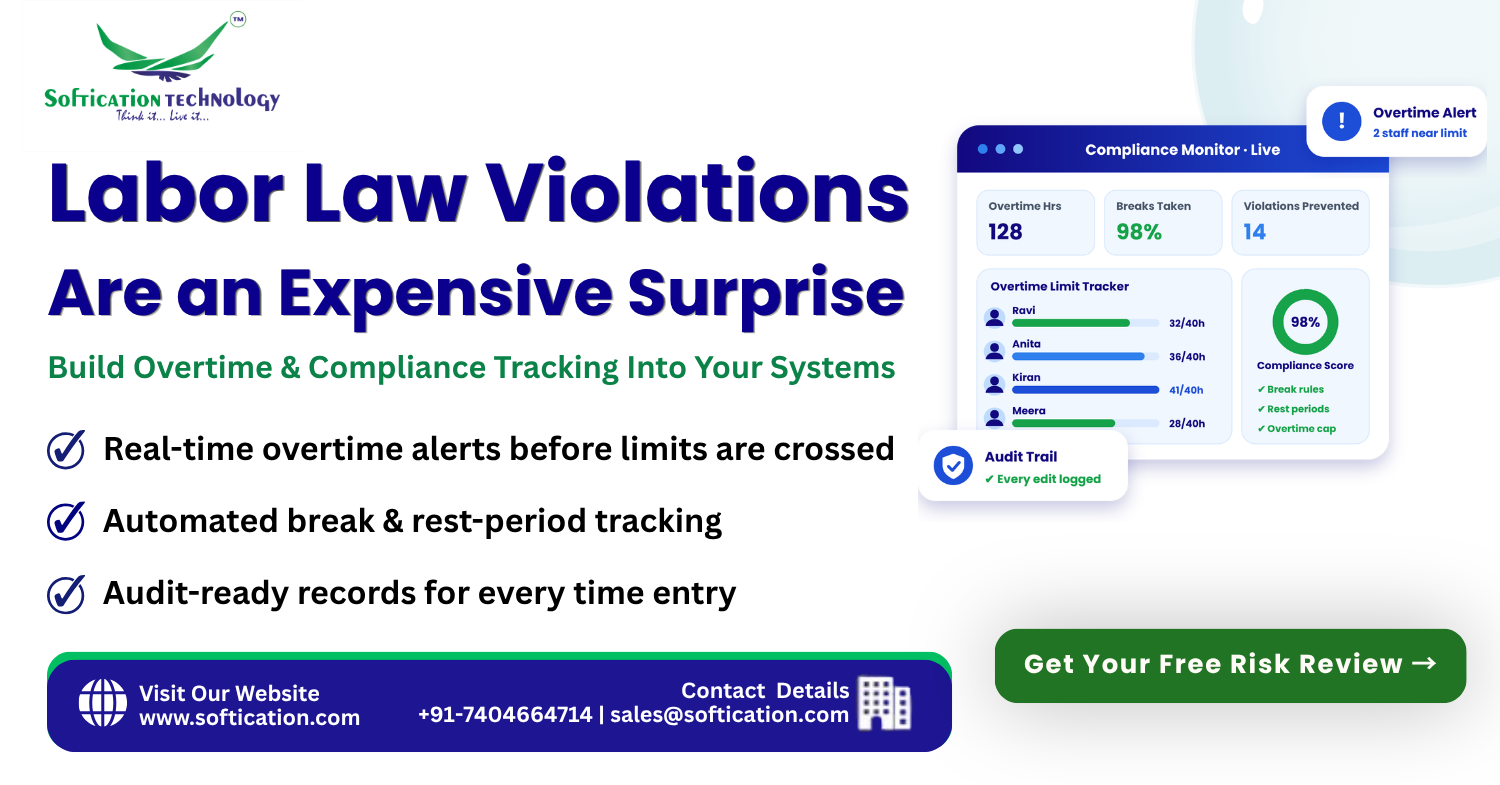
- Real-time overtime tracking, calculating hours as they accumulate and alerting managers before thresholds are crossed
- Automated break and rest enforcement, prompting breaks, recording them, and flagging missed or short breaks immediately
- Rule engines by jurisdiction, role, and employee type, applying the right overtime, premium, and rest rules to each person automatically
- Compliance-aware scheduling, warning managers when a draft schedule would create overtime, insufficient rest, or other violations before it is published
- Tamper-evident time records and audit trails, showing who changed what, when, and why
- Approval workflows for exceptions, so overtime and edits require authorization and leave a record
- Configurable rule updates, making it simple to adjust the system when regulations or company policies change
- Compliance dashboards and reports, giving HR and leadership a clear view of risk, violations prevented, and open issues
- Integration with payroll, ensuring the correct premiums and overtime rates flow into pay automatically
The goal is a system where doing the compliant thing is the default, and violations become the exception that gets flagged, not the surprise that gets discovered.
SoftiCation's Capability: We Build Compliance Into the Workflow, Not Around It
At SoftiCation, we don't treat compliance as a separate reporting layer. We build it into scheduling, time tracking, and payroll so rules are enforced at the moment decisions are made. Our capability includes:
- Custom overtime and compliance rule engines, configured for your jurisdictions, roles, contracts, and internal policies
- Real-time overtime alerts and forecasting, flagging employees approaching limits before costs and violations occur
- Break and rest-period tracking systems, with automated prompts, records, and exception flags
- Compliance-aware scheduling modules, validating shifts against rules before they are published
- Audit trail and tamper-evident record systems, preserving a defensible history of time entries and edits
- Exception and approval workflow development, controlling and documenting overtime and manual changes
- Payroll and HRMS integration, so compliant hours turn into correct pay without manual handoffs
- Compliance dashboards and reporting, giving leadership clear visibility into risk across every location
- Configurable, maintainable rule management, so your team can update rules as regulations evolve, without rebuilding the system
We build systems designed around your specific obligations, working alongside your legal or compliance advisors to translate the rules into reliable automation.
Want to see how compliance rules could be built into your own systems? [Talk to a Compliance Systems Specialist →]
Proof: What This Looks Like in Practice
Consider a multi-site business that relied on managers to watch employee hours and on payroll staff to apply overtime rules at the end of each period. Rules varied slightly between locations, break records were inconsistent, and corrections were common. A routine review found overtime calculated incorrectly for several employees across multiple pay periods, requiring back-pay corrections and a time-consuming internal investigation.
A compliance tracking layer was built into the business's scheduling, time tracking, and payroll workflow. Overtime thresholds were monitored in real time, with alerts sent to managers as employees approached limits. Break compliance was tracked automatically, and the scheduling tool warned managers when a draft schedule would create an overtime or rest-period problem. Every time entry and edit was recorded in an audit trail, and location-specific rules were configured centrally.
After rollout, overtime and break exceptions were caught and corrected during the pay period rather than after it, payroll corrections dropped sharply, and managers stopped relying on memory for rule details. When a later review took place, the business could show a complete, consistent record of hours, approvals, and rule application.
This reflects the real value of building compliance into your systems: it turns an unpredictable risk into a managed process.
Ready to stop being surprised by compliance issues? [Get Your Free Compliance Tracking Consultation →]
Is Your Business Exposed to Labor Law Surprises?
If compliance in your business still depends on people remembering rules and checking hours by hand, the question isn't whether a gap exists. It's whether you'll find it before someone else does. Building overtime and compliance tracking into your systems closes the gap at the source.
Get a Free Labor Compliance Systems Consultation and find out exactly where your current processes expose you, and what an automated compliance layer built for your business would look like.
[Get Your Free Labor Compliance Systems Consultation →]
Or talk to us directly. We'll walk you through what's possible with your current systems. 📞 Call/WhatsApp us today to discuss your compliance tracking needs.