Scheduling one team in one location is a manageable task. Scheduling dozens of teams across several locations, each with its own staffing needs, local labor rules, and last-minute changes, is a different problem entirely. Many growing businesses discover this the hard way: the scheduling approach that worked at two locations quietly falls apart at ten.
If your location managers each run scheduling their own way, if employees can't pick up shifts at nearby sites, and if head office has no clear view of coverage, you're dealing with shift chaos. Here's why it happens, what it costs, and how a properly built multi-location scheduling system fixes it.
The Problem: Scheduling Built for One Location Breaks at Scale
Most businesses start with simple scheduling: a spreadsheet, a shared calendar, or a basic app maintained by one manager. As new locations open, the same approach gets copied and customized by each location manager. Over time, this creates a patchwork of inconsistent processes with predictable problems:
- Every location schedules differently, using separate spreadsheets, apps, or even messaging groups, with no standard process
- No central visibility, so head office can't see coverage, labor spend, or gaps across locations without asking each manager
- Employees locked into a single site, even when a nearby location is short-staffed and they have spare availability
- Last-minute call-outs handled by phone calls and texts, with no system to find qualified cover across locations quickly
- Inconsistent labor rules, since different locations may fall under different local overtime, break, and scheduling regulations that managers track manually
- Skills and certifications not tracked, leading to shifts staffed by people who aren't qualified or authorized for certain tasks
- Different demand patterns ignored, where each location's busy periods are guessed at rather than planned from data
- Schedule changes not communicated reliably, leaving employees unsure of their shifts and managers unsure who will actually show up
None of this is the fault of individual managers. It is what happens when a process designed for one site is stretched across many without proper systems behind it.
The Business Consequence: Scheduling Chaos Hits Costs, Service, and Retention
Inconsistent scheduling across locations doesn't stay an administrative problem. It affects labor cost, customer experience, compliance, and employee retention.
Uneven staffing across locations. One location is overstaffed and paying for idle hours while another a few kilometers away is short-handed and losing sales or frustrating customers.
Higher overtime costs. Without cross-location visibility, a location relies on overtime from its own staff instead of using available employees from nearby sites.
Compliance exposure. Overtime, mandatory breaks, minimum rest periods, and predictive scheduling rules can differ by location. Tracking them manually across many sites is a recipe for violations and penalties.
Service quality drops. Understaffed shifts and unqualified coverage lead to longer waits, more errors, and inconsistent customer experiences between locations.
Manager time wasted. Every location manager spends hours each week building and fixing schedules, plus handling call-outs and swaps by hand, instead of running their site.
Employee frustration and turnover. Last-minute changes, unclear schedules, and no flexibility to pick up extra hours elsewhere are common reasons shift workers leave.
Leadership blind spots. Without consolidated data, executives can't compare locations fairly, spot patterns, or plan staffing for growth.
Every new location multiplies these problems unless the scheduling process itself is built to scale.
Wondering how much inconsistent scheduling is costing your locations? [Get a Free Multi-Location Scheduling Assessment →]
The Solution: Centralized, Multi-Location Scheduling Architecture
The fix isn't asking every manager to be more careful. It's giving the whole organization one scheduling system that handles location-specific rules while still providing central visibility and control. A properly built multi-location scheduling system typically includes:
- One centralized scheduling platform used by every location, with a consistent process and shared data
- Location-specific rules and templates, so each site's demand patterns, shift structures, and local labor laws are respected automatically
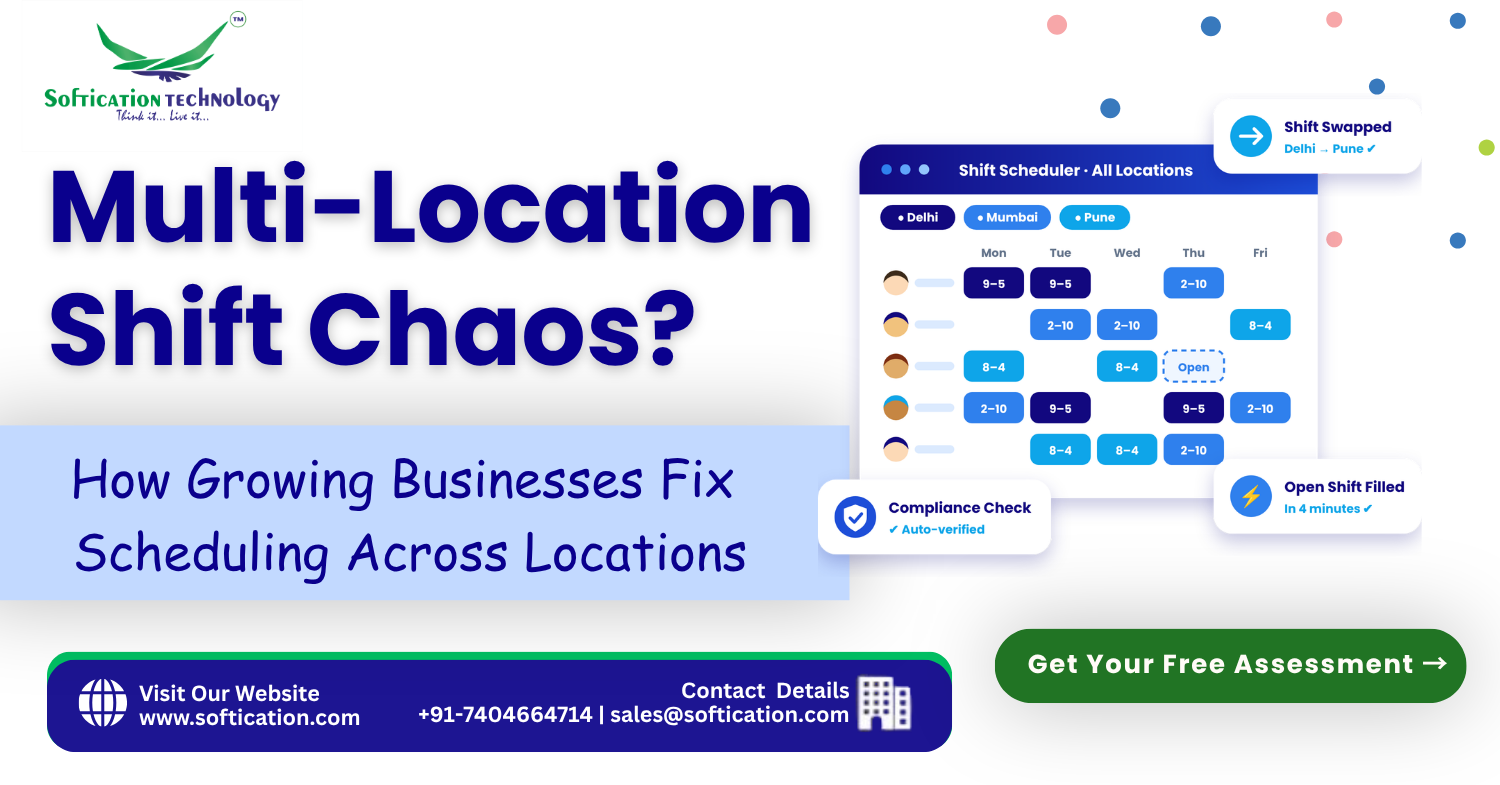
- Cross-location shift sharing, letting employees with availability pick up open shifts at nearby sites, subject to approval rules
- Skills and certification tracking, ensuring only qualified and authorized employees are scheduled for specific roles
- Automated compliance checks, flagging overtime risk, missed breaks, and rest-period violations before schedules are published
- Instant open-shift notifications and call-out handling, so gaps are filled in minutes through the system instead of phone calls
- Demand-based scheduling, using historical sales, footfall, or workload data to suggest staffing levels per location
- Real-time central dashboards, giving head office a live view of coverage, labor cost, and variances across all locations
- Mobile apps for managers and employees, so schedules, swaps, and alerts are accessible anywhere
The goal is one coordinated workforce rather than a collection of separate teams managed in isolation.
SoftiCation's Capability: We Build Scheduling Systems That Scale With Your Locations
At SoftiCation, we build multi-location scheduling systems around how your business actually operates, including your location structure, roles, local compliance needs, and growth plans. Our capability includes:
- Custom multi-location scheduling platform development, supporting any number of sites, departments, and shift patterns
- Rule engines for local labor law and company policy, applied automatically per location, role, and employee
- Cross-location workforce pooling, enabling shift sharing and shared availability across nearby sites
- Skills, certifications, and role-based scheduling, ensuring the right qualified person is scheduled for each shift
- Demand forecasting integration, using your sales, traffic, or workload data to guide staffing recommendations
- Real-time head office dashboards, consolidating coverage, labor cost, overtime, and attendance across all locations
- Mobile apps for employees and managers, with instant notifications, swaps, and open-shift claiming
- Integration with time tracking, payroll, and HRMS, so scheduled, worked, and paid hours stay connected
- Scalable architecture, so adding a new location means configuring it, not rebuilding the process
We build one system that handles the complexity, so your managers don't have to.
Want to see how a multi-location scheduling system would work for your business? [Talk to a Scheduling Systems Specialist →]
Proof: What This Looks Like in Practice
Consider a growing retail and service business with around a dozen locations, where each location manager built schedules in their own spreadsheet. Shift swaps were arranged by text message, call-outs were handled by phoning colleagues one by one, and head office had no consolidated view of coverage. Some locations regularly paid overtime while others a short distance away had employees with unused availability, and compliance with local break and overtime rules depended on each manager's memory.
A centralized multi-location scheduling platform was built, with location-specific templates and rules for each site. Employees could view their schedules and claim open shifts through a mobile app, including shifts at nearby locations where they were approved to work. Automated compliance checks flagged overtime and break violations before schedules were published, and a head office dashboard showed coverage and labor cost across every location in real time.
After rollout, unplanned overtime fell as nearby locations began sharing staff, call-outs were covered in a fraction of the previous time through instant open-shift alerts, and managers spent far less time building and fixing schedules. Leadership gained a consistent, comparable view of every location, which also made planning for the next location opening much easier.
This reflects the core value of a centralized system: it doesn't remove local flexibility, it adds consistency and visibility so the whole business benefits from its combined workforce.
Ready to fix shift chaos across your locations? [Get Your Free Scheduling System Consultation →]
Is Scheduling Chaos Holding Back Your Growth?
If every new location adds more scheduling complexity instead of simply adding capacity, the process, not the people, is the bottleneck. A centralized, multi-location scheduling system turns that complexity into an advantage by pooling your workforce, enforcing compliance automatically, and giving leadership a clear view of the whole operation.
Get a Free Multi-Location Scheduling Consultation and find out exactly how a system built for your locations, rules, and growth plans would work.
[Get Your Free Multi-Location Scheduling Consultation →]
Or talk to us directly. We'll walk you through what's possible for your business. 📞 Call/WhatsApp us today to discuss your multi-location scheduling challenges.