
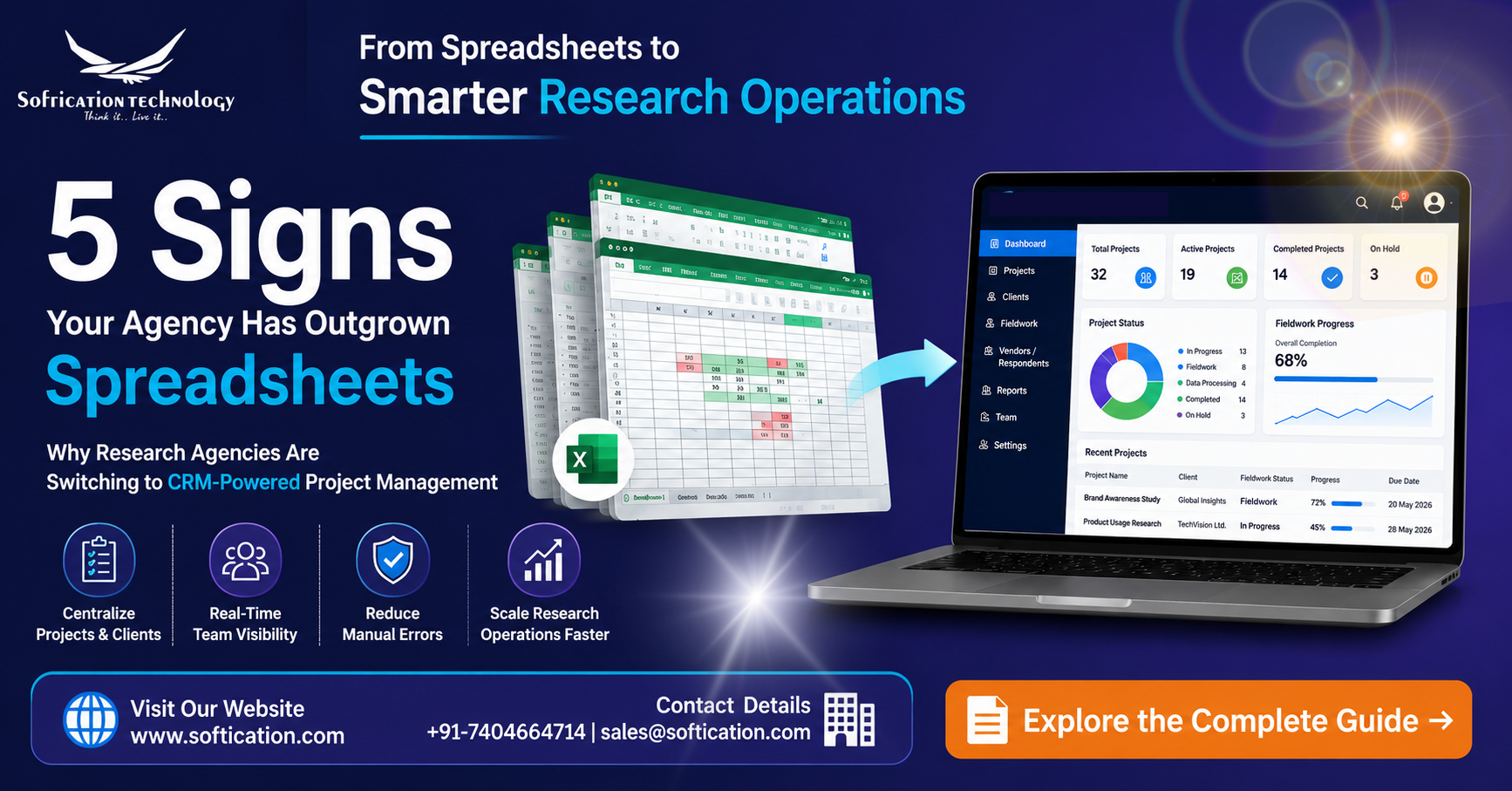
Every research agency starts with spreadsheets. They're free, flexible, and genuinely fine for tracking a handful of projects and vendors. The problem is that most agencies keep using them long after they've stopped being fine — because the breakdown happens gradually, not all at once. Here are five signs that spreadsheets have quietly become the bottleneck slowing your agency down.
Spreadsheets don't fail loudly. There's no single moment where they "stop working." Instead, small inefficiencies pile up — a missed vendor update here, a duplicate respondent there, an hour spent reconciling numbers before a client call — until an agency realizes it's spending as much time managing its tools as managing its research. This post covers the five most common signs that it's time to move from spreadsheets to a dedicated CRM built for research operations.
Sign 1: You're Manually Reconciling Data From Multiple Vendors Before Every Client Update
If preparing for a client status call means opening three or four vendor portals, copying numbers into a master spreadsheet, and double-checking that nothing was missed, that's a clear signal the current setup isn't scaling.
This process usually starts manageable — one or two vendors, updated weekly. It becomes a real time cost once an agency is running multiple concurrent projects, each with several vendors, each needing to be checked and reconciled separately before anyone can answer a simple "how's the project going" question with confidence.
What this costs in practice: hours per week spent on manual reconciliation that a centralized dashboard would show automatically, in real time, without anyone needing to touch a spreadsheet.
Sign 2: You've Had a Duplicate or Fraudulent Respondent Slip Through More Than Once
Spreadsheets have no built-in way to check whether a respondent completing survey B is the same person who already completed survey A last month. Preventing this manually means someone has to remember to check, cross-reference respondent IDs by hand, or rely on vendors self-policing their own panels — none of which scale reliably.
If your team has caught (or worse, missed) a duplicate participant issue more than once, that's not a one-off mistake — it's a structural gap that will keep recurring until respondent tracking is centralized across projects rather than managed per-project or per-vendor.
What this costs in practice: compromised data quality that may not surface until a client questions a result, at which point the damage to trust is harder to repair than the original tracking problem would have been to prevent.
Sign 3: Redirect Links and Quota Tracking Are Managed in Separate, Disconnected Places
A common spreadsheet-era setup looks like this: quotas tracked in one sheet, redirect URLs configured and stored in another document or email thread, and vendor-specific parameters remembered case by case rather than documented consistently. Every new project means rebuilding this from scratch, and every new vendor added mid-project means another manual update across multiple disconnected places.
This fragmentation is exactly where operational mistakes creep in — a redirect misconfigured because the quota sheet wasn't checked first, or a quota left open past its target because nobody cross-referenced the redirect logs.
What this costs in practice: a rising error rate as project count grows, since more moving pieces tracked in more disconnected places means more opportunities for something to fall through the cracks.
Sign 4: New Team Members Take Weeks to Learn "How We Track Things Here"
Spreadsheet-based systems tend to be personal rather than institutional — built up over time by whoever set them up first, with conventions, tabs, and formulas that make sense to the people who built them but require significant onboarding for anyone new. If training a new project manager on "our system" takes longer than training them on research methodology itself, that's a sign the system has become a liability rather than a convenience.
This also creates a knowledge risk: if the person who built and maintains the master spreadsheet leaves, the institutional knowledge of how the tracking actually works often leaves with them.
What this costs in practice: slower onboarding, inconsistent tracking practices across team members, and a single point of failure if the spreadsheet's original owner is unavailable or leaves the agency.
Sign 5: You Can't Answer "How Did Vendor X Perform Across Our Last Five Projects" Without Significant Manual Work
This is often the clearest signal of all. As an agency matures, vendor selection should get smarter over time — favoring vendors with consistently strong data quality and steering away from ones with recurring issues. That requires being able to look at vendor performance across projects, not just within a single one.
If answering that question means digging through five separate project spreadsheets and manually comparing notes, the agency doesn't actually have usable vendor performance data — it has scattered records that happen to contain the information, buried in a format that makes it impractical to act on.
What this costs in practice: repeating avoidable vendor mistakes because performance history isn't visible or accessible at the point where a vendor decision is actually being made.
What Comes After Spreadsheets
None of this means spreadsheets are inherently bad tools — they're simply the wrong tool once an agency crosses a certain threshold of concurrent projects, vendors, and respondents. A CRM built specifically for research operations typically addresses all five signs at once, because they're symptoms of the same underlying gap: no centralized, real-time source of truth across projects, vendors, and respondents.
What that generally includes:
- Centralized respondent tracking with built-in duplicate and fraud detection across projects, not just within one
- Standardized, automated redirect management tied directly to quota logic
- Real-time dashboards that eliminate manual vendor reconciliation before client updates
- Institutional, system-based tracking that doesn't depend on one person's spreadsheet conventions
- Historical vendor performance data that's queryable across projects, not siloed per project
The Bottom Line
Spreadsheets are a completely reasonable starting point — the mistake isn't using them early, it's not recognizing when the agency has outgrown them. If two or more of these five signs sound familiar, it's less a question of whether to move to a dedicated system and more a question of how much avoidable time, quality risk, and institutional knowledge loss is being absorbed by staying with the current setup.
FAQ: CRM for Research Agencies
How do I know if my research agency has outgrown spreadsheets? Common signs include manually reconciling vendor data before every client update, recurring duplicate respondent issues, disconnected quota and redirect tracking, slow onboarding for new team members, and an inability to review vendor performance across multiple past projects without significant manual work.
What does a CRM for research agencies actually do differently than spreadsheets? It centralizes respondent, vendor, quota, and redirect data into one real-time system, which enables automated duplicate detection, live dashboards, and historical vendor performance tracking — all of which are difficult to maintain reliably across multiple disconnected spreadsheets.
Is it worth switching to a CRM if my agency only runs a few projects at a time? For very small, low-volume operations, spreadsheets may still be manageable. The switch generally pays off once an agency is running multiple concurrent projects with several vendors each, where manual reconciliation and tracking start consuming meaningful time and introducing quality risk.
Can a CRM help prevent survey fraud and duplicate respondents? Yes. Centralized respondent tracking across projects makes it possible to flag when the same individual attempts to participate multiple times, which is difficult to catch reliably when respondent data is scattered across separate, per-vendor or per-project spreadsheets.
How long does it typically take to migrate from spreadsheets to a dedicated research CRM? This varies by agency size and project volume, but the bigger factor is usually process change rather than the technical migration itself — teams need to shift from ad hoc, spreadsheet-based habits to consistent, system-based tracking, which is a change management process as much as a software one.