Introduction
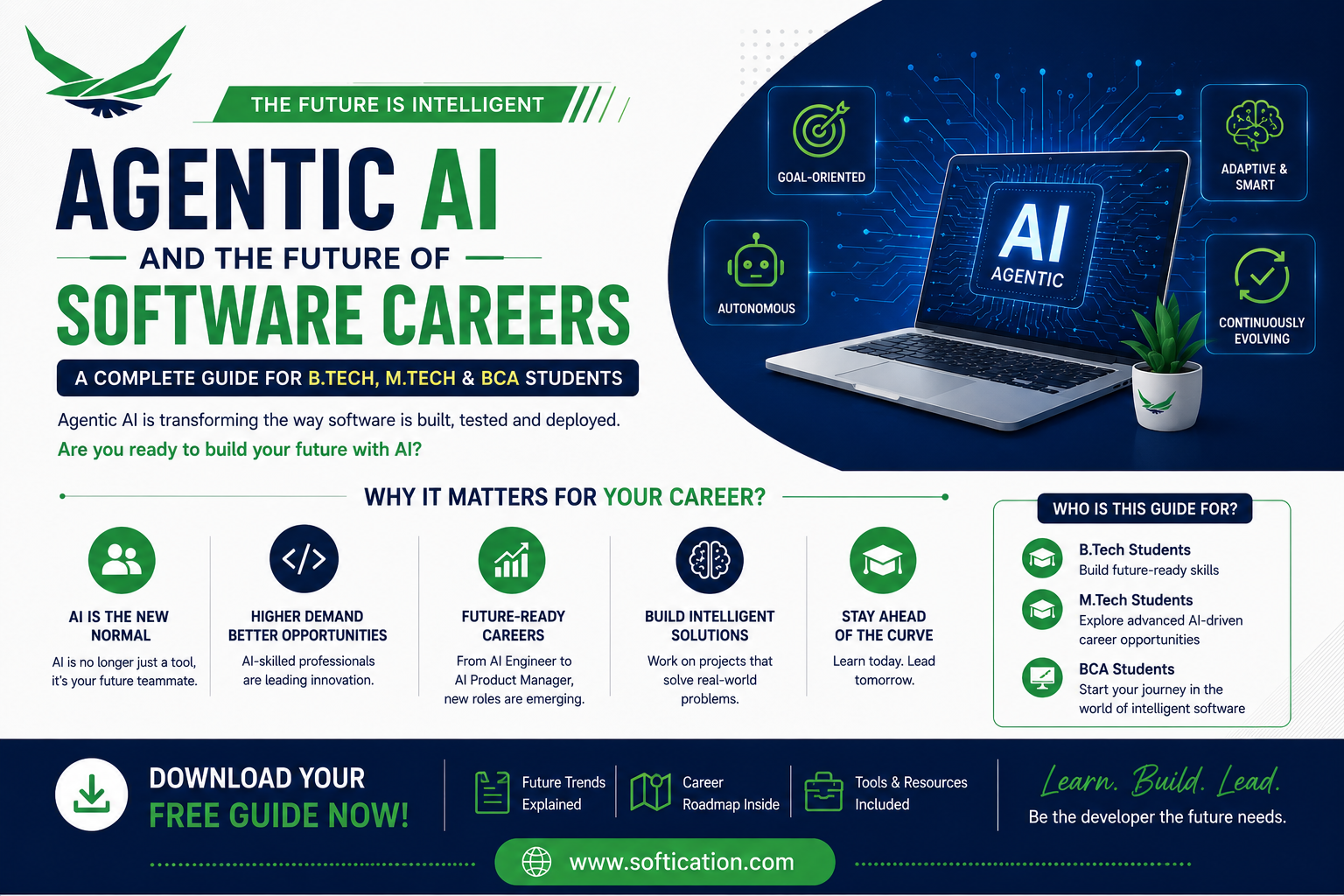
Every few years, the software industry goes through a shift big enough to redefine what it means to be "job-ready." We saw it with the rise of the internet, then mobile, then cloud computing. Today, we are standing at the edge of the next one, and it's called Agentic AI.
For students pursuing B.Tech, M.Tech, or BCA, this shift isn't a distant trend to read about someday. It is happening right now, in the same industry you are preparing to enter. The good news is this: the industry isn't shrinking; it's transforming. And students who understand this transformation early will have a real advantage over those who don't.
This article is written for exactly that purpose: to give you a clear, honest, and practical understanding of what Agentic AI is, how it is changing the software industry, and precisely what you need to learn and do to build a strong career in this new era.
What Is Agentic AI?
Until recently, most people's experience with AI was limited to chatbots, you type a question, it types back an answer, and the interaction ends there. Agentic AI is a new generation of AI systems that don't just respond; they act.
An AI "agent" can:
Understand a goal, not just a single question
Break that goal into steps and plan how to achieve it
Use tools; writing code, browsing the web, calling APIs, operating software
Check its own work, catch errors, and retry
Continue working across multiple steps with minimal human intervention
Example to understand the difference:
A traditional AI assistant tells you how to fix a bug.
An agentic AI system finds the bug, writes the fix, runs the tests, confirms they pass, and raises it for your review, all on its own.
This capability is no longer experimental. It is already being used inside software companies, startups, and IT service organizations across the world, including in India's growing tech ecosystem.
How Agentic AI Is Changing the Software Industry
To plan your career properly, you need to understand where the industry is actually moving. Here are the real, on-the-ground changes:
1. The definition of "productive work" is changing
Earlier, an engineer's value was often measured by how much code they wrote. Now, routine coding basic CRUD APIs, boilerplate, simple bug fixes, repetitive test writing is increasingly handled by AI agents. Human value is shifting toward problem definition, system design, and verification of correctness.
2. Entry-level work is evolving, not vanishing
Yes, some of the simple tasks that freshers traditionally started with are now faster to do with AI. But this does not mean there is no room for freshers. It means companies now expect freshers to understand systems more deeply, not just write syntax — because someone still has to review, test, and take responsibility for what AI produces.
3. New job roles are emerging
AI Agent/Workflow Engineer — designs and manages systems where AI agents complete real business tasks
Prompt & Context Engineer — structures instructions and information so AI tools perform reliably
AI Quality & Evaluation Engineer — tests whether AI-generated output is correct, safe, and unbiased
Human-AI Workflow Designer — decides what should be automated and what needs human review
4. Development speed has increased dramatically
Projects that once took a full team months to prototype can now be built in days by a small team, or even one skilled developer using AI tools well. This raises the ceiling of what a capable fresher can build and demonstrates a huge opportunity if used correctly.
5. Trust, security, and correctness now matter more than ever
As AI agents start taking real actions deploying code, handling data, integrating with live systems the cost of an undetected mistake rises. This is increasing demand for engineers with strong fundamentals in testing, security, and system design, because someone must be able to verify and be accountable for what the AI does.
Is a Software Career Still Worth It?
Yes, without a doubt. But the shape of that career is different from what it was five years ago.
AI is not replacing engineers. It is replacing a specific kind of task: repetitive, well-defined, low-judgment work. Engineers who only ever learned to convert requirements into code line-by-line will feel the most pressure. Engineers who understand systems, think in terms of outcomes, and know how to direct powerful AI tools toward real results will be in a stronger position than ever before.
You are entering this field at a moment when the tools available to you are more powerful than any previous generation of engineers has had. That means what you, even as a fresher, can build, learn, and demonstrate is also greater than ever. That is a genuine advantage, if you approach it with the right mindset and the right skills.
What You Need to Learn (The Complete Roadmap)
A. Strong Foundations — Still Non-Negotiable
These fundamentals do not go out of date, no matter how advanced AI tools become. In fact, they are what allow you to judge whether AI-generated work is actually correct.
Data Structures & Algorithms (DSA) — needed to reason about efficiency, correctness, and to clear technical interviews
Core Computer Science subjects — Operating Systems, Computer Networks, DBMS, and Object-Oriented Programming
One programming language, learned deeply — Python, Java, or JavaScript are strong choices; depth matters more than breadth at this stage
Version control (Git/GitHub) — essential for any real-world or team project
Basic system design — how applications, servers, databases, and APIs fit together
B. The New Layer Every Student Must Add
Understanding how LLMs and AI agents work — at a conceptual level: what a model is, what a "context window" is, how tools and agents connect, what retrieval and embeddings mean
Prompt and context engineering — the skill of giving AI systems clear, structured instructions to get reliable results; this is now a real, learnable, and valuable skill
Daily hands-on use of AI coding tools — use agentic coding assistants for real academic or personal projects; learn where they save time and where they make mistakes
Reviewing and verifying AI-generated code — practice reading AI output critically, writing tests for it, and identifying what it got wrong. This is fast becoming a core job skill, not an optional one
API integration, cloud basics, and deployment — understand how to connect tools, deploy a working application, and operate in real environments (AWS/Azure/GCP basics are enough to start)
C. Soft Skills That Matter More Now, Not Less
Clear written communication — specifications, documentation, and prompts are now core engineering artifacts, not side tasks
Problem decomposition — breaking a vague requirement into clear, checkable steps is exactly what makes you effective at directing AI tools
Judgment and healthy skepticism — knowing when to trust AI output and when to verify it carefully
What You Need to Do — A Practical Action Plan
Learning concepts is not enough. Here is what to actually do, starting this month:
Build one real project you genuinely care about — not a copied tutorial. Use AI tools to move faster, but make sure you understand every part well enough to explain it confidently in an interview.
Learn to use at least one agentic AI coding tool properly. Use it for real tasks — fixing bugs, writing tests, refactoring code. Study where it performs brilliantly and where it quietly makes mistakes.
Stay consistent with DSA and system design practice. This is the discipline that lets you evaluate AI-generated code instead of blindly trusting it a skill that directly impacts your interview performance and job readiness.
Document and share what you build. A short blog post, LinkedIn article, or GitHub README explaining your project, including where AI helped and where you had to correct it, is a strong signal to recruiters and hiring managers that you can work effectively in this new era.
Get real-world exposure, even in small ways: internships, freelance micro-projects, open-source contributions, or helping a local business build something small. Real feedback teaches lessons no tutorial can.
Talk to working professionals. Ask engineers and industry mentors how their day-to-day work has changed in the past year. A few honest conversations will teach you more than dozens of articles.
Build a portfolio, not just a resume. In this era, what you have built and can explain matters as much as, or more than, your marks or certificates.
A Message to Every B.Tech, M.Tech, and BCA Student
I understand that entering the software industry at a time of such rapid change can feel uncertain. But every major shift in this industry- the internet, mobile computing, cloud computing created the same feeling for the students entering at that time. And every single time, the ones who leaned in, stayed curious, and kept building real things came out ahead not despite the change, but because of it.
You do not need to have everything figured out today. You need a clear direction, consistent effort, and the willingness to keep learning as these tools evolve. Agentic AI is not here to take away your opportunity; it is here to hand you a much bigger one, if you are willing to learn how to use it well.
Start learning. Start building. Start now.
Amarnath Rana, Founder and CEO of SoftiCation Technology Pvt. Ltd.,