
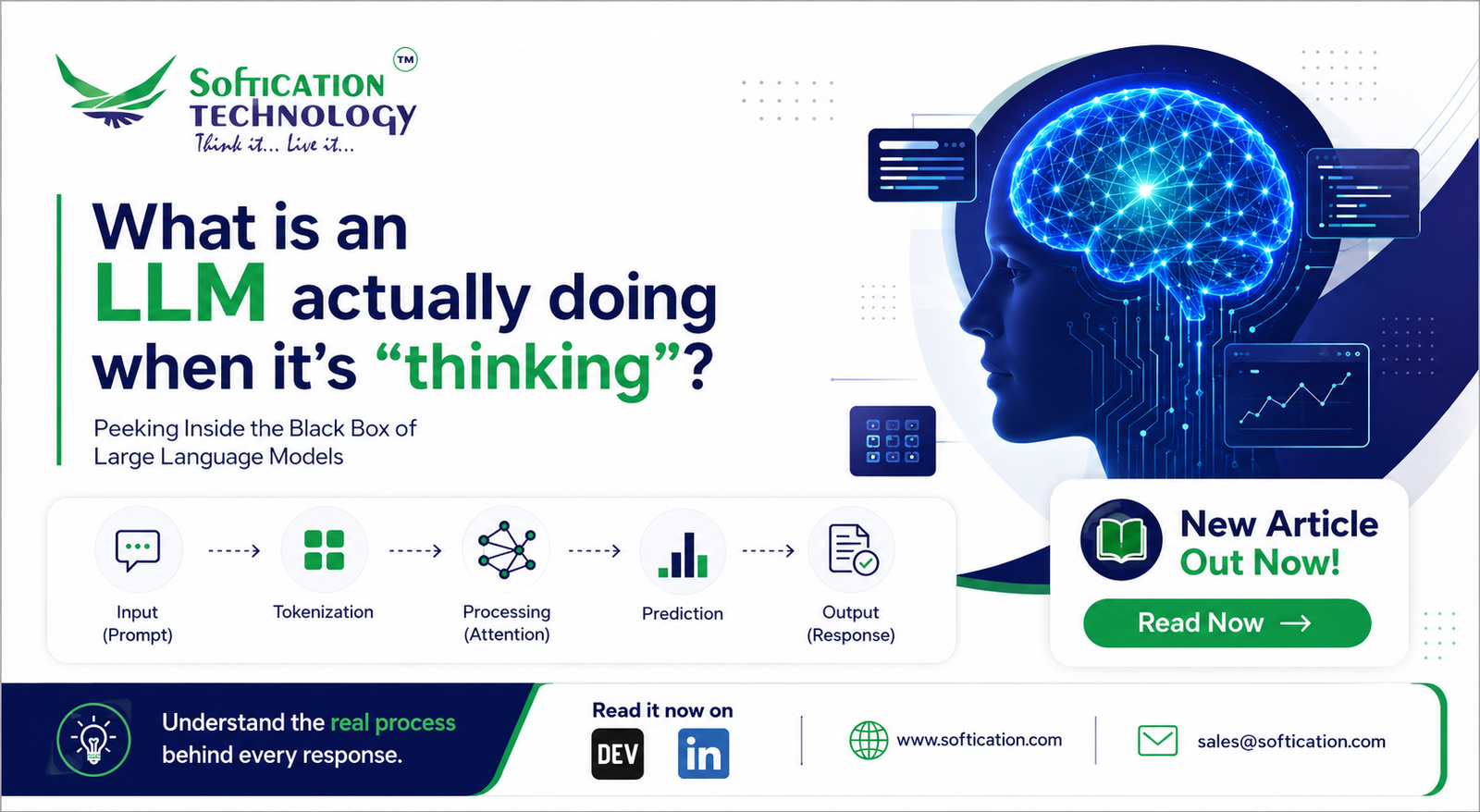
What Is an LLM Actually Doing When It's “Thinking”?
By the Softication Technology Team | AI Development, SaaS Engineering & Web Development
Every time you type a prompt into ChatGPT, Claude, or any modern AI assistant, you'll often see a line that says something like “Thinking…” before the answer appears. It's an appealing word, it makes the model sound like it's pausing to reflect, weighing options, and forming a judgment the way a person would. But what's actually happening under the hood is a lot more mechanical, and understanding it matters if your business is building anything on top of AI, a SaaS product, an autonomous agent, or a website powered by intelligent features.
At Softication Technology Pvt. Ltd., we build exactly these kinds of products for clients across SaaS Development, Agentic AI, and Web Development. This post is our attempt to demystify what “AI thinking” really is, in plain language, and to show why getting this right (or wrong) has real consequences for the products you build.
1. It's Not Thinking, It's Predicting the Next Word, Over and Over
At its core, a large language model (LLM) is a next-token predictor. A “token” is roughly a word or word fragment. Given everything written so far, your prompt plus anything the model has already generated, it calculates a probability for every possible next token, picks one, appends it to the text, and repeats the process.
There is no separate “thinking stage” that happens before the writing starts. The writing is the computation. Every word you see appear on screen is the result of one more pass through this same prediction process.
What happens inside each prediction?
• The text so far is converted into numerical vectors (embeddings) that represent meaning.
• These vectors pass through many transformer layers, where an “attention” mechanism lets each token weigh how relevant every other token in the context is to it.
• The final layer produces a probability distribution over the entire vocabulary, tens of thousands of possible next tokens.
• One token is sampled from that distribution, and the cycle repeats for the next token.
2. What “Reasoning” or Chain-of-Thought Really Is
Newer models often produce visible reasoning, a chain of intermediate steps before the final answer. This looks like genuine deliberation, and in a practical sense it works: models that write out their steps solve harder problems more reliably than ones that jump straight to an answer.
But the mechanism is the same token-by-token prediction described above. The difference is that each generated reasoning token becomes part of the context used to predict the next one. Writing “Step 1… Step 2…” gives the model more intermediate computation and more context to condition on, which happens to produce better answers, not because the model is deliberating in a human sense, but because generating structured intermediate text is a more effective way to arrive at a correct continuation.
In short: reasoning-style output is a technique that improves prediction quality, not evidence of an inner monologue.
3. What an LLM Is Not Doing
It helps to be equally clear about the myths this word “thinking” invites:
• No persistent internal goal state. Between tokens, there's no ongoing belief or intention sitting in memory; everything the model “knows” mid-generation is encoded in the text produced so far plus its trained weights.
• No fact-checking against the real world. The model produces statistically plausible continuations based on patterns learned from training data, not verified lookups (unless it's explicitly given a tool, like search, to call).
• No separate “thinking module.” For most models, the visible reasoning text and the final answer are produced by the exact same token-by-token process; there isn't a hidden layer of “real” cognition distinct from the words on screen.
4. Why This Matters If You're Building an AI Product
This isn't just a technical curiosity, it has direct consequences for anyone building a product around an LLM:
• Prompt and context design matters more than “magic” intelligence. Since the model's whole “understanding” of a task lives in the text you give it, how you structure context, instructions, and examples directly determines output quality.
• Agentic AI systems need explicit tools, memory, and verification loops. Because a model has no built-in fact-checking or persistent state, reliable agents are engineered around it, with retrieval, tool-calling, and validation steps, not assumed to “know better” on their own.
• SaaS products using AI features need guardrails, not just a good model. Rate limits, output validation, fallback logic, and human review points are what turn a probabilistic text generator into a dependable product feature.
• Costs and latency scale with reasoning length. Every extra “thinking” token is a real compute cost and a real delay, architecture decisions (when to let a model reason at length vs. respond directly) affect both user experience and your bill.
5. How Softication Technology Turns This Into Real Products
Understanding how LLMs actually work is the foundation of everything we build. Softication Technology Pvt. Ltd. works with founders, product teams, and enterprises across three core areas:
SaaS Development End-to-end design and engineering of multi-tenant SaaS platforms, architecture, billing, dashboards, and scalable back-ends built to grow with your user base. | Agentic AI Development Autonomous AI agents that plan, call tools, retrieve data, and complete multi-step workflows reliably, built with the guardrails real LLM behavior requires. | Web Development Fast, SEO-friendly websites, e-commerce storefronts, and web applications, from marketing sites to complex custom web apps and CRM integrations. |
Who we work with
• Startups and founders who need a SaaS MVP built right the first time, from low-ticket tools to high-ticket enterprise platforms.
• Product teams exploring Agentic AI, customer-support agents, internal workflow automation, and AI copilots embedded in existing software.
• Businesses needing a website, e-commerce store, web application, or CRM built or modernized, with SEO built in from day one.
• Companies planning to layer AI features onto an existing product and needing an engineering partner who understands both the AI and the software architecture around it.
Our process
• Discovery: We map your business goals to a concrete technical scope, whether that's a SaaS platform, an agent, or a website.
• Architecture: We design the system (data, APIs, AI integration points, hosting) before writing production code.
• Build: iterative development with regular check-ins, so you see working software early, not just at the end.
• Launch & scale: Deployment, monitoring, and a roadmap for what to build next as usage grows.
6. Ready to Build Something on Top of AI; The Right Way?
Whether you're exploring an Agentic AI feature, planning a new SaaS platform, or need a website that actually converts and ranks, Softication Technology Pvt. Ltd. can help you go from idea to a working product built on a real understanding of how these systems behave, not just hype.
Get in touch with our team to discuss your project: SaaS Development · Agentic AI Development · Web Development