
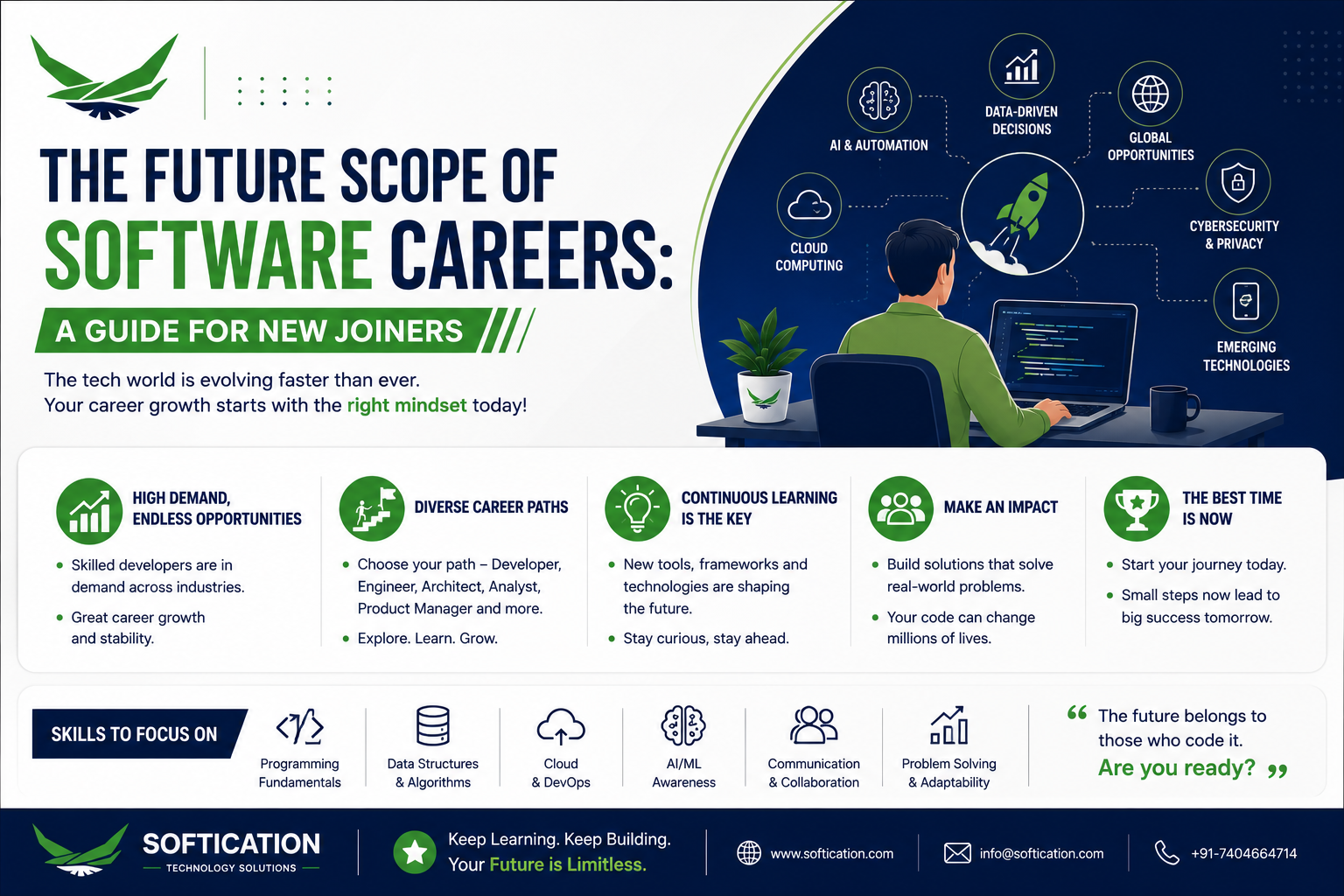
The Future Scope of Software Careers: A Complete Guide for New Joiners
Introduction
Starting your first job in the software industry is a significant milestone. You have spent years studying, building small projects, and preparing for interviews, and now you are finally in. But once the initial excitement settles, many new joiners start asking themselves a familiar question: is this really the right time to begin a career in software, and is there a real future here?
If that question has crossed your mind, this article is written for you. Let us look honestly at where this industry is headed, the specific career paths open to you today, and why this is one of the most promising times to be starting out.
Part 1: Why the Future Scope Is Larger Than It Appears
Software is now part of every industry
Two decades ago, a software career usually meant working at an IT services firm or a product company. Today, software runs healthcare systems, agriculture platforms, banking infrastructure, logistics networks, education platforms, and government services. Nearly every industry now depends on software in some form. This has widened, not narrowed, the range of places a software professional can build a career.
AI is creating new roles, not just automating old ones
AI tools are certainly automating repetitive coding work. At the same time, they are giving rise to new roles that simply did not exist a few years ago. New joiners today have the advantage of entering the field just as these specializations are taking shape, which gives them a genuine head start compared to those already settled into older ways of working.
India's technology sector continues to grow
Global capability centers, product companies, SaaS businesses, and AI-focused startups are expanding across Indian cities at a strong pace. These organizations are actively looking for young professionals who are comfortable with modern development tools and emerging technologies, because this is precisely the skill set currently in short supply.
Remote work has widened the opportunity map
A new joiner today is no longer limited to job openings in their own city. Many companies now hire remote engineers, and freelance or contract-based technical work has become a respected career path in its own right. Geography plays a smaller role in career opportunity than it once did.
The learning curve is shorter than before
With AI-assisted learning tools, coding assistants, and easy access to documentation and mentorship, a motivated new joiner can now reach a solid level of competence in a fraction of the time it once took.
Part 2: Career Opportunities Across Emerging Fields
One of the biggest advantages a new joiner has today is choice. Unlike a decade ago, when most students followed a narrow path into either core development or testing, today's graduates can choose from a wide range of specialized, high-demand career tracks. Here is an honest look at the major fields open to you right now.
1. Generative AI (GenAI)
Generative AI covers systems that create content, including text, images, code, audio, and video, based on learned patterns from large datasets.
Typical roles: GenAI Developer, Applied AI Engineer, LLM Engineer, AI Product Engineer, Machine Learning Engineer
What you would work on: building applications on top of large language models, fine-tuning models for specific business use cases, designing retrieval systems that combine company data with AI models, and integrating GenAI features into existing products.
Skills to build: Python, machine learning fundamentals, working knowledge of transformer-based models, experience with frameworks such as LangChain or similar tools, API integration, and a solid understanding of how prompting and fine-tuning affect model behavior.
Why it matters: Almost every software product today is adding some form of AI-powered feature, from chatbots to content generation to intelligent search. Demand for engineers who can build these features responsibly is growing quickly.
2. Agentic AI
Agentic AI takes GenAI a step further, focusing on systems that can plan, take actions, use external tools, and complete multi-step tasks with minimal human supervision.
Typical roles: AI Agent Engineer, Automation Engineer, AI Workflow Designer, Applied AI Engineer
What you would work on: designing agents that can complete real business workflows, connecting AI systems to tools and APIs, building evaluation systems to check whether an agent's actions are correct and safe, and designing the boundaries around what an agent is allowed to do without human approval.
Skills to build: strong programming fundamentals, understanding of agent frameworks and tool calling, API design, testing and evaluation methods for AI systems, and a good grasp of system design, since agentic systems are essentially distributed systems with an AI component at the center.
Why it matters: This is one of the newest and fastest-growing areas in the industry. Very few professionals currently have deep experience here, which means new joiners who invest time now can become genuinely early specialists rather than late followers.
3. Data Science
Data science focuses on extracting insights and building predictive models from data to support decision-making.
Typical roles: Data Scientist, Machine Learning Engineer, Research Analyst, Applied Scientist
What you would work on: cleaning and analyzing large datasets, building and testing predictive models, running experiments, and communicating findings to business teams in a way that influences real decisions.
Skills to build: Python or R, statistics and probability, machine learning algorithms, SQL, data visualization tools, and the ability to clearly explain technical findings to non-technical stakeholders.
Why it matters: Every company sitting on large amounts of data needs people who can turn that data into decisions. This demand has remained consistently strong for years and continues to grow as more industries digitize their operations.
4. Data Analytics
Data analytics is closely related to data science but focuses more on interpreting existing data to answer specific business questions, rather than building predictive models.
Typical roles: Data Analyst, Business Intelligence Analyst, Reporting Analyst, Insights Analyst
What you would work on: building dashboards, analyzing trends, preparing reports for leadership teams, and helping departments make data-informed decisions on a day-to-day basis.
Skills to build: SQL, Excel, data visualization tools such as Power BI or Tableau, basic statistics, and strong business communication skills.
Why it matters: This is often one of the more accessible entry points into the data field for new graduates, since it requires strong analytical thinking without necessarily needing deep machine learning expertise from day one.
5. Cloud Computing
Cloud computing involves designing, deploying, and managing applications and infrastructure on platforms such as AWS, Microsoft Azure, and Google Cloud.
Typical roles: Cloud Engineer, Cloud Support Engineer, Solutions Architect, Site Reliability Engineer
What you would work on: setting up and managing cloud infrastructure, ensuring applications run reliably and securely, optimizing costs, and supporting teams as they migrate systems to the cloud.
Skills to build: one major cloud platform in depth, networking fundamentals, Linux basics, containerization tools such as Docker and Kubernetes, and scripting for automation.
Why it matters: Nearly every company is either already on the cloud or actively migrating to it. Cloud skills are considered foundational across almost every other specialization, including AI and data roles, which makes this a strong area to build competence in regardless of your eventual specialization.
6. DevOps and Cloud Infrastructure
Closely tied to cloud computing, DevOps focuses on the practices and tools that connect development and operations, enabling faster and more reliable software delivery.
Typical roles: DevOps Engineer, Platform Engineer, Infrastructure Engineer, Release Engineer
What you would work on: building automated deployment pipelines, managing infrastructure as code, monitoring system health, and helping development teams ship software faster and more safely.
Skills to build: CI/CD tools, containerization, infrastructure as code tools such as Terraform, monitoring and logging tools, and strong Linux and networking fundamentals.
Why it matters: As companies ship software more frequently, the need for reliable, automated infrastructure has grown substantially. This field also blends well with cloud computing, giving you flexibility to specialize further later.
7. Software Development
Traditional software development remains one of the largest and most stable career paths, spanning web development, mobile development, and backend systems.
Typical roles: Software Development Engineer, Full Stack Developer, Backend Developer, Frontend Developer, Mobile App Developer
What you would work on: designing and building applications, writing and maintaining backend systems, developing user interfaces, and increasingly, integrating AI-powered features into these applications.
Skills to build: strong fundamentals in data structures and algorithms, one or two programming languages in depth, database design, API development, and growing familiarity with AI coding tools as part of your daily workflow.
Why it matters: Development remains the backbone of the entire industry. Even as AI tools handle more routine coding tasks, the need for engineers who can design robust systems, make sound architectural decisions, and build genuinely new products remains strong.
8. Cybersecurity
As more systems move online, protecting them has become a specialized and highly valued field of its own.
Typical roles: Security Analyst, Penetration Tester, Security Engineer, SOC Analyst
What you would work on: identifying vulnerabilities in systems, monitoring for threats, responding to security incidents, and helping teams build applications with security built in from the start.
Skills to build: networking fundamentals, operating systems, common vulnerability frameworks, security tools, and a genuine curiosity about how systems can be broken and defended.
Why it matters: As AI systems and cloud infrastructure become more central to business operations, the surface area that needs protection has grown significantly, creating strong and steady demand for security professionals.
Part 3: How to Choose the Right Path for You
With so many options, it is natural to feel unsure about which direction to pursue. A few honest questions can help guide that decision.
Do you enjoy working with numbers, patterns, and analysis, or do you enjoy building things end to end? Those who enjoy analysis often gravitate toward data science, data analytics, or applied AI roles. Those who enjoy building tend to do well in development, cloud, or DevOps roles.
Are you drawn to the newest, least defined areas, or do you prefer well-established paths with clear expectations? Fields such as Agentic AI and GenAI are exciting but still forming, which means less structured guidance and more self-directed learning. Fields such as development, cloud computing, and data analytics have clearer, more established learning paths.
Do you enjoy direct business interaction, or do you prefer deep technical problem solving? Roles such as data analyst or business intelligence analyst involve regular interaction with business teams. Roles such as backend development, cloud engineering, or AI agent engineering tend to be more deeply technical.
There is no wrong answer here. What matters most is choosing a direction, committing to it for a meaningful period, and building real depth, rather than staying only at a surface level across too many areas at once.
Part 4: The Mindset That Helps New Joiners Succeed
Scope and career options alone do not build a career. Mindset does. A few shifts in thinking tend to separate professionals who grow steadily from those who feel stuck.
Continuous learning matters more than complete knowledge. No one, including senior engineers and industry leaders, knows everything in a field that changes this quickly. What matters is the ability to learn consistently and adapt as things change.
You do not need permission to start building. Personal projects, open source contributions, and self-directed learning are available to anyone willing to put in the time, often at no cost. You can begin developing your skills outside of your assigned work.
Mistakes are part of the process, not a sign of failure. Every experienced engineer has broken something in production or misunderstood a requirement early in their career. What matters is how you respond, learn from it, and move forward.
AI tools work best as a multiplier for learning, not a replacement for it. New joiners who use AI to understand concepts faster, explore different approaches, and take on bigger challenges early tend to grow more quickly than those who avoid these tools out of caution.
Part 5: What Growth Typically Looks Like in the Early Years
Career growth in this industry rarely follows a straight line, but a general pattern is worth understanding.
The first year is usually about learning how real systems work. This includes understanding the codebase or data systems you are working with, asking questions, learning from colleagues, and completing small tasks end to end.
The second year is often when ownership begins. This is the stage where you start owning features or projects rather than isolated tasks, estimate your own work, communicate blockers early, and think through edge cases on your own.
From the third year onward, specialization usually begins. This might mean moving deeper into one of the fields discussed above, whether that is AI, data, cloud, or development, or moving toward system architecture and technical leadership. The strength of your foundation in the earlier years shapes how confidently you can take this next step.
Part 6: Practical Advice for New Joiners
Ask questions freely. No one expects a new joiner to already know everything. What is valued is genuine curiosity and effort.
Understand the business, not only the technology. Knowing why a product exists and whom it serves makes you a far more effective professional than understanding only the technical layer.
Use AI tools to speed up learning, not to bypass it. Use them to understand unfamiliar concepts, explore alternative solutions, and work faster, while still making sure you understand what is actually happening.
Keep a record of what you learn. A simple habit of noting down problems you solved each week builds into a valuable record of your growth and a strong portfolio over time.
Find a mentor and a peer group. A mentor offers perspective and guidance. A peer group keeps you accountable and motivated, especially on difficult days.
Do not neglect the fundamentals. Regardless of which field you choose, continue strengthening your understanding of core computer science concepts, mathematics, and problem-solving. These fundamentals are what allow you to move confidently between specializations later in your career if needed.
Recognize small wins. Your first merged pull request, your first completed analysis, your first deployed application, or your first resolved production issue all matter. A strong career is built through the steady accumulation of these moments.
A Message to New Joiners
If you are just starting, it is worth remembering that you are not behind, and you have not missed your opportunity. You are entering an industry that continues to expand into nearly every sector of the economy, with more specialized career paths available today than at any point in the past. Whether your interest lies in GenAI, Agentic AI, data science, data analytics, cloud computing, DevOps, development, or cybersecurity, there is a genuine and growing need for skilled professionals in every one of these areas.
The professionals who will shape the next decade of this industry are the ones joining it today, those willing to stay curious, choose a direction, keep building, and treat challenges as opportunities to grow rather than reasons for doubt.
Your first job is not the final destination. It is the starting point. Approach it with patience, consistency, and curiosity, and the future scope of this industry will take care of the rest.
Welcome to the industry. It is time to start building.
Amarnath Rana is the Founder and CEO of SoftiCation Technology Pvt. Ltd.