When a workforce management system crashes, everyone notices. Nobody can clock in, schedules disappear, and the support phone rings. The problem gets fixed fast, because it can't be ignored.
The more expensive failures are the ones nobody sees. A sync between time tracking and payroll quietly stops working. A rule update never reaches one location. Notifications go out late, or not at all. A calculation drifts a few minutes off per shift. The system still looks like it's running, and meanwhile errors pile up, employees work around it, and productivity leaks away without a single alert.
If your workforce system "works" but your team keeps using spreadsheets on the side, you may already be living with silent failure. Here's how it happens, what it costs, and how to catch it early.
The Problem: Workforce Systems Degrade Without Anyone Noticing
A workforce management system isn't a single program. It's a set of connected parts: scheduling, time capture, attendance rules, payroll integration, notifications, mobile apps, user permissions, and reports. Each part depends on others, and on external services such as payroll providers, ERPs, SMS gateways, biometric devices, and identity systems. Over time, things drift or break in ways that don't trigger an obvious error:
- Integrations fail partially, such as a sync that processes most records but silently skips some
- Rules fall out of date, because policy or regulation changed but the system configuration didn't
- Notifications stop or delay, so employees miss shift changes and managers miss approvals
- Devices go offline, such as biometric readers, kiosks, or mobile apps that stop syncing data
- Data quality decays, with duplicate employees, wrong cost centers, expired contracts, and orphaned records accumulating
- Permissions drift, leaving former employees with access or managers without the access they need
- Performance slows gradually, so reports and schedules take longer to load until people stop using them
- Updates break things, as new app versions, operating systems, or third-party changes cause subtle incompatibilities
- Small calculation errors repeat, such as rounding, break deductions, or overtime thresholds that are slightly wrong for a subset of employees
- Nobody owns monitoring, so problems are found only when someone complains
The common thread is that nothing "goes down." The system keeps running while quietly becoming less accurate, less reliable, and less trusted.
The Business Consequence: Silent Failures Drain Productivity and Create Risk
Because silent failures don't announce themselves, their costs are spread out and easy to misattribute. They show up as small problems everywhere.
Lost time to workarounds. When people stop trusting the system, they build side spreadsheets, double-check entries, and message each other to confirm what the software should have handled.
Payroll and pay-accuracy issues. Small errors in hours, rates, or deductions repeat every cycle, producing underpayments, overpayments, and corrections that consume HR and finance time.
Compliance exposure. If overtime, break, or leave rules are applied incorrectly or not at all, violations accumulate quietly until an audit or complaint brings them to light.
Scheduling and coverage failures. Missed notifications and stale schedules lead to no-shows, understaffed shifts, and last-minute scrambles.
Management time lost to firefighting. Supervisors spend their day fixing individual cases instead of managing, because the underlying issue is never identified.
Eroding employee trust. Employees who experience wrong pay, missing shifts, or unreliable apps lose confidence in the company, and frontline turnover rises.
Bad data driving bad decisions. Dashboards built on incomplete or incorrect data mislead leadership about labor cost, productivity, and absenteeism.
Expensive late fixes. Problems found months later need back-pay corrections, data cleanup, and sometimes legal advice, which costs far more than catching them early.
Wasted software investment. A system that isn't trusted or used properly delivers a fraction of the value you paid for.
Silent failure is expensive precisely because it lasts long enough to become normal.
Curious what might be quietly failing in your system? [Get a Free Workforce System Health Check →]
The Solution: Monitoring, Validation, and Ongoing Care Built Into the System
The answer isn't hoping nothing breaks. It's designing and operating the system so that problems surface quickly, before they cost real money. A resilient workforce management setup typically includes the following layers:
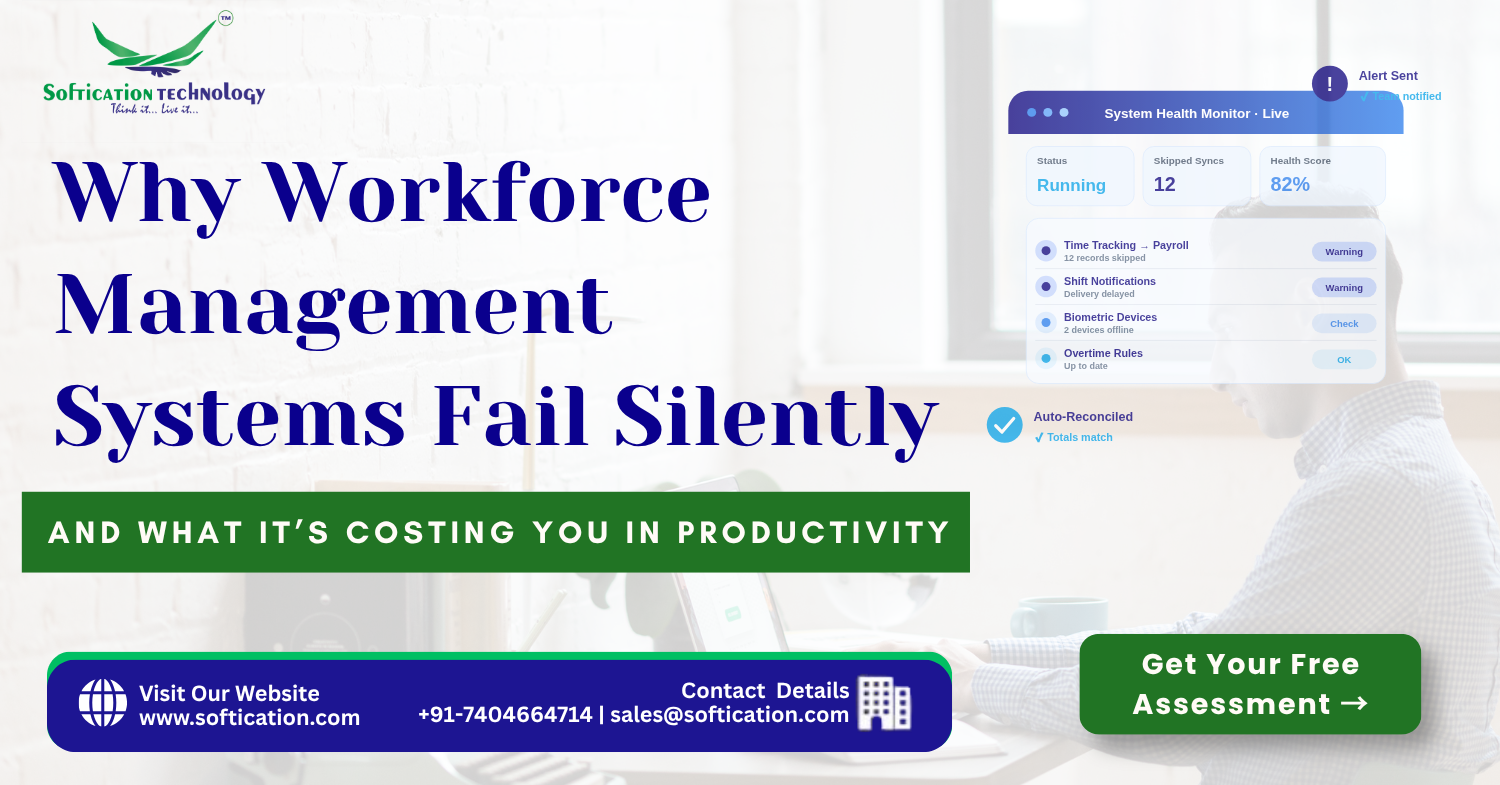
- Integration health monitoring, tracking whether each sync ran, how many records processed, and how many failed or were skipped
- Data validation rules, flagging missing codes, duplicate employees, impossible hours, and mismatches between systems
- Automated reconciliation, comparing totals across scheduling, time tracking, payroll, and the ERP, and alerting on differences
- Alerts and escalation, notifying the right people when jobs fail, devices go offline, or thresholds are crossed
- Rule and configuration audits, reviewing overtime, break, leave, and pay rules regularly against current policy and regulation
- Device and app monitoring, tracking kiosks, biometric readers, and mobile app versions and sync status
- Notification delivery tracking, confirming that messages were delivered and acknowledged
- Performance monitoring, watching response times and load so slowdowns are fixed before users give up
- Access reviews, checking permissions and deactivating accounts promptly when roles change
- Health dashboards and regular reports, giving HR, finance, and IT a clear view of system status and open issues
- Structured maintenance and updates, with testing before changes go live and rollback plans when something goes wrong
- Clear ownership and runbooks, so someone is responsible for noticing and fixing problems
When these practices are in place, failures become visible events that get handled quickly instead of invisible leaks that run for months.
SoftiCation's Capability: We Build Systems That Tell You When Something Is Wrong
At SoftiCation, we build and maintain workforce systems with monitoring and reliability designed in from the start, and we can add them to systems you already run. Our capability includes:
- Workforce system health checks, reviewing integrations, data quality, rules, devices, and performance to identify silent failures already in progress
- Integration monitoring and reconciliation, with automated checks between scheduling, time tracking, payroll, HRMS, and ERP systems
- Data validation and cleanup, finding and resolving duplicates, mismatches, and orphaned records
- Alerting and escalation frameworks, so the right person is notified quickly when something fails
- Rule and compliance audits, confirming overtime, break, leave, and pay logic matches current policy and regulations
- Device and mobile app monitoring, tracking sync status, versions, and connectivity across your fleet
- Performance optimization, improving response times and reliability as data volumes and users grow
- Health dashboards for HR, finance, and IT, showing system status, sync results, and open issues in one place
- Managed maintenance and support, including updates, testing, and incident response
- Documentation and runbooks, so your team knows how to respond when issues arise
We treat reliability as a feature, not an afterthought, because a workforce system is only valuable if people can trust it.
Want to see how monitoring could be added to your workforce system? [Talk to a Workforce Systems Specialist →]
Proof: What This Looks Like in Practice
Consider a multi-location business whose workforce system had run without major incident for over a year. Managers still kept side spreadsheets "just in case," payroll corrections were common each cycle, and occasional complaints about missing shift notifications were treated as one-off glitches. Nobody could point to a specific failure.
A system health review looked beneath the surface. It found that the sync between time tracking and payroll was silently skipping records with a missing cost center code, a notification service was failing intermittently for one carrier, and an overtime rule for one location had not been updated after a policy change. A few biometric devices had also stopped syncing for several days at a time without anyone noticing.
Fixes were made, and monitoring was added: sync results with failed and skipped counts, automated reconciliation between systems, alerts for offline devices and notification failures, and a scheduled rule review. Within a few pay cycles, payroll corrections fell sharply, notification complaints stopped, and managers retired their side spreadsheets because the numbers could be trusted again. Leadership also gained a simple health dashboard showing the system's status at a glance.
This reflects the central lesson: the most costly failures are the ones nobody sees, and the cheapest fix is to make them visible.
Ready to find out what your system isn't telling you? [Get Your Free System Health Check →]
Is Your Workforce System Quietly Costing You Productivity?
If your team double-checks the system, keeps spreadsheets as a safety net, or fixes the same kinds of errors every cycle, silent failures may already be at work. Monitoring, validation, and regular care turn a fragile system into one your people can rely on, and bring hidden costs into the open before they grow.
Get a Free Workforce System Health Check Consultation and find out exactly what could be failing quietly in your own setup, and what it would take to fix and monitor it.
[Get Your Free System Health Check Consultation →]
Or talk to us directly. We'll walk you through what to look for and how we can help. 📞 Call/WhatsApp us today to discuss your workforce system reliability needs.