
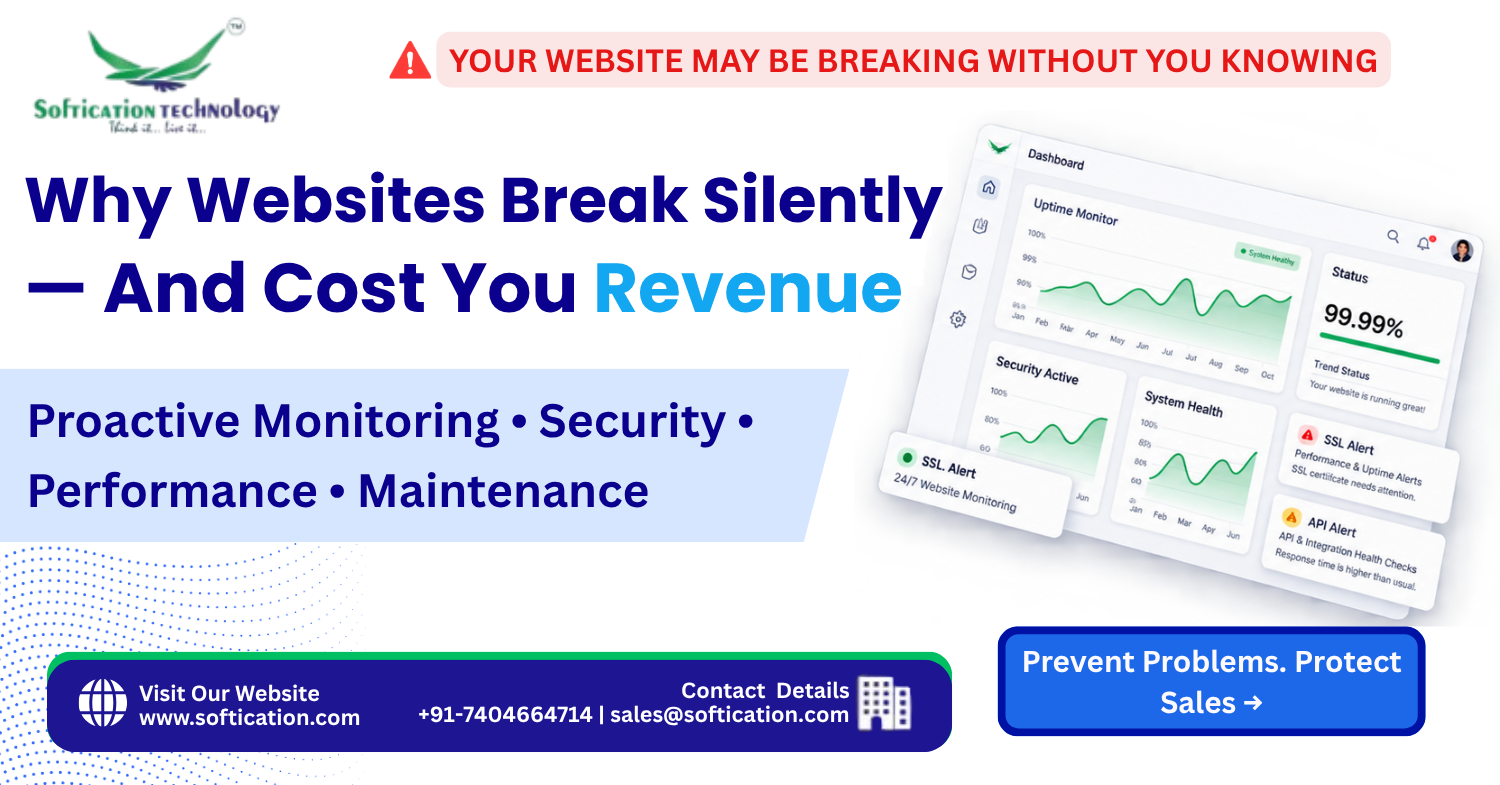
A website going down with an obvious error page is bad. But it's rarely the most expensive kind of failure. The costlier problems are the ones nobody notices — a broken integration quietly failing in the background, an SSL certificate that expired overnight, a plugin conflict that breaks checkout for just one payment method. The site looks fine. It isn't.
If your website doesn't have active monitoring, you likely won't know about these issues until a customer complains, a report shows a revenue drop, or search rankings quietly slide. This guide covers what actually breaks silently, why it happens, and what proper post-launch maintenance looks like.
The Problem: Websites Degrade Even When Nothing "Changes"
Once a website launches, most businesses shift attention elsewhere — to marketing, sales, operations. But a live website isn't a static asset. It depends on a constantly moving set of external systems, and any one of them can fail without warning:
- SSL certificates expire on a schedule, and if renewal isn't automated or monitored, browsers start warning visitors the site isn't secure — or block access entirely.
- Third-party API integrations change or break — a payment gateway updates its API, a shipping calculator changes its response format, and your integration silently stops working for a subset of transactions.
- Plugins and dependencies fall out of sync as they're updated independently, sometimes creating conflicts that only affect specific browsers, devices, or user flows.
- Server resources get exhausted gradually — a database that's never optimized grows slower and slower until page loads become sluggish enough to drive users away.
- Broken links and 404s accumulate as products get discontinued or pages get restructured, quietly hurting both user experience and SEO.
- Security vulnerabilities go unpatched, sitting exposed until they're exploited — often long after a patch was available.
None of this requires anyone to make a mistake. It's simply what happens to any complex system left unattended over time.
The Business Consequence: Silent Failures Cost More Because Nobody Catches Them Early
A visible outage gets fixed fast because everyone notices immediately. Silent failures are expensive precisely because they don't announce themselves.
Lost sales that go unexplained. If checkout breaks for users on a specific browser or payment method, you don't see an obvious outage — you just see a gradual, hard-to-diagnose dip in conversion rate that takes time to even notice, let alone trace back to the cause.
SEO ranking decay. Search engines penalize slow load times, broken links, and security warnings. By the time rankings visibly drop, the underlying issue has often been active for weeks or months.
Security breach exposure. Unpatched vulnerabilities are frequently how sites get compromised — and the cost of a breach (data loss, remediation, reputational damage, potential legal exposure) is dramatically higher than the cost of ongoing patching would have been.
Compounding technical debt. Small unresolved issues tend to make future changes harder and riskier, since developers have to work around accumulated problems instead of building on a stable foundation.
Customer trust erosion. A site that feels slow, occasionally broken, or insecure teaches visitors — consciously or not — to trust the business less, even if they can't articulate exactly why.
The businesses hit hardest by silent failures are usually the ones who assume "the site is live, so it's fine" — right up until a much bigger, more expensive problem forces attention.
The Solution: Proactive Monitoring and Ongoing Maintenance
The fix isn't waiting for something to visibly break — it's catching issues before they affect customers. A proper maintenance approach includes:
- Uptime and performance monitoring that alerts your team the moment something goes down or slows significantly, rather than waiting for a customer complaint
- Automated SSL certificate renewal and monitoring, so certificates never lapse unnoticed
- Regular security patching for the CMS, plugins, and server infrastructure, closing vulnerabilities before they're exploited
- Integration health checks that verify third-party APIs (payment, shipping, inventory) are still functioning as expected
- Scheduled performance audits to catch gradual slowdowns before they become a noticeable problem
- Broken link and 404 monitoring, keeping both user experience and SEO intact as the site evolves
- Regular backups with tested restore procedures, so a worst-case failure doesn't mean permanent data loss
This shifts website management from reactive firefighting to a system where most problems are caught and resolved before customers ever notice them.
SoftiCation's Capability: We Keep Your Site Running Before You Even Know Something's Wrong
At SoftiCation, post-launch maintenance isn't an afterthought — it's a structured, ongoing service built specifically to catch silent failures early. Our approach typically includes:
- 24/7 uptime and performance monitoring with real-time alerts for your team
- Automated SSL and security patch management, keeping the site current without manual tracking
- Integration monitoring for critical third-party services — payment gateways, shipping APIs, inventory systems — with alerts if something stops responding correctly
- Scheduled maintenance reviews covering performance, broken links, plugin conflicts, and dependency updates
- Security vulnerability scanning and patching, reducing exposure to known exploits
- Backup management with tested recovery procedures, so you're never one failure away from losing everything
- Monthly reporting so you have visibility into what's being monitored and what's been proactively fixed
We treat your website as a system that needs ongoing attention, not a project that's "done" once it launches.
Proof: What This Looks Like in Practice
Consider an online retailer whose checkout conversion rate had been gradually declining over several weeks, with no obvious cause and no customer complaints pointing to a specific issue. Internally, the assumption was that the drop reflected seasonal demand or marketing performance, since the site appeared to be functioning normally during manual testing.
A monitoring and audit process revealed the real issue: a recent update to the payment gateway's API had silently broken one of three supported payment methods, causing transactions using that method to fail at the final step. Because the failure only affected a subset of users and didn't trigger a visible site-wide error, it had gone unnoticed for weeks. Alongside the fix, ongoing integration monitoring was put in place to catch similar failures immediately going forward, rather than relying on manual testing to eventually surface them.
Once the broken payment method was restored, checkout conversion recovered to its previous baseline within days. The retailer also identified, through the same monitoring setup, an SSL renewal that had been set to expire within the following month — addressed proactively before it could cause a second, unrelated outage.
This illustrates why silent failures are often more damaging than visible ones: the cost accumulates quietly, for as long as nobody's actively watching for it.
Is Something Already Breaking Silently on Your Site?
Most businesses don't find out about silent failures until the cost has already added up — a slow conversion decline, a ranking drop, or a security incident that could have been prevented. Proactive monitoring catches these issues while they're still small and inexpensive to fix.
Get a Maintenance & Monitoring Plan and find out exactly what could be quietly costing you revenue right now — before it becomes a bigger problem.