For most businesses, labor is the largest controllable expense. Yet many leadership teams only see what they spent on their workforce weeks after the money has gone out. By the time a payroll report lands on someone's desk, the overtime has already been worked, the shifts have already been overstaffed, and the budget has already been missed.
If your workforce reporting depends on exports, spreadsheets, and month-end summaries, you're making today's decisions with last month's data. Here's what that's really costing you, and how real-time workforce analytics dashboards change it.
The Problem: Workforce Data Arrives Too Late to Act On
Workforce data usually exists in plenty. The problem is where it lives and when it becomes usable. Scheduling, time tracking, payroll, leave, and HR records sit in separate systems, and turning them into a single picture takes manual effort. That creates a familiar set of gaps:
- Reports compiled manually from multiple exports, often taking hours or days before anyone can read them
- Labor cost visibility only after payroll runs, so overruns are discovered when it's too late to prevent them
- No live view of overtime, meaning managers can't intervene before employees cross overtime thresholds
- Absenteeism and attendance patterns hidden inside raw timesheets, with no trend analysis
- Inconsistent metrics across teams and locations, where each manager measures productivity and utilization differently
- No way to compare scheduled vs. actual hours without manually reconciling two separate data sources
- Limited forecasting, since historical data isn't structured for spotting patterns like seasonal demand or recurring understaffing
- Leadership relying on gut feel for hiring and staffing decisions because the data isn't readily available or trusted
The result is a business that has plenty of workforce data and very little workforce insight.
The Business Consequence: Delayed Data Means Costly Decisions
When workforce decisions are made without current data, the cost shows up quietly but consistently.
Preventable overtime costs. Without real-time alerts, overtime builds up unnoticed during the pay period. Once payroll reveals it, the spending is already locked in.
Overstaffing and understaffing. Without clear demand-versus-coverage data, businesses tend to guess, and each wrong guess either wastes labor budget or hurts service quality and burns out employees.
Hidden productivity gaps. If you can't see utilization by team, role, or location, underperforming areas stay hidden and high performers go unrecognized.
Missed turnover warning signs. Patterns like rising absenteeism or declining engagement often appear in the data well before resignations do, but only if someone can actually see them.
Slow, unreliable budgeting. Forecasting labor costs from outdated or manually assembled numbers leads to budgets that miss the mark repeatedly.
Wasted analyst and manager hours. Every hour spent assembling reports by hand is an hour not spent acting on what the data says.
Weak leadership decisions. Hiring plans, expansion decisions, and cost-cutting measures built on stale or incomplete workforce data carry real strategic risk.
Businesses that can't see their workforce costs in real time are effectively managing their largest expense with a delay.
Curious how much visibility you're missing? [Get a Free Workforce Analytics Assessment →]
The Solution: Real-Time Workforce Analytics Dashboards
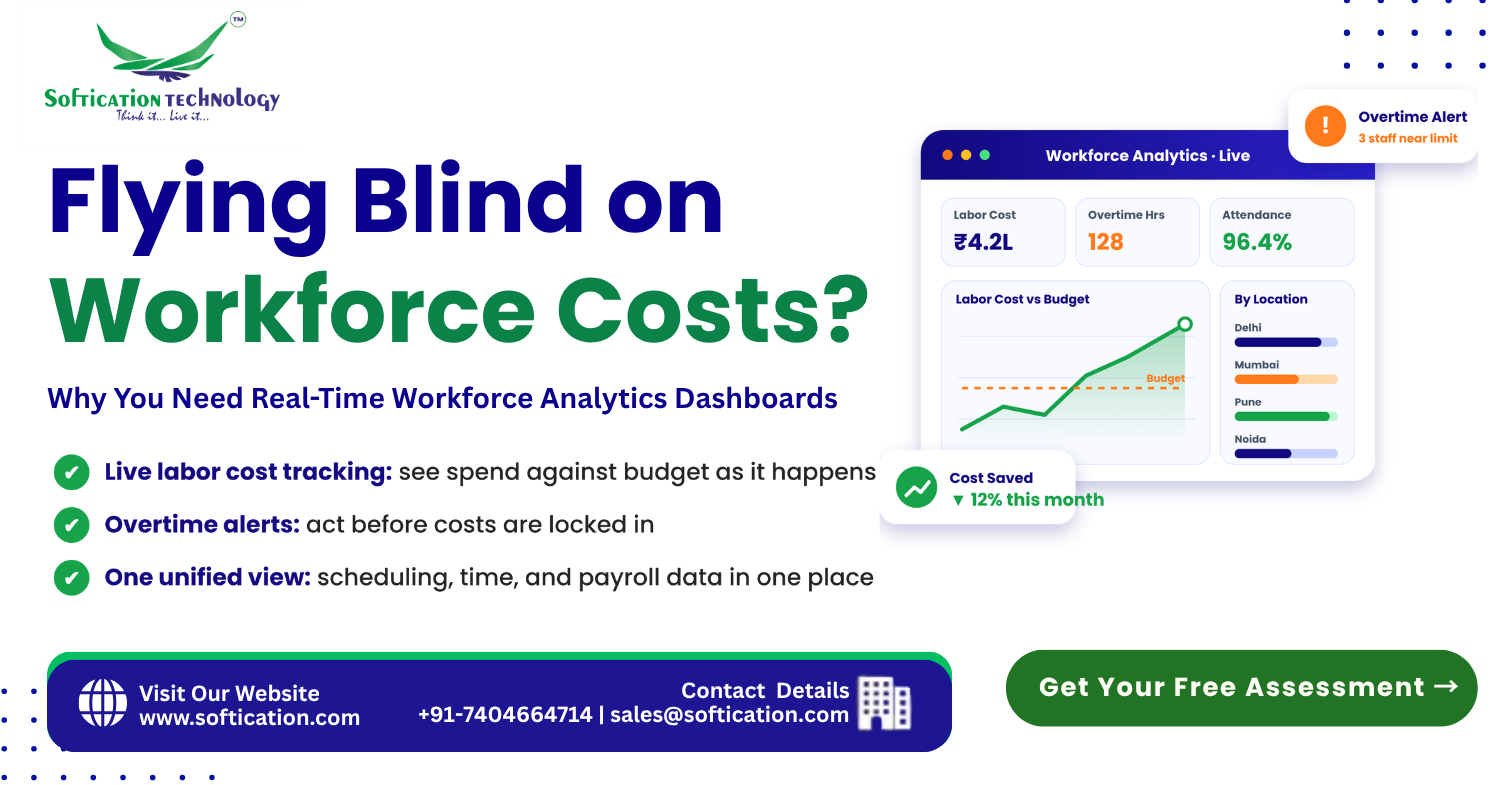
A real-time workforce analytics dashboard pulls data from scheduling, time tracking, payroll, and HR systems into one live view, so leaders and managers can see what is happening now, not what happened last month. A well-built dashboard typically includes:
- Live labor cost tracking against budget, updated as hours are worked rather than after payroll
- Overtime alerts and forecasts, flagging employees and teams approaching thresholds before costs are incurred
- Scheduled vs. actual hours comparison, highlighting variances as they develop
- Attendance and absenteeism trends, with breakdowns by team, location, or time period
- Utilization and productivity metrics standardized across teams, so comparisons are meaningful
- Headcount, turnover, and retention analytics, showing trends and early warning signals
- Demand forecasting support, using historical patterns to plan staffing more accurately
- Role-based views, so executives see the big picture while managers see the details for their own teams
- Drill-down and export options, letting users move from a high-level trend to the underlying records quickly
The goal isn't more reports. It's faster, better decisions made while there is still time to change the outcome.
SoftiCation's Capability: We Build Dashboards Around the Decisions You Actually Make
At SoftiCation, we don't build generic dashboards full of metrics nobody uses. We start with the decisions your leadership and managers need to make, then build the data layer and visualizations that support them. Our capability includes:
- Custom workforce analytics dashboard development, designed around your specific KPIs, roles, and reporting needs
- Data integration across systems, connecting scheduling, time tracking, payroll, HRMS, and ERP data into one reliable source
- Real-time data pipelines, so dashboards reflect current activity instead of yesterday's export
- Automated alerts and notifications for overtime risk, budget variance, absenteeism spikes, and coverage gaps
- Role-based access and views for executives, HR, and location managers
- Predictive analytics and forecasting modules, helping plan staffing and budgets based on historical patterns
- Mobile-friendly dashboards, giving managers access to key numbers wherever they are
- Data governance and security, ensuring sensitive employee and payroll data stays protected and access-controlled
We build analytics your team will actually use, because they're designed around real decisions rather than generic reporting templates.
Want to see what a dashboard built around your KPIs would look like? [Talk to a Workforce Analytics Specialist →]
Proof: What This Looks Like in Practice
Consider a multi-location business whose leadership received a labor cost report only after each pay period closed. Compiling that report required an analyst to combine exports from the time clock, scheduling tool, and payroll system, which took several days. Overtime regularly exceeded budget in a few locations, but nobody found out until the money had already been spent.
A real-time analytics dashboard was built on top of the existing systems, connecting scheduling, time tracking, and payroll data into one live view. Managers received automated alerts when employees were approaching overtime thresholds, and leadership gained a single screen showing labor cost against budget by location, updated throughout the day. Attendance and absenteeism trends were added as standard views, with the ability to drill down into individual teams.
After rollout, managers began adjusting schedules mid-period to avoid overtime instead of discovering it afterward, the manual report-building effort was eliminated, and leadership had a reliable, current view of labor spend across all locations. Planning conversations shifted from debating whose numbers were right to deciding what to do about them.
This reflects the real value of workforce analytics: the benefit isn't the charts themselves, it's the ability to act while the numbers can still be changed.
Ready to stop flying blind on workforce costs? [Get Your Free Dashboard Consultation →]
Is Your Business Making Workforce Decisions on Last Month's Data?
If labor is one of your biggest costs but your visibility into it arrives weeks late, you're managing with a delay that costs real money. Real-time analytics closes that gap by putting accurate, current workforce data in front of the people who can act on it.
Get a Free Workforce Analytics Consultation and find out exactly what a real-time dashboard would show you about your own workforce costs, and where you may be losing money today.
[Get Your Free Workforce Analytics Consultation →]
Or talk to us directly. We'll walk you through what's possible with your current systems. 📞 Call/WhatsApp us today to discuss your workforce analytics needs.