You've invested in a good website, run ads, and worked on SEO. Traffic is coming in. But sales don't match the visitor numbers, and every month you wonder where all those people went.
That gap between visitors and buyers is exactly what conversion rate optimization (CRO) addresses. Instead of paying for more traffic, CRO helps you get more value from the traffic you already have. This guide explains what's usually going wrong, what it costs you, and the practical fixes that make the biggest difference, so you can start turning more visitors into customers.
The Problem: Most Websites Lose Buyers They've Already Paid For
Every visitor to your store took effort or money to attract. Yet on a typical site, the large majority leave without buying. Some of that is normal. But a lot of it is avoidable friction that quietly pushes interested people away. Common culprits include:
- Slow page loads, especially on mobile networks, where visitors leave before the page finishes loading
- Unclear value proposition, so visitors can't tell within seconds what you sell and why they should buy from you
- Weak product pages, with poor images, thin descriptions, missing specifications, and no social proof
- Confusing navigation and search, making it hard for shoppers to find what they came for
- A poor mobile experience, with tiny tap targets, awkward forms, and layouts designed for desktop
- Trust gaps, such as no reviews, unclear return policies, missing contact details, or an unprofessional look
- Surprise costs, where shipping, taxes, or fees appear late in checkout and shock the buyer
- Long or complicated checkout, with forced account creation, too many fields, or limited payment options
- Unclear calls to action, so visitors don't know what to do next
- Errors and bugs, such as broken buttons, failed form submissions, or issues that only affect certain browsers
- Guesswork over data, where changes are made based on opinions instead of evidence from visitor behavior
Individually, these look like small issues. Together, they decide whether your website is a sales machine or a leaky bucket.
The Business Consequence: Low Conversion Rates Make Everything More Expensive
Conversion rate affects almost every number in your business.
Higher cost per acquisition. If fewer visitors buy, each customer costs more to acquire. Your ad spend, SEO effort, and content investment all produce fewer sales than they should.
Wasted marketing budget. Sending more traffic to a leaky site just increases the leak. Many businesses keep buying traffic when fixing the website would deliver more.
Lower profit margins. When acquisition costs rise and conversion stays flat, margins shrink, sometimes to the point where campaigns stop being worthwhile.
Slower growth. Growth needs either more traffic or better conversion. Without conversion improvements, you're forced to rely on more spend.
Hidden revenue left on the table. A small increase in conversion rate can be worth far more than the same percentage increase in traffic, because the extra sales come from visitors you already have.
Bad decisions from bad data. Without testing and measurement, teams debate opinions, redesign for aesthetics, and sometimes make things worse.
Customer frustration. Friction doesn't just lose a sale; it can lose the customer for good and leave a negative impression of your brand.
Put simply, your conversion rate is a multiplier on every marketing rupee, dollar, or pound you spend.
Curious how much revenue your website is leaving behind? [Get a Free Conversion Audit →]
The Solution: A Systematic Approach to Conversion Optimization
CRO isn't about random tweaks or copying competitors. It's a repeatable process of finding where visitors drop off, forming hypotheses about why, testing changes, and keeping what works.
First, know your numbers
Conversion rate is the percentage of visitors who complete a desired action, such as buying.
Conversion rate = (orders ÷ visitors) × 100
For example, if 10,000 visitors produce 200 orders, your conversion rate is 2%. Improving it to 2.5% means 50 more orders from the same traffic, without spending anything extra on acquisition.
Other metrics to watch alongside it include:
- Add-to-cart rate and checkout start rate, to see where shoppers fall away
- Cart abandonment rate, the share who add items but don't complete the purchase
- Average order value, because conversions and basket size both drive revenue
- Bounce rate and engagement by page, to find pages that fail to hold attention
- Performance by device, channel, and new vs. returning visitors, since averages hide problems
The conversion fixes that matter most
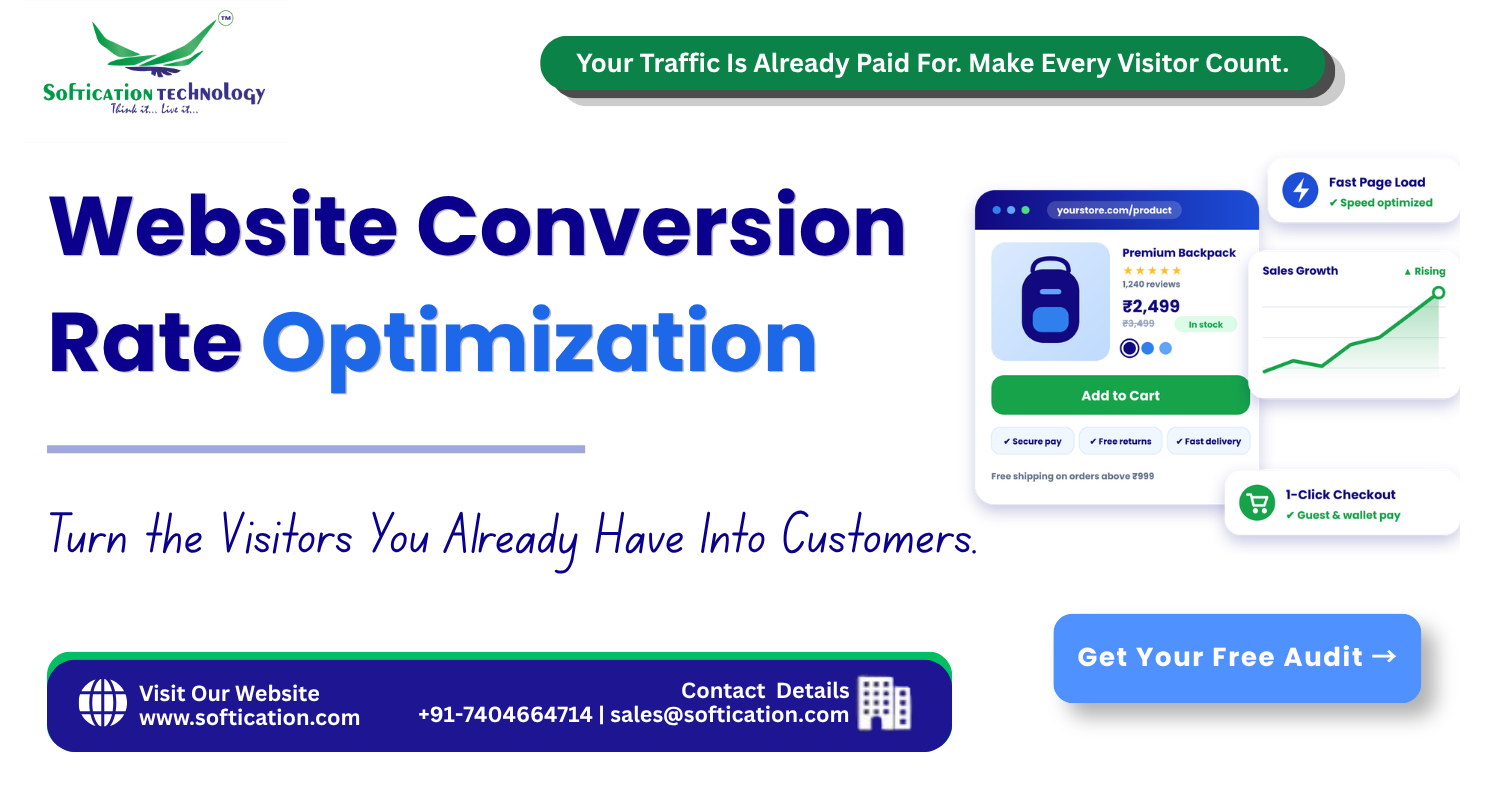
1. Speed up your site. Page speed is one of the most reliable levers. Compress images, use modern formats, enable caching and a content delivery network, reduce heavy scripts and plugins, and optimize the code that runs in the browser. Every second of delay gives visitors a reason to leave.
2. Make the value proposition instantly clear. Within a few seconds, a visitor should understand what you sell, who it's for, and why you're a good choice. Use a clear headline, a supporting line, and strong visuals above the fold.
3. Improve product pages. Product pages do the selling. Use high-quality images from multiple angles, video where helpful, clear specifications, honest descriptions, size and fit guidance, stock and delivery information, and visible reviews. Answer the questions a buyer would normally ask in a shop.
4. Build trust. Show reviews and ratings, security badges where relevant, clear returns and refund policies, real contact information, and recognizable payment options. Trust removes the hesitation that stops a purchase.
5. Simplify navigation and search. Organize categories logically, offer useful filters, and make search forgiving of typos and synonyms. Shoppers who find products quickly are far more likely to buy.
6. Design for mobile first. Make tap targets large, forms short, and key actions reachable with a thumb. Use sticky add-to-cart buttons, simple menus, and mobile-friendly payment options.
7. Streamline checkout. This is where many sales are lost. Offer guest checkout, reduce form fields, enable autofill, show progress, display total costs early, and support the payment methods your customers prefer, including wallets and local options.
8. Be upfront about costs and delivery. Surprise charges are a leading reason for abandoned carts. Show shipping costs and delivery estimates as early as possible.
9. Use clear, consistent calls to action. Buttons should say what happens next, stand out visually, and appear where visitors are ready to act.
10. Recover abandoned carts. Use well-timed emails or messages with the cart contents, helpful reminders, and, where appropriate, incentives, to bring back shoppers who left.
11. Use social proof and urgency honestly. Reviews, user-generated photos, and "bestseller" labels help. Genuine low-stock or deadline messages can motivate action, but fake urgency damages trust.
12. Personalize where it helps. Recommendations based on browsing, returning-customer shortcuts, and relevant offers can lift both conversion and order value.
13. Fix errors and friction. Test forms, buttons, and flows across browsers and devices. A hidden bug can cost more than any design problem.
14. Make support easy to reach. Live chat, visible contact options, and helpful FAQs resolve doubts at the moment they arise.
Prioritize with an impact-and-effort view
| Fix | Typical impact | Typical effort |
|---|---|---|
| Page speed optimization | High | Medium |
| Checkout simplification | High | Medium |
| Mobile experience improvements | High | Medium to high |
| Product page improvements | High | Low to medium |
| Trust signals and policies | Medium to high | Low |
| Navigation and search improvements | Medium | Medium |
| Abandoned cart recovery | Medium to high | Low to medium |
| Personalization | Medium | High |
Start with high-impact, lower-effort fixes, then move on to larger projects.
Test, don't guess
Good CRO runs on evidence. Use analytics to find drop-off points, session recordings and heatmaps to see behavior, and customer feedback to understand motives. Then run A/B tests to compare versions, with enough traffic and time to reach reliable conclusions. Document what you learn, because even failed tests reveal insights.
Remember the technical foundation
Many conversion problems are really technical problems: slow servers, bloated themes, rigid checkout, poor integrations, or limited platform flexibility. If your platform makes it hard to change checkout, speed up pages, or run tests, optimization effort will hit a ceiling. For a wider view of how platform and architecture choices affect results, see our pillar guide, Custom Web & E-Commerce Development: The Complete Guide for Businesses in 2026.
SoftiCation's Capability: We Find the Leaks and Fix Them Technically
At SoftiCation, we combine conversion expertise with engineering, so recommendations don't stay on a slide. We implement them. Our capability includes:
- Conversion audits, analyzing your funnel, analytics, user behavior, and technical performance to identify where and why visitors drop off
- Analytics and tracking setup, ensuring your data is accurate and actionable
- Page speed and Core Web Vitals optimization, including image, code, caching, and hosting improvements
- Checkout redesign and development, with simplified flows, guest checkout, wallets, and local payment methods
- Mobile-first UX and front-end development, designed around real mobile behavior
- Product page and navigation redesign, improving clarity, trust, and findability
- A/B and multivariate testing setup, with proper measurement and reporting
- Abandoned cart and lifecycle automation, integrated with your store and marketing tools
- Platform and architecture improvements, removing technical limits on optimization
- Ongoing optimization programs, with regular testing, reporting, and iteration
We focus on measurable results, so every change is tied to a metric that matters to your business.
Want to see where your website is losing buyers? [Talk to a Conversion Specialist →]
Proof: What This Looks Like in Practice
Consider an online retailer with healthy traffic from search and paid campaigns but a conversion rate that had been stuck for months. The team had redesigned the homepage twice without much effect. A conversion audit looked at the data instead of opinions and found three clear problems: mobile pages loaded slowly because of oversized images and heavy scripts, the checkout required account creation and asked for more fields than necessary, and shipping costs only appeared on the final step.
Fixes were prioritized by impact. Images and scripts were optimized, and caching and a content delivery network were configured. Checkout was rebuilt with guest purchase, fewer fields, autofill, and mobile wallet support, and delivery costs and times were shown on the product and cart pages. An abandoned cart email sequence was added.
After launch, mobile load times improved noticeably, more shoppers completed checkout, and fewer carts were abandoned at the final step. Because tracking had been set up properly, the team could see which changes produced results and continue testing, rather than guessing at the next redesign.
This illustrates the pattern behind most successful optimization: find the real friction, fix it in order of impact, and measure the effect.
Ready to turn more of your visitors into buyers? [Get Your Free CRO Consultation →]
Frequently Asked Questions
What is a good conversion rate for an e-commerce website? It varies widely by industry, price point, traffic source, and device, so there's no single benchmark that applies to everyone. The more useful comparison is your own rate over time, segmented by channel and device.
How long does CRO take to show results? Quick fixes such as speed improvements and checkout friction can show results within weeks. Testing-based improvements build over months, since tests need enough traffic to be reliable.
Do I need a lot of traffic to do CRO? Higher traffic allows faster, more reliable testing, but even lower-traffic sites benefit from fixing obvious usability, speed, and trust problems based on analytics and user research.
Is CRO the same as SEO? No. SEO brings more visitors to your site, while CRO increases the share of those visitors who buy. They work best together.
Can my current platform support CRO? Most can support basic improvements. If the platform limits checkout customization, performance, or testing, platform changes or custom development may be needed.
Ready to Get More From the Traffic You Already Have?
Before you spend more on ads or content, check how well your website converts the visitors it already receives. A structured audit often reveals fixes that pay for themselves quickly and make every future marketing dollar work harder.
Get a Free Conversion Audit and find out exactly where your website is losing buyers, what to fix first, and what it could be worth.
[Get Your Free Conversion Audit →]
Or talk to us directly. We'll walk you through what we'd look at and why. 📞 Call/WhatsApp us today to discuss improving your website's conversions.