Choosing an e-commerce platform is one of the most consequential decisions you'll make for your online business. It shapes your launch speed, your running costs, how easily you can add features, how well your store performs under load, and how painful (or painless) growth will be.
Everyone has an opinion. Shopify fans say it's the only sensible option. WordPress loyalists swear by WooCommerce. Developers push custom builds. The honest answer is that each can be the right choice, and each can be the wrong one, depending on your business. This guide compares all three fairly, so you can decide based on your needs instead of someone's preference.
The Problem: Platform Choices Are Often Made on the Wrong Criteria
Most businesses pick a platform based on a demo, a friend's recommendation, or the lowest quote. These shortcuts lead to predictable problems:
- Choosing on price alone, without modeling the real cost of apps, plugins, transaction fees, hosting, and maintenance over several years
- Underestimating future needs, such as B2B pricing, subscriptions, marketplaces, multi-currency, or custom workflows
- Overestimating current needs, and paying for custom development when a ready-made platform would have launched faster and cheaper
- Ignoring integrations, then discovering the platform can't connect cleanly to your ERP, inventory, or CRM
- Believing that "no-code" means "no limits", until a requirement doesn't fit the platform's model
- Falling for plugin sprawl, where every missing feature becomes another add-on that slows the site and creates risk
- Overlooking ownership and control, including data portability, customization depth, and dependence on a vendor's roadmap
- Following trends, instead of matching the platform to catalog size, traffic, team skills, and business model
A wrong choice doesn't usually show up on day one. It shows up a year or two later, when the business has grown and the platform hasn't.
The Business Consequence: A Mismatched Platform Is Expensive to Fix
Costly migrations. Moving platforms later means rebuilding templates, re-integrating systems, migrating data, and protecting SEO. It costs far more than choosing well initially.
Hidden running costs. Subscription tiers, paid apps, premium plugins, developer time for workarounds, and transaction fees can make a "cheap" option expensive over time.
Limited growth. If the platform can't support the way you want to sell, you either change your business model to fit the tool or spend heavily to bend the tool.
Performance problems. Heavy themes and many plugins can slow stores, and slow stores convert fewer visitors.
Operational friction. Poor integrations create manual work: re-entering orders, reconciling stock, and fixing errors.
Security and maintenance burden. Self-hosted platforms need regular updates and monitoring. Neglect creates vulnerabilities.
Lost time. Months spent on the wrong platform are months not spent on marketing, product, and customers.
The goal is not to find the "best" platform in the abstract. It's to find the one that fits your business now and for the next few years.
Not sure which option fits your store? [Get a Free Platform Recommendation →]
The Solution: Compare All Three Honestly, Then Match to Your Needs
Shopify
Shopify is a hosted, subscription-based e-commerce platform. It handles hosting, security, and core commerce features for you.
Strengths
- Fast to launch, with a polished admin and checkout
- Hosting, updates, and security managed by the platform
- Large app marketplace and many themes
- Reliable performance without managing servers
- Strong built-in payments, shipping, and sales channel tools
Limitations
- Deep customization of checkout and back-end logic can be restricted, depending on your plan and approach
- Costs grow with apps, premium themes, and plan tiers; transaction fees may apply depending on payment setup, so always check current pricing
- Complex B2B pricing, unusual workflows, or heavy integrations may need workarounds or custom apps
- You depend on the platform's rules, roadmap, and pricing
Best for: Brands that want to launch quickly, have fairly standard catalogs and checkout, and prefer not to manage infrastructure.
WooCommerce
WooCommerce is an open-source e-commerce plugin for WordPress. You host it yourself (or with a managed host) and extend it with themes and plugins.
Strengths
- Highly flexible, with a huge ecosystem of plugins and developers
- Full control over your data and hosting
- Strong content and SEO capabilities through WordPress
- Lower licensing costs for the core software
- Easier to customize than hosted platforms for many requirements
Limitations
- You're responsible for hosting, updates, backups, and security
- Plugin conflicts and bloat can slow the site and cause instability
- Performance at larger scale requires careful engineering and good hosting
- Costs shift from subscriptions to hosting, premium plugins, and developer time
Best for: Content-driven businesses, stores that need moderate customization, and teams comfortable with (or supported in) managing a self-hosted setup.
Custom Development
Custom development means building your store with a framework and architecture chosen for your needs, for example Laravel or Node.js on the back end with React or Next.js on the front end. It may be fully bespoke or headless, using a commerce engine with a custom front end.
Strengths
- Built around your exact business logic, workflows, and user experience
- Deep, clean integrations with ERP, CRM, inventory, and other systems
- Full control over performance, security, and scalability
- No dependence on a platform's limits or roadmap
- Ideal for marketplaces, subscription models, B2B portals, and unusual pricing
Limitations
- Higher upfront cost and longer build time
- Requires ongoing maintenance and development capacity
- Needs a capable development partner and clear requirements
- Overkill if your needs are simple
Best for: Businesses with complex requirements, significant integration needs, high performance demands, or business models that standard platforms don't support well.
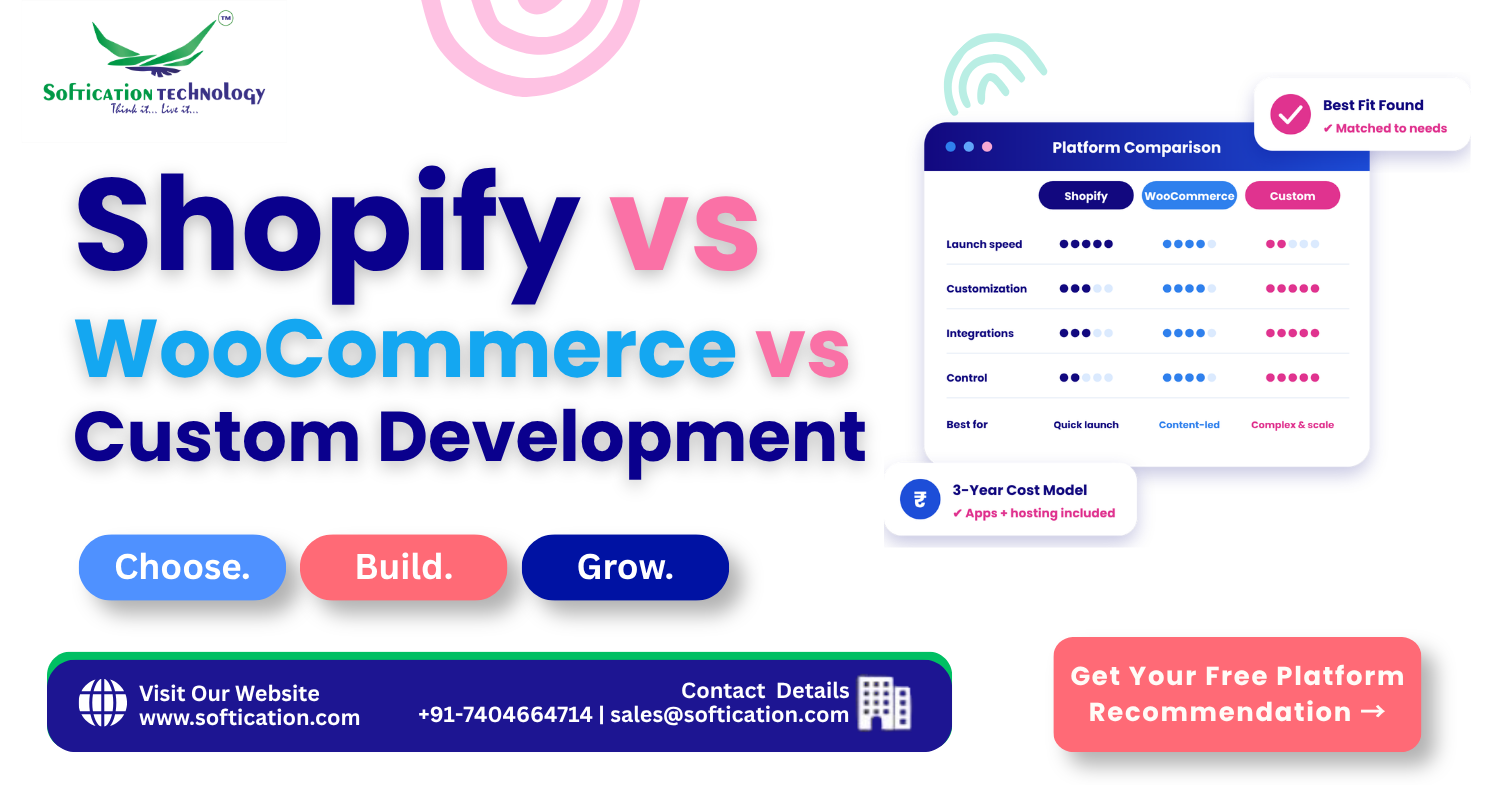
Side-by-side comparison
| Factor | Shopify | WooCommerce | Custom Development |
|---|---|---|---|
| Speed to launch | Fastest | Fast to moderate | Slowest |
| Upfront cost | Low | Low to moderate | Highest |
| Ongoing cost | Subscription, apps, possible fees | Hosting, plugins, maintenance | Hosting, maintenance, development |
| Customization | Moderate | High | Unlimited |
| Integrations | Good via apps; complex ones need work | Good via plugins; flexible | Built to your systems |
| Performance control | Platform-managed | Depends on hosting and setup | Full control |
| Security & updates | Managed by platform | Your responsibility | Your responsibility, with good practices |
| Scalability | Strong for standard stores | Depends on engineering | Designed for your scale |
| Data ownership | Platform-hosted | Full ownership | Full ownership |
| Technical effort | Low | Moderate | High (handled by your partner) |
| Best fit | Standard stores, fast launch | Flexible, content-led stores | Complex, high-scale, or unique models |
A simple decision framework
Ask these questions:
- How standard is your business model? Standard catalog and checkout point toward Shopify or WooCommerce. Unusual pricing, subscriptions, marketplaces, or B2B workflows point toward custom.
- How many systems must it connect to? A few common tools are fine on platforms. Deep ERP, inventory, or proprietary system integration often favors custom.
- What's your growth horizon? Fast, high-volume growth means thinking about performance and architecture from the start.
- Who will maintain it? If you don't want to manage infrastructure, Shopify or a custom build with managed support is easier than self-managed WooCommerce.
- What's your real budget over three years? Include apps, plugins, hosting, developer time, and the cost of workarounds, not just the build price.
- How important is control? If owning your data, logic, and roadmap matters, WooCommerce or custom offers more.
- How fast do you need to launch? If speed matters most, start with a platform and plan an upgrade path.
The hybrid and phased approach
You don't have to choose forever. Many businesses launch on Shopify or WooCommerce, then add custom modules, integrations, or a custom front end as needs grow. Others use a headless setup that keeps a platform's commerce engine while building a custom experience on top. Planning for this path from the start avoids painful rebuilds later. For a wider overview of the options, see our pillar guide, Custom Web & E-Commerce Development: The Complete Guide for Businesses in 2026.
SoftiCation's Capability: Platform-Neutral Advice and Expert Development on All Three
At SoftiCation, we don't push one platform. We build on Shopify, WooCommerce, and custom architectures, so our recommendation is based on your needs, not our preference. Our capability includes:
- Platform assessment and recommendation, comparing options against your catalog, integrations, budget, and growth plans
- Three-year total cost modeling, including apps, plugins, hosting, development, and transaction costs
- Shopify development, including custom themes, apps, and integrations
- WooCommerce development, including performance-tuned builds, custom plugins, and managed hosting guidance
- Custom and headless e-commerce development with Laravel, Node.js, React, and Next.js
- ERP, CRM, payment, shipping, and inventory integration on any platform
- Migration between platforms, protecting SEO rankings, data, and customer accounts
- Performance and security optimization for existing stores
- Phased roadmaps, so you launch quickly and add custom capability only when it pays off
- Ongoing maintenance and support, keeping stores secure, fast, and current
We'll tell you plainly if a ready-made platform is enough, and equally plainly if it isn't.
Want an unbiased recommendation for your business? [Talk to an E-Commerce Specialist →]
Proof: What This Looks Like in Practice
Consider a business that planned to build a fully custom store because a previous agency had recommended it. A short assessment showed that the catalog was straightforward, the checkout standard, and the only unusual need was a connection to the company's inventory system. A custom build would have cost significantly more and taken much longer than necessary.
Instead, the store was built on a ready-made platform for fast launch, with a custom integration developed to sync inventory automatically. This kept the build economical, got the store live quickly, and solved the one requirement the platform couldn't handle on its own.
A year later, as the business added wholesale customers with special pricing and a complex quoting process, the team revisited the architecture. Because the original build was planned with growth in mind, custom modules for wholesale pricing were added without replacing the whole store.
This illustrates the practical lesson: the best platform choice is the one that matches your needs today, leaves room for tomorrow, and avoids paying for complexity you don't need.
Ready to choose the right foundation for your store? [Get Your Free Platform Consultation →]
Frequently Asked Questions
Is Shopify better than WooCommerce? Neither is better in general. Shopify is easier and faster to launch with managed hosting. WooCommerce offers more flexibility and control but needs more maintenance. The right choice depends on your needs and capacity.
When is custom development worth it? When you have unusual business logic, complex integrations, high performance requirements, or models like marketplaces, subscriptions, or B2B portals that standard platforms handle awkwardly.
Is custom development always more expensive? Upfront, usually. Over several years, the comparison depends on subscription and plugin costs, workarounds, and the revenue impact of performance and features. A three-year cost model gives a clearer picture.
Can I start on Shopify or WooCommerce and move to custom later? Yes. Many businesses do. Planning the architecture and data structure carefully from the start makes later upgrades much smoother.
What about headless commerce? Headless means separating the front end from the commerce engine. It gives design and performance freedom while keeping a proven back end. It suits businesses that need a custom experience without rebuilding everything.
Not Sure Which Platform Is Right for You?
The right e-commerce platform depends on your products, systems, team, and plans, not on what's popular. A short, honest conversation can save months of effort and a significant amount of money.
Get a Free Platform Recommendation and find out whether Shopify, WooCommerce, custom development, or a hybrid approach fits your business best.
[Get Your Free Platform Recommendation →]
Or talk to us directly. We'll give you a straight, unbiased answer. 📞 Call/WhatsApp us today to discuss your e-commerce platform decision.