Pre-Screener & CAPTCHA Screener: Improving Respondent Qualification and Survey Security in Market Research
Market research is not just about collecting responses. It is about reaching the right respondents and maintaining the quality and integrity of survey participation.
As online surveys and digital research panels continue to grow, research teams face two important challenges: identifying eligible participants and reducing automated or suspicious survey submissions.
A respondent may complete a survey, but that does not automatically mean they match the research requirements. Similarly, a survey link being accessible online does not mean every submission comes from a genuine participant.
This is where two important capabilities become valuable: Pre-Screener and CAPTCHA Screener.
At SoftiCation Technology Pvt. Ltd., we have introduced these capabilities into our market research tools to help research teams improve respondent qualification and add another layer of protection to their survey workflows.
Let's understand how they work and why they matter.
What Is a Pre-Screener in Market Research?
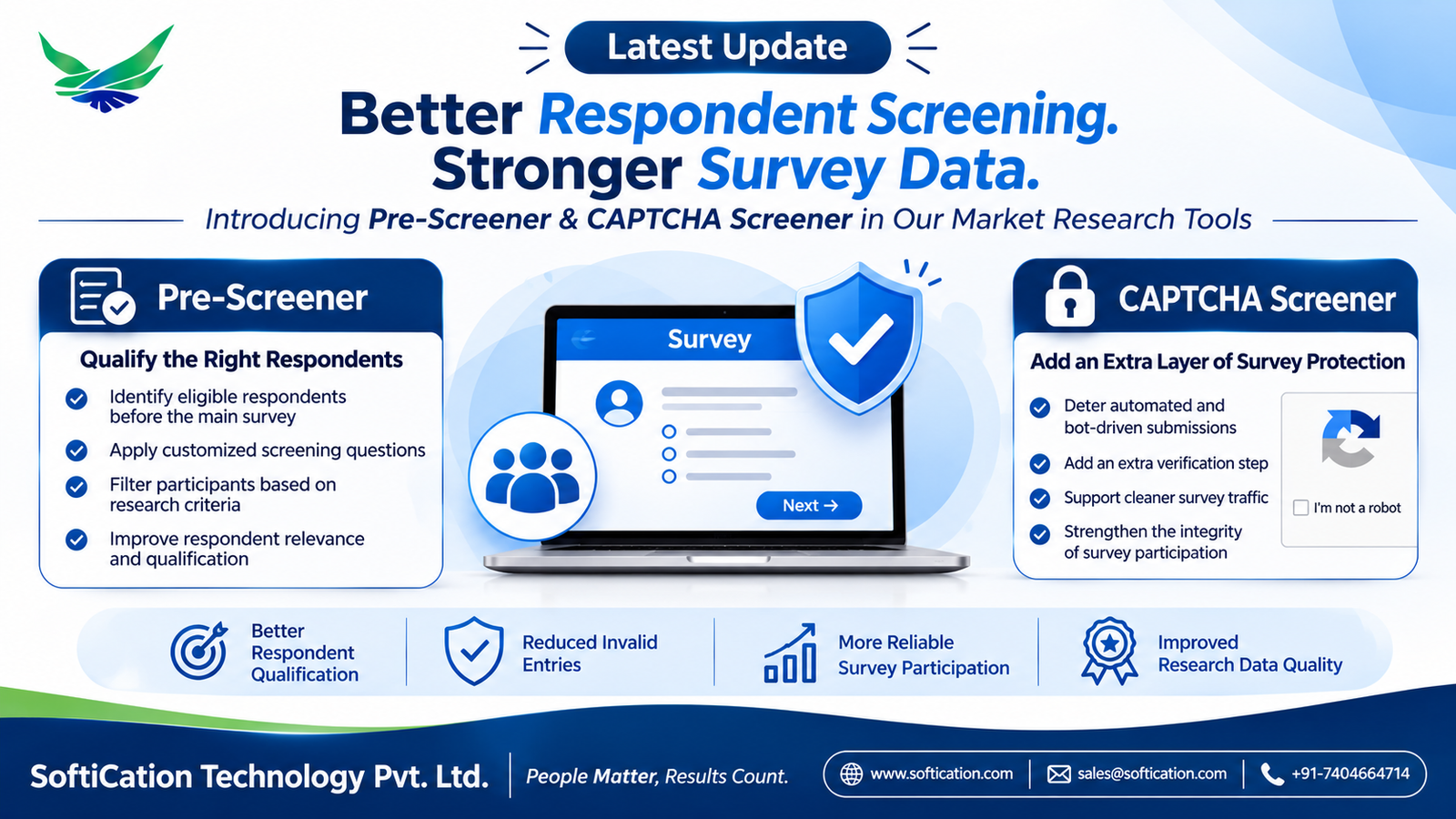
A Pre-Screener is an initial set of screening questions presented to potential respondents before they enter the main survey.
Its purpose is to determine whether a participant meets the eligibility requirements of a particular research project.
For example, imagine a research company conducting a study about online shopping habits among consumers who have purchased products online within the last 30 days.
The research team may need to identify respondents based on:
Age group
Geographic location
Recent purchasing behaviour
Product usage
Employment or professional background
Other project-specific eligibility criteria
Instead of allowing every participant to enter the main questionnaire, a pre-screener evaluates their responses against the defined screening requirements.
How Does a Pre-Screener Work?
A typical pre-screening workflow can include the following steps:
1. Respondent Opens the Survey
The participant accesses the survey through a panel invitation, survey link or research platform.
2. Screening Questions Appear
The system presents questions based on the research project's eligibility requirements.
3. Responses Are Evaluated
The respondent's answers are checked against the configured screening criteria.
4. Eligibility Is Determined
Based on the configured rules, the participant can qualify or be screened out.
5. Eligible Respondents Continue
Qualified respondents proceed to the main survey, while ineligible participants are directed through the appropriate screen-out workflow.
Key Benefits of Pre-Screener Software
Better respondent qualification: Identify participants who match the target audience.
Project-specific screening: Configure questions according to individual research requirements.
Improved survey relevance: Help ensure that the main questionnaire reaches the intended audience.
More efficient workflows: Reduce unnecessary participation in surveys where eligibility requirements are not met.
Flexible screening rules: Support different screening requirements across research projects.
A well-designed pre-screener helps research teams make better decisions about who should enter a survey.
What Is a CAPTCHA Screener in Online Surveys?
Online surveys can be exposed to automated traffic, scripts, and bot-driven submissions.
These activities may affect survey participation quality, increase unnecessary processing, and make it harder for research teams to distinguish genuine participation from automated activity.
A CAPTCHA Screener introduces an additional verification step to help determine whether a survey interaction is likely to be coming from a human participant rather than an automated program.
CAPTCHA stands for Completely Automated Public Turing Test to Tell Computers and Humans Apart.
It is commonly used across websites, registration forms, login pages, and online applications to help protect digital interactions.
In market research, CAPTCHA verification can provide an additional layer of protection before respondents proceed with survey participation.
Why Is CAPTCHA Protection Important for Market Research?
1. Helps Deter Automated Submissions
CAPTCHA challenges can make automated survey submissions more difficult.
2. Adds an Extra Verification Layer
An additional verification step helps research platforms assess survey interactions before allowing participation.
3. Supports Cleaner Survey Traffic
Reducing automated activity can help research teams maintain more reliable survey participation.
4. Strengthens Survey Integrity
CAPTCHA can complement other respondent validation and survey quality measures.
5. Supports Online Research Panels
Panel providers and research platforms can use CAPTCHA as one component of a broader respondent verification strategy.
It is important to understand that CAPTCHA alone cannot identify every fraudulent or low-quality response. It should be used alongside other appropriate survey quality and validation controls.
Pre-Screener vs CAPTCHA Screener: What Is the Difference?
Although both features support better survey operations, they solve different problems.
| Feature | Pre-Screener | CAPTCHA Screener |
|---|---|---|
| Primary purpose | Respondent qualification | Human interaction verification |
| Main focus | Research eligibility | Automated activity deterrence |
| Uses | Screening questions | Verification challenge |
| Evaluates | Responses against project criteria | Whether an interaction is likely human |
| Main benefit | Better audience relevance | Additional survey protection |
The important distinction: A pre-screener helps determine whether a respondent is eligible for a research project. A CAPTCHA screener helps add protection against automated participation.
Using both capabilities together can support a stronger survey screening workflow.
How Pre-Screener and CAPTCHA Work Together
Consider an online consumer research project targeting participants from a specific age group and location.
A combined screening workflow could look like this:
Step 1: Survey Entry
The respondent opens the survey invitation.
Step 2: CAPTCHA Verification
An additional verification challenge is presented to help deter automated participation.
Step 3: Pre-Screener Questions
The participant answers project-specific screening questions.
Step 4: Eligibility Evaluation
The platform evaluates the submitted answers against the configured criteria.
Step 5: Survey Access
Eligible participants proceed to the main questionnaire. Ineligible participants follow the configured screen-out process.
Step 6: Main Survey Participation
Qualified respondents continue with the research questionnaire.
This workflow combines two different types of checks: interaction verification and research eligibility screening.
Why Market Research Companies Need Better Screening Tools
Research companies, online panel providers, survey agencies, and data collection teams operate across different audiences, geographies, and project requirements.
Without appropriate screening and validation processes, teams may face challenges such as:
Respondents who do not match the target audience.
Unnecessary survey entries from ineligible participants.
Automated or bot-driven survey activity.
Increased manual review requirements.
Difficulty maintaining consistent screening processes across projects.
Reduced confidence in the quality of collected responses.
A structured screening workflow can help address these operational challenges.
However, screening is only one part of research quality. Survey design, respondent recruitment, quota management, duplicate detection, response validation and data review also play important roles.
Introducing Pre-Screener and CAPTCHA Screener in SoftiCation Market Research Tools
At SoftiCation Technology Pvt. Ltd., we continuously work on developing practical technology solutions for market research companies and research operations teams.
Our market research tools now include two additional capabilities:
1. Pre-Screener Module
Designed to support respondent qualification before the main survey.
Key capabilities include:
Custom screening questions.
Project-specific eligibility requirements.
Respondent qualification workflows.
Screening before main survey access.
Better alignment between research requirements and survey participants.
2. CAPTCHA Screener Module
Designed to add an extra verification layer to online survey participation.
Key capabilities include:
CAPTCHA-based respondent verification.
Additional protection against automated submissions.
Support for cleaner survey traffic.
Improved survey participation integrity.
These capabilities complement our broader market research technology solutions, helping teams manage more structured survey and respondent workflows.
Building a Complete Market Research Technology Ecosystem
Modern research operations require more than a questionnaire or survey link.
Research teams may need several connected modules to manage their daily operations.
A market research technology platform can bring together:
Respondent Management: Manage respondent records and participation workflows.
Panel Management: Organize and manage online research panel operations.
Survey Programming: Build customized surveys with routing and logic.
Pre-Screener: Qualify respondents before the main questionnaire.
CAPTCHA Screener: Add protection against automated participation.
Quota Management: Configure and monitor project-specific quotas.
Survey Redirects: Manage completion, termination, and quota-full routing.
Vendor Management: Organize research vendors and their activities.
Client Management: Manage client information and project relationships.
Project Management: Create, assign, and monitor research projects.
Invoice Management: Organize project-related billing workflows.
Reporting and Analytics: Monitor survey and project performance.
The objective is to help research organizations bring important operational activities into a more connected and manageable environment.
Best Practices for Implementing Survey Screening
Adding screening technology is only the beginning. Proper configuration and responsible implementation are equally important.
Here are some practices research teams should consider:
1. Define Clear Eligibility Requirements
Screening questions should directly relate to the research objectives.
2. Keep Screening Questions Relevant
Avoid unnecessary questions that increase respondent effort without improving qualification.
3. Use CAPTCHA Appropriately
Apply verification where it makes sense for the survey workflow. Ensure that the verification experience remains accessible and does not create unnecessary friction for genuine respondents.
4. Review Screen-Out Logic
Test qualifying and non-qualifying respondent journeys before launching a survey.
5. Protect Respondent Information
Follow applicable privacy requirements and collect only the information needed for the research purpose.
6. Combine Multiple Quality Measures
Use screening alongside appropriate response validation, duplicate checks, quota monitoring and quality review.
7. Monitor Performance
Review screening outcomes, respondent drop-offs and verification failures to identify areas for improvement.
Conclusion: Better Screening Supports Better Market Research
The success of a market research project depends on more than the number of completed surveys.
It depends on reaching the right audience, maintaining reliable participation and applying appropriate quality controls throughout the research process.
A Pre-Screener helps research teams identify eligible respondents before the main survey, while a CAPTCHA Screener adds another layer of protection against automated participation.
Together, these capabilities can contribute to more structured, efficient and reliable survey operations.
SoftiCation Technology Pvt. Ltd. is building market research tools that help research teams simplify respondent management, survey programming, screening, quota management and project operations.
Looking for Custom Market Research Software?
Whether you operate an online research panel, market research agency, survey company or data collection business, we can help you explore technology solutions aligned with your operational requirements.
Let's build smarter research workflows together.
SoftiCation Technology Pvt. Ltd.
Website: https://www.softication.com/
Email: sales@softication.com
Phone: +91-7404664714
People Matter, Results Count.
Frequently Asked Questions
1. What is a pre-screener in market research?
A pre-screener is a set of initial screening questions used to determine whether a potential respondent meets the eligibility requirements of a research project before entering the main survey.
2. What is a CAPTCHA screener in surveys?
A CAPTCHA screener adds a verification challenge to help distinguish human interactions from automated activity and deter bot-driven survey submissions.
3. What is the difference between a pre-screener and CAPTCHA?
A pre-screener evaluates research eligibility based on respondent answers. CAPTCHA helps verify survey interactions and deter automated activity. They serve different purposes.
4. Can pre-screening improve survey data quality?
Pre-screening can help improve audience relevance by filtering participants against project-specific eligibility requirements. Overall data quality also depends on survey design, respondent validation and other quality controls.
5. Does CAPTCHA completely prevent survey fraud?
No. CAPTCHA can help deter automated activity, but it does not detect every type of fraud or guarantee that every response is genuine. It should be combined with other appropriate validation methods.
6. What features should market research software include?
A market research platform may include respondent management, panel management, survey programming, pre-screening, CAPTCHA verification, quota management, redirects, vendor and client management, project management, invoicing and reporting.
7. Can SoftiCation develop custom market research software?
Yes. SoftiCation provides custom software development for market research workflows, including respondent management, survey programming, screening, quota management and other research operations based on project requirements.