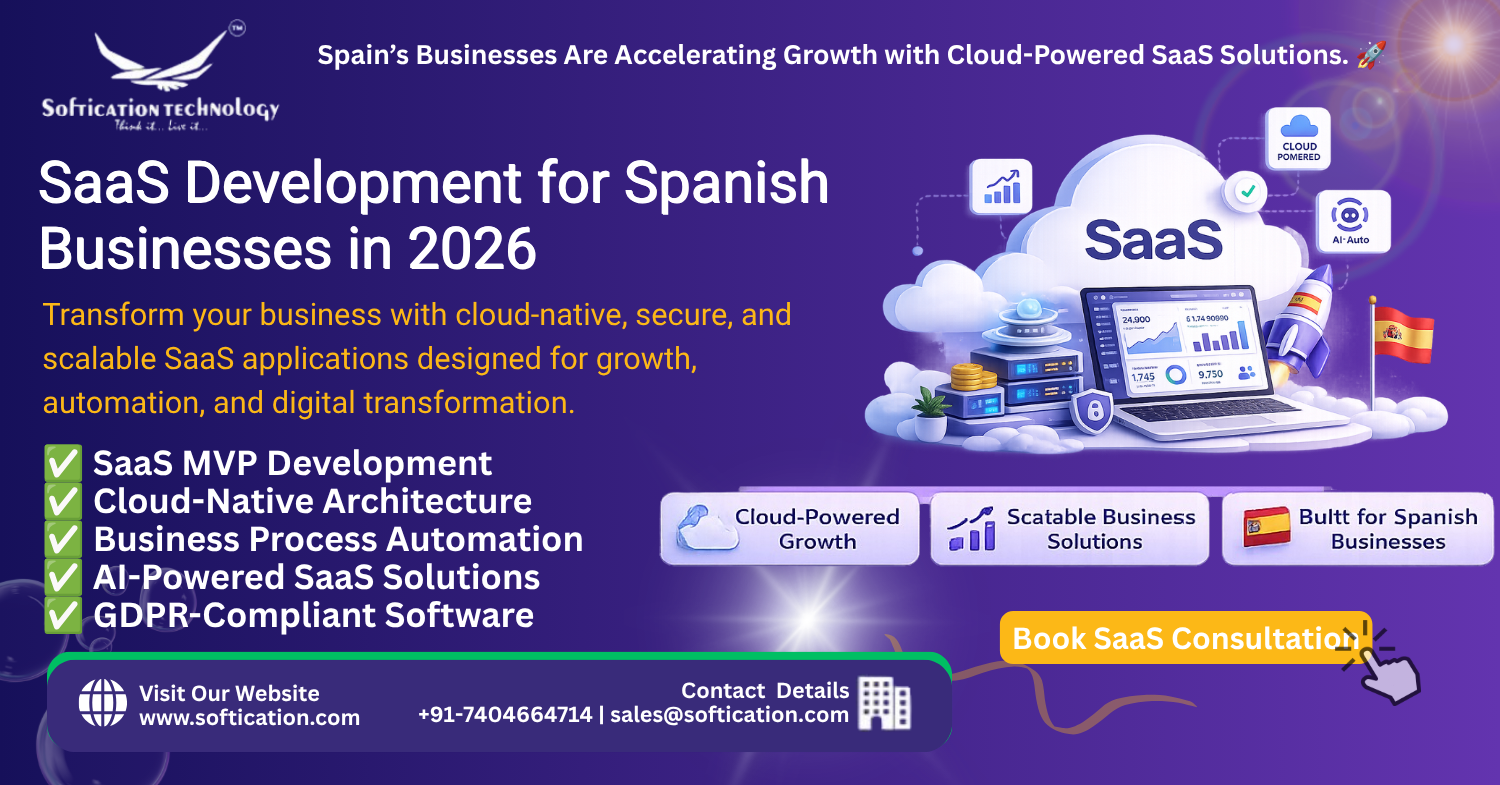
Spain is rapidly becoming one of Europe’s fastest-growing digital economies. From startups and SMEs to large enterprises, businesses across Spain are investing heavily in SaaS (Software as a Service) solutions to improve efficiency, reduce operational costs, and accelerate digital transformation.
In 2026, cloud-based software is no longer a competitive advantage—it's a business necessity. Companies are adopting SaaS platforms for customer management, operations, analytics, automation, collaboration, and business growth.
Whether you're a startup in Madrid, an e-commerce company in Barcelona, or a growing enterprise expanding across Europe, investing in the right SaaS solution can significantly improve scalability and profitability.
In this guide, we'll explore SaaS development for Spanish businesses, technology trends, development costs, cloud infrastructure, security requirements, and strategies for building successful SaaS platforms in 2026.
Why SaaS Is Growing in Spain
Spanish businesses are embracing digital transformation faster than ever before.
Several factors are driving SaaS adoption:
- Increasing cloud adoption
- Growth of remote work
- Demand for automation
- Rising digital commerce
- Expansion of AI-powered tools
- Need for scalable software solutions
SaaS platforms help businesses:
✅ Reduce infrastructure costs
✅ Improve operational efficiency
✅ Scale faster
✅ Access software from anywhere
✅ Automate repetitive tasks
As a result, SaaS development continues to be one of the most valuable technology investments for Spanish businesses.
What Is SaaS Development?
SaaS development refers to building cloud-based software applications that users access via the internet instead of installing software locally.
Popular SaaS examples include:
- CRM platforms
- ERP systems
- Project management software
- Accounting tools
- AI automation platforms
- Customer support systems
- Business analytics dashboards
SaaS solutions allow businesses to provide services through subscription-based models while maintaining scalability and recurring revenue.
Benefits of SaaS Development for Spanish Businesses
1. Lower Operational Costs
Traditional software often requires expensive hardware and maintenance.
SaaS applications eliminate many infrastructure expenses through cloud hosting.
Benefits
- Reduced hardware costs
- Lower maintenance expenses
- Simplified software updates
2. Scalability
Modern businesses need software that grows alongside their operations.
SaaS platforms can easily scale based on:
- User growth
- Data volume
- Business expansion
- Market demand
This flexibility makes SaaS ideal for growing Spanish companies.
3. Remote Accessibility
Employees can access SaaS applications from anywhere.
Advantages include:
- Remote collaboration
- Multi-location access
- Mobile compatibility
- Improved productivity
This is particularly valuable for distributed teams and modern workplaces.
4. Recurring Revenue Opportunities
For startups and software providers, SaaS creates predictable subscription-based revenue streams.
Benefits include:
✅ Monthly recurring revenue (MRR)
✅ Better financial forecasting
✅ Improved customer retention
✅ Long-term business sustainability
SaaS Trends Shaping Spain in 2026
Several trends are influencing SaaS adoption across Spain.
1. AI-Powered SaaS Platforms
Artificial Intelligence is becoming a core feature of modern SaaS applications.
Popular AI use cases include:
- Chatbots
- Predictive analytics
- Sales forecasting
- Customer support automation
- Workflow optimization
Spanish businesses are increasingly investing in AI-driven software solutions.
2. Cloud-Native SaaS Development
Cloud-native architecture improves:
- Performance
- Reliability
- Security
- Scalability
Modern SaaS products are commonly built on cloud-first infrastructures.
3. Business Process Automation
Organizations are automating repetitive workflows through SaaS tools.
Examples include:
- CRM automation
- Invoice processing
- HR management
- Customer onboarding
- Marketing automation
Automation improves productivity while reducing operational costs.
4. Data Analytics & Dashboards
Businesses need real-time insights to remain competitive.
SaaS analytics platforms help companies:
- Monitor performance
- Analyze customer behavior
- Improve decision-making
- Track KPIs
Data-driven organizations consistently outperform competitors.
Best Technology Stack for SaaS Development
Selecting the right technology stack is critical for long-term success.
Frontend Technologies
React
One of the most popular frontend frameworks for SaaS applications.
Benefits:
- Fast performance
- Scalable architecture
- Excellent user experience
Next.js
Widely used for:
- SEO optimization
- Faster loading speeds
- Better performance
Backend Technologies
Node.js
Ideal for:
- APIs
- Real-time applications
- SaaS platforms
Python
Popular for:
- AI applications
- Automation tools
- Data analytics
Laravel
Excellent for:
- Business applications
- CRM platforms
- Custom SaaS systems
Cloud Infrastructure for SaaS
Reliable cloud infrastructure is essential.
Popular cloud providers include:
AWS
Advantages:
- Global infrastructure
- High availability
- Advanced security
Microsoft Azure
Popular among enterprise businesses because of:
- Strong compliance support
- Enterprise integrations
- Hybrid cloud capabilities
SaaS Development Costs in Spain
Development costs depend on project complexity and requirements.
SaaS MVP Development
Typical MVP features include:
- Authentication
- User management
- Dashboard
- Subscription billing
Estimated Cost
€10,000 – €40,000
Mid-Level SaaS Platform
Includes:
- Analytics
- API integrations
- Automation features
Estimated Cost
€40,000 – €100,000
Enterprise SaaS Solutions
Advanced systems may include:
- AI capabilities
- ERP integrations
- Multi-tenant architecture
- Enterprise security
Estimated Cost
€100,000 – €300,000+
Security & GDPR Compliance
Spanish businesses operating within Europe must comply with GDPR regulations.
Important security measures include:
✅ Data encryption
✅ Secure authentication
✅ Access controls
✅ Audit logging
✅ Backup systems
✅ User consent management
GDPR compliance is essential for maintaining customer trust and avoiding legal risks.
Common SaaS Use Cases in Spain
Spanish businesses commonly invest in SaaS solutions for:
Customer Relationship Management (CRM)
Manage customer interactions and sales pipelines.
ERP Systems
Streamline operations and resource management.
E-Commerce Platforms
Support online retail growth.
AI Automation
Improve productivity through intelligent workflows.
Analytics Platforms
Enable data-driven business decisions.
Challenges in SaaS Development
Businesses may encounter challenges such as:
- Choosing the right architecture
- Managing development budgets
- Ensuring GDPR compliance
- Scaling infrastructure
- Maintaining application security
Working with experienced SaaS development partners can significantly reduce these risks.
Why Businesses Choose Custom SaaS Development
Custom SaaS solutions offer advantages over off-the-shelf software.
Benefits include:
✅ Tailored functionality
✅ Better scalability
✅ Improved security
✅ Competitive differentiation
✅ Full ownership of the product
Custom software aligns perfectly with business requirements and growth plans.
Future of SaaS Development in Spain
The SaaS industry in Spain is expected to continue growing rapidly beyond 2026.
Key growth drivers include:
- AI adoption
- Cloud computing
- Business automation
- Digital transformation
- Enterprise software modernization
Businesses investing in scalable SaaS platforms today will be better positioned for long-term growth and innovation.
Final Thoughts
SaaS development is transforming how Spanish businesses operate in 2026.
From startups and SMEs to large enterprises, organizations are using cloud-based software to automate processes, improve customer experiences, reduce costs, and scale more efficiently.
By choosing the right technology stack, cloud infrastructure, and development strategy, Spanish businesses can build future-ready SaaS platforms capable of supporting long-term growth.
Investing in custom SaaS development today creates a strong foundation for tomorrow’s digital economy.
Frequently Asked Questions (FAQs)
What is SaaS development?
SaaS development involves building cloud-based software applications that users access through the internet on a subscription basis.
Why are Spanish businesses investing in SaaS?
SaaS offers scalability, automation, lower operational costs, and improved business efficiency.
How much does SaaS development cost in Spain?
Costs typically range from €10,000 for MVPs to €300,000+ for enterprise-grade SaaS platforms.
Which technologies are best for SaaS development?
React, Next.js, Node.js, Python, Laravel, AWS, and Azure are among the most popular choices.
Is GDPR compliance important for SaaS applications?
Yes. Any SaaS platform serving European customers must comply with GDPR requirements.
Talk To SaaS Development Experts
Looking to build a powerful SaaS solution for your business?
SoftiCation helps businesses with:
✅ SaaS MVP Development
✅ Cloud-Native Applications
✅ React & Next.js Development
✅ AWS & Azure Solutions
✅ GDPR-Compliant SaaS Platforms
✅ AI-Powered Software Development
🚀 Talk To SaaS Development Experts Today
📞 +91-7404664714
🌐 www.softication.com
✉️ sales@softication.com
Build scalable, secure, and future-ready SaaS solutions designed for business growth.