
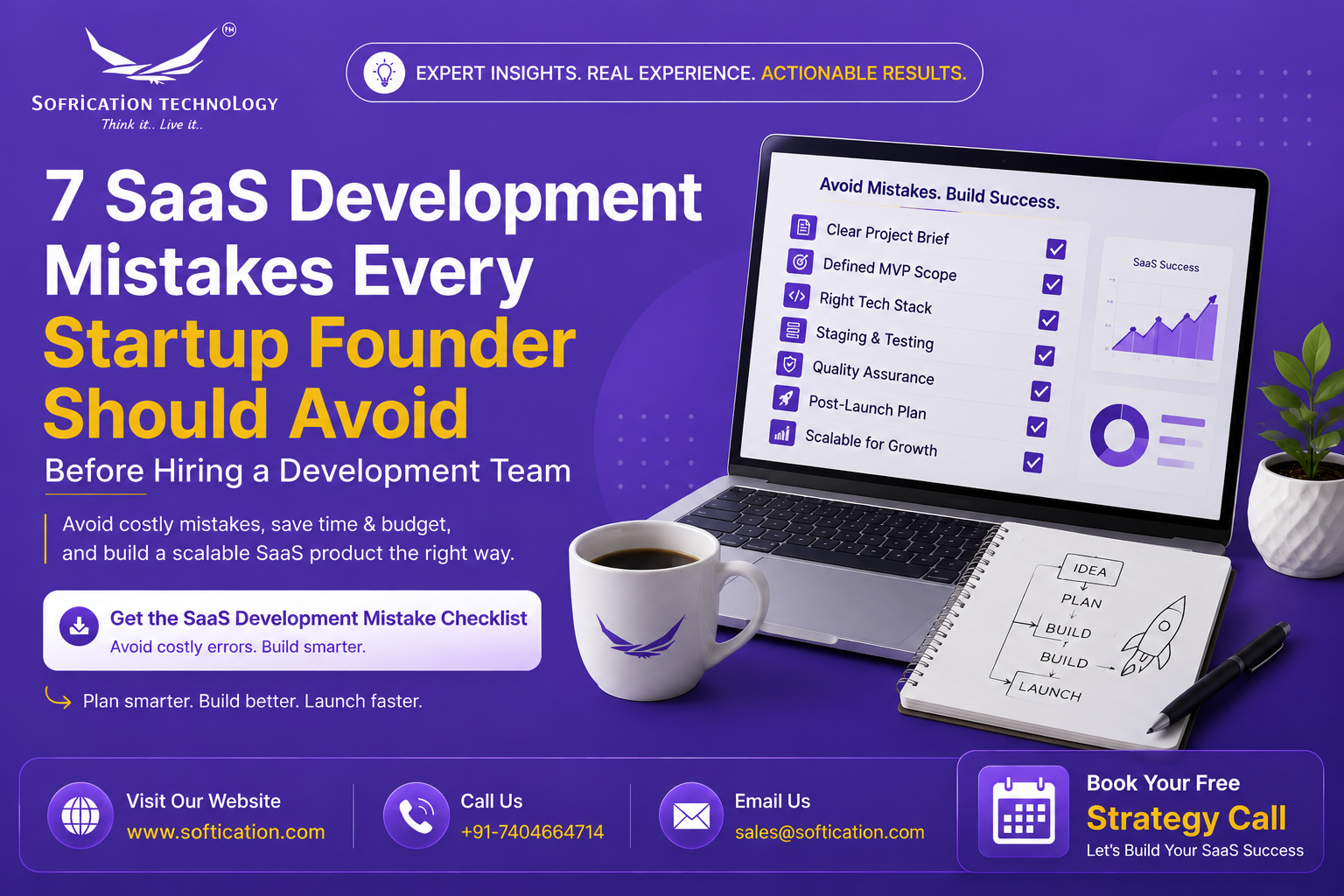
After 50+ SaaS projects, we've seen the same 7 mistakes costing founders 3–6 months of extra time and $30,000+ in wasted budget. Most of them happen before the first line of code is written.
The pattern is almost always the same. A founder has a great idea, a rough sketch of what they want, and a deadline they've already told investors or customers about. They jump on a call with a dev team, get excited, sign a contract, and start building. Six months later, they're over budget, behind schedule, and the product still doesn't do what they originally imagined.
None of that happens because the developers were bad at writing code. It happens because of decisions made before anyone opened an IDE. Here's what we see over and over — and how to avoid it.
Mistake 1: No Tech Brief Before the First Call
Founders often walk into their first conversation with a dev team armed with nothing more than a verbal pitch. "It's like Uber, but for X" is not a technical brief — it's a tagline.
Without a brief, the dev team is forced to guess at scope, and guesses always default to either overbuilding (wasting your budget) or underbuilding (missing what you actually need). Every assumption made on that first call becomes a costly correction three weeks later.
A basic tech brief should include:
- The core user flow (what does someone do, step by step, in your product)
- Must-have features vs. nice-to-have features, clearly separated
- Any existing systems it needs to integrate with (payment processors, CRMs, APIs)
- Rough target launch date and any hard external deadlines
- Platforms required (web, iOS, Android, or all three)
You don't need to be technical to write this. You need to be specific. "Users can upload a video, our system compresses it, and they get a shareable link" is a brief. "Users share videos" is not.
Mistake 2: Scope Creep Starts on Day 1
Scope creep has a reputation for happening slowly, over time, as a project drags on. In reality, we see it start in week one — usually because scope was never locked down to begin with.
Here's the trap: founders (rightly) want to stay creative and responsive to new ideas. But "we might want to add X later" without a clear process for evaluating that request turns into "let's just add it now" turns into a product that's twice the size of what was quoted, for the same price and timeline.
The fix isn't to kill creativity — it's to separate it from execution:
- Lock a defined MVP scope in writing before development starts
- Create a simple "change request" process: new ideas go into a backlog, get scoped and quoted separately, and get prioritized for a v1.1 release
- Review the backlog every 2 weeks instead of injecting changes mid-sprint
This keeps founders free to keep having ideas — which they should — without derailing the timeline they already committed to.
Mistake 3: Choosing on Price, Not Value — The $8,000 Mistake We See Monthly
Every month, we talk to a founder who went with the cheapest quote, and every month, we hear some version of the same story: the code was unmaintainable, half the features didn't actually work, and they had to pay a second team $8,000–$15,000 just to fix what the first team built before any new work could even start.
A low quote isn't a good deal if it doesn't include:
- Code that follows standard architecture and naming conventions (so any future developer can pick it up)
- Basic documentation
- Testing, not just "it worked when I clicked through it once"
- A team that will still exist and answer emails in six months
Price should be one input in the decision, not the deciding one. The cheapest quote and the most expensive quote are both red flags — the sweet spot is a team that can clearly explain why their price is what it is, tied to specific deliverables.
Mistake 4: No Staging Environment — Why 40% of Launches Break in Production
We see this constantly: a team builds directly against the live production environment because "it's faster" or "we'll set up staging later." Then launch day arrives, something breaks that nobody tested for, and the founder is debugging a live product in front of their first paying customers.
A staging environment is a separate, production-like copy of your app where new code gets tested before it ever reaches real users. It's not optional infrastructure — it's the difference between finding a bug on a Tuesday afternoon internally, or finding it on launch day in a support ticket.
At minimum, insist on:
- A staging environment that mirrors production (same database structure, same third-party integrations)
- A checklist that every feature runs through in staging before deployment
- Automated or manual smoke tests before every release, not just the final one
This single practice alone eliminates a huge share of the "why is nothing working" panic we see around launch dates.
Mistakes 5, 6, 7: No Post-Launch Plan, Wrong Contract Type, Skipping QA
Mistake 5 — No post-launch plan. Founders plan obsessively for launch day and then have no plan for day two. Who fixes bugs that show up with real users? Who owns the server if something goes down at 2am? Get this in writing before launch, not after something breaks.
Mistake 6 — Wrong contract type. Fixed-price contracts sound safe but incentivize teams to cut corners once they've spent their budgeted hours. Time-and-materials contracts sound risky but, paired with the scope-locking process from Mistake 2, actually give you more control and better quality. Match the contract type to your project's certainty level — a well-defined MVP can work fixed-price; anything exploratory should be time-and-materials with clear milestones.
Mistake 7 — Skipping QA. QA is the first thing cut when a project runs behind schedule, and it's the most expensive corner to cut. A bug caught in QA costs minutes to fix. The same bug found by a customer costs you the customer, a support ticket, an engineering fire drill, and often a public complaint. Budget for QA from the start — it should never be the thing that gets sacrificed to hit a date.
FAQs: SaaS Development Mistakes to Avoid
1. What's the most common mistake founders make before hiring a dev team? Not writing a tech brief. Founders often describe their product idea verbally on a first call instead of documenting core user flows, must-have features, integrations, and deadlines in writing. Without this, the dev team is left guessing at scope — and every guess costs time and money to correct later.
2. How do I avoid scope creep without killing new ideas? Lock your MVP scope in writing before development starts, then create a simple change-request process. New ideas go into a backlog, get scoped and quoted separately, and are reviewed every two weeks — instead of being added mid-sprint. This keeps you free to innovate without derailing your timeline or budget.
3. Should I hire the cheapest dev team I can find? No. A low price that doesn't include maintainable code, documentation, and real testing usually ends up costing more — we regularly see founders pay $8,000–$15,000 to a second team just to fix what the cheapest team built. Compare quotes based on what's included, not just the number.
4. What are common hiring offshore dev team mistakes? The biggest ones are choosing purely on hourly rate, skipping a written tech brief because of time-zone or communication gaps, not agreeing on a staging/QA process upfront, and picking a fixed-price contract for work that's still exploratory. Offshore teams can deliver excellent results — the mistakes are the same ones that hurt any dev engagement, just easier to overlook across time zones.
5. Why do so many SaaS launches break in production? Roughly 40% of the launch issues we see trace back to skipping a staging environment. Without a production-like environment to test in first, bugs get discovered by real users instead of your team — often during the worst possible moment, launch day itself.
6. Fixed-price or time-and-materials contract — which is better? It depends on how well-defined your project is. A tightly scoped MVP can work well as fixed-price. Anything more exploratory should be time-and-materials with clear milestones, paired with a locked-scope process — this actually gives founders more control and better quality than a fixed-price deal that incentivizes cutting corners.
7. What should a post-launch support plan include? At minimum: who fixes bugs reported by real users, who's on call if something goes down outside business hours, and what the response-time expectations are. This should be agreed upon and in writing before launch day, not figured out reactively after something breaks.
The Pattern Behind All 7 Mistakes
Look closely and every mistake on this list has the same root cause: decisions made too fast, too early, without enough specificity. A brief that's too vague. A scope that's never locked. A price picked without asking what it includes. A staging step skipped to save a week. A contract chosen for how it sounds rather than how it performs. A launch with no plan for day two. QA treated as optional.
None of these mistakes require more money to avoid. They require more clarity, earlier.