
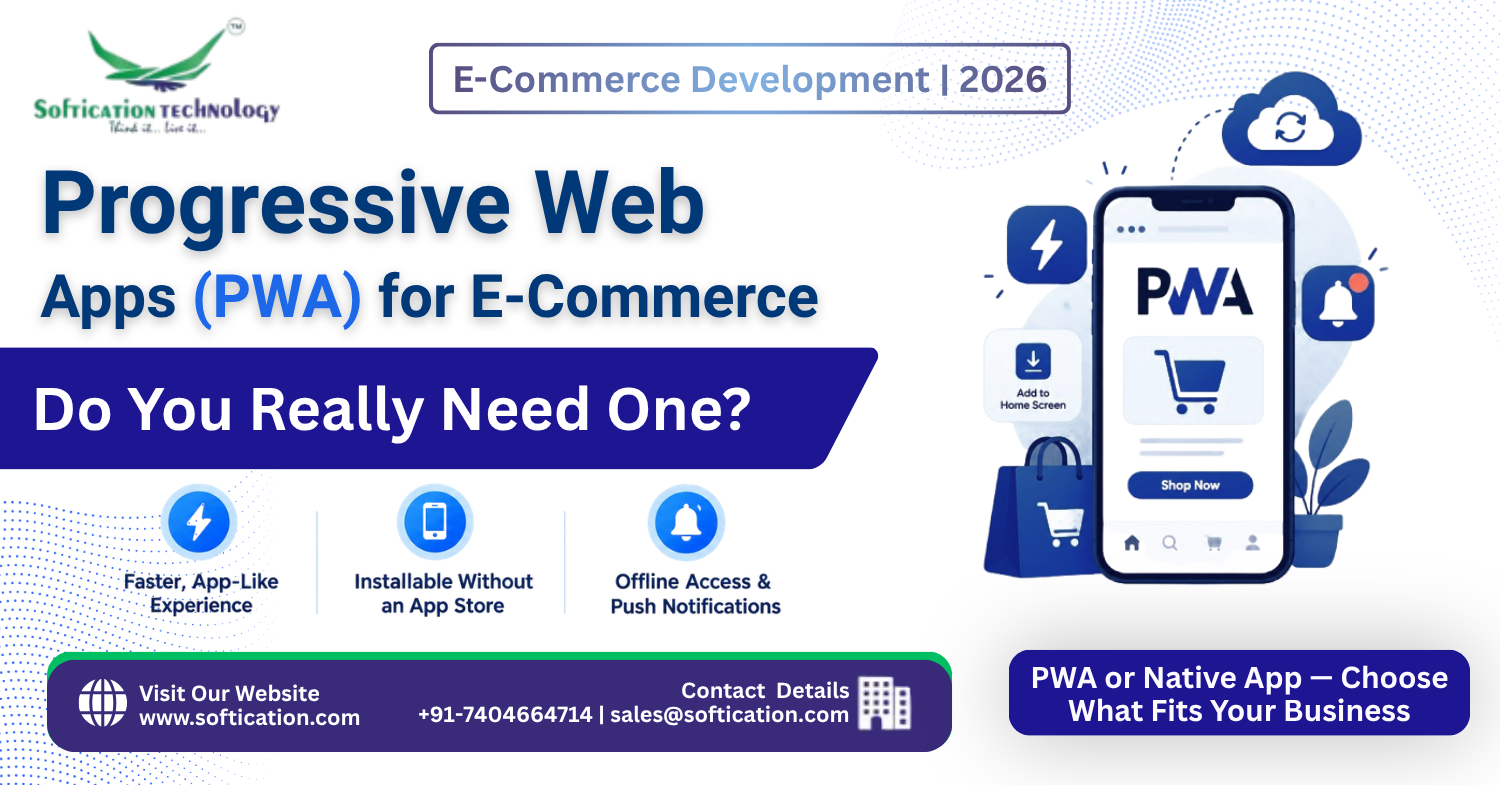
Progressive Web Apps sit in a genuinely useful middle ground between a standard website and a native mobile app — offering app-like features without app store distribution or native development costs. For some e-commerce businesses, this is exactly the right fit. For others, it's added complexity solving a problem they don't actually have. Here's how to tell which category your business falls into.
This post is part of our Web & E-Commerce Development: The Complete Technical Playbook for 2026, and builds on concepts covered in our guides on website speed and Core Web Vitals and choosing a web development tech stack, both of which are directly relevant to building a well-performing PWA.
What a PWA Actually Is
A Progressive Web App is a website built with specific web technologies that allow it to behave more like a native app — installable to a device's home screen, capable of working offline or with poor connectivity, and able to send push notifications, all without going through an app store. Technically, this is achieved through a combination of a web app manifest (defining how the app appears when installed) and a service worker (enabling offline functionality and background capabilities).
Critically, a PWA is still fundamentally a website — it's built and deployed using standard web technologies, updates instantly without requiring users to download a new version, and is discoverable through search engines the way a normal website is, unlike a native app which lives behind app store search and discovery.
What PWAs Offer E-Commerce Businesses
Installability without app store friction Customers can add your PWA to their home screen directly from the browser, without the multi-step app store download process — removing a meaningful conversion barrier compared to native app installation.
Offline and poor-connectivity resilience Service workers can cache key content and functionality, allowing at least partial browsing (and in some implementations, cart management) even when a customer's connection drops or is unreliable — genuinely useful for mobile shoppers on inconsistent networks.
Push notifications PWAs can send push notifications on supported platforms and browsers, enabling re-engagement campaigns (abandoned cart reminders, restock alerts, promotions) similar to what a native app offers, though platform support varies and is somewhat more limited than native app notification capabilities, particularly historically on iOS.
Faster perceived performance Because PWAs are built with performance-conscious techniques (caching, efficient loading strategies) as a core part of the approach, they often deliver a noticeably faster, more app-like feel than a standard, unoptimized mobile website — directly relevant to the conversion impact covered in our guide on Core Web Vitals.
Significantly lower cost than native app development Since a PWA is built on standard web technology rather than platform-specific native code, it avoids the cost of building and maintaining separate iOS and Android codebases, making it a meaningfully more accessible investment for most e-commerce businesses.
Where PWAs Fall Short of Native Apps
Limited access to device-level features PWAs have more restricted access to certain native device capabilities compared to fully native apps — while this gap has narrowed over time, particularly demanding use cases (advanced camera integration, certain hardware sensors) may still favor native development.
Platform-specific limitations, particularly historically on iOS Apple's support for PWA capabilities, including push notifications and installability, has historically lagged behind Android's, though this gap has been narrowing with recent iOS updates. It's worth verifying current platform support specifically for the features your business needs most, since this continues to evolve.
Less prominent than a native app in app store search Since PWAs aren't distributed through app stores by default, they don't benefit from app store search discovery the way native apps do — a real consideration for businesses relying partly on app store visibility for customer acquisition.
Not always the strongest choice for highly complex, feature-intensive apps For applications requiring extensive, complex native functionality — deep hardware integration, highly demanding real-time performance — native development may still offer meaningful advantages over a PWA approach.
Is a PWA Right for Your Business? A Decision Framework
Question 1: Do you have meaningful repeat mobile traffic that would benefit from app-like convenience? If a significant share of your customers are mobile visitors who return regularly, a PWA's installability and offline resilience genuinely improve that experience. If most traffic is one-time or infrequent visitors, the installability advantage matters less.
Question 2: Is your current mobile website underperforming? A PWA built with performance-conscious architecture inherently addresses many mobile performance issues. If your existing mobile experience is already fast and well-optimized, the marginal PWA-specific benefit is smaller.
Question 3: Do you need native app-store presence for discovery or credibility reasons? Some businesses specifically benefit from app store presence — competitive category norms, customer expectations, or discovery through app store search. If this matters to your business, a PWA alone won't address it, since it isn't distributed through app stores by default.
Question 4: What's your budget and timeline relative to a full native app? A PWA is a meaningfully lower-cost, faster path to app-like functionality than native development. If budget or timeline constraints make native app development impractical right now, a PWA is a reasonable way to capture much of the value at a fraction of the investment.
Question 5: Do you need deep device-level integration (advanced camera features, certain hardware sensors, highly demanding background processing)? If yes, native development may still be necessary regardless of PWA capabilities, since some device-level access remains more mature and reliable in a fully native context.
PWA vs. Native App: A Practical Comparison
| Factor | Progressive Web App | Native App |
|---|---|---|
| Development cost | Lower — single codebase, standard web technology | Higher — often separate iOS/Android development |
| Distribution | Direct install from browser, no app store required | Requires app store submission and approval |
| Updates | Instant, no user action required | Requires user to download updates |
| Device feature access | Good, but more limited than native | Full access to device capabilities |
| Discoverability | Through search engines, like a normal website | Through app store search and browsing |
| Best for | Most e-commerce businesses wanting app-like experience without full native investment | Businesses needing deep device integration or strong app-store presence |
The Bottom Line
A PWA is a genuinely strong fit for the majority of e-commerce businesses considering a step up from a standard mobile website but not yet ready to commit to full native app development — offering meaningful improvements in installability, offline resilience, and perceived performance at a fraction of native development cost. It's not the right fit for businesses specifically needing deep device integration or strong app-store discovery, where native development still holds real advantages. For most growing e-commerce businesses evaluating this decision, starting with a well-built PWA, and revisiting native app investment only once a clear, demonstrated need emerges, is the lower-risk path. For the broader technical context this decision fits within, see our complete web and e-commerce development playbook for 2026.
FAQ: Progressive Web Apps for E-Commerce
What is a Progressive Web App (PWA) in simple terms? A PWA is a website built with specific web technologies that make it behave more like a native app — installable to a home screen, capable of working offline, and able to send push notifications — while remaining fundamentally a website, discoverable through search engines and updated instantly without app store downloads.
Is a PWA cheaper than building a native mobile app? Yes, significantly. A PWA uses a single codebase built on standard web technology, avoiding the cost of separate native iOS and Android development, making it a meaningfully more accessible investment for most e-commerce businesses.
Do PWAs work on iPhones? Yes, though Apple's support for certain PWA capabilities, including push notifications and installability, has historically lagged behind Android's. This gap has narrowed with recent iOS updates, but it's worth verifying current platform support for the specific features your business needs.
Can a PWA replace a native app entirely? For most e-commerce businesses, yes — a well-built PWA captures the majority of the practical benefit of app-like functionality. Businesses with specific needs for deep device integration or strong app-store discovery may still find native development worthwhile.
Does a PWA improve website performance? Generally, yes. PWAs are built with performance-conscious techniques like caching as a core part of the approach, often delivering a noticeably faster, more app-like experience than a standard, unoptimized mobile website.