
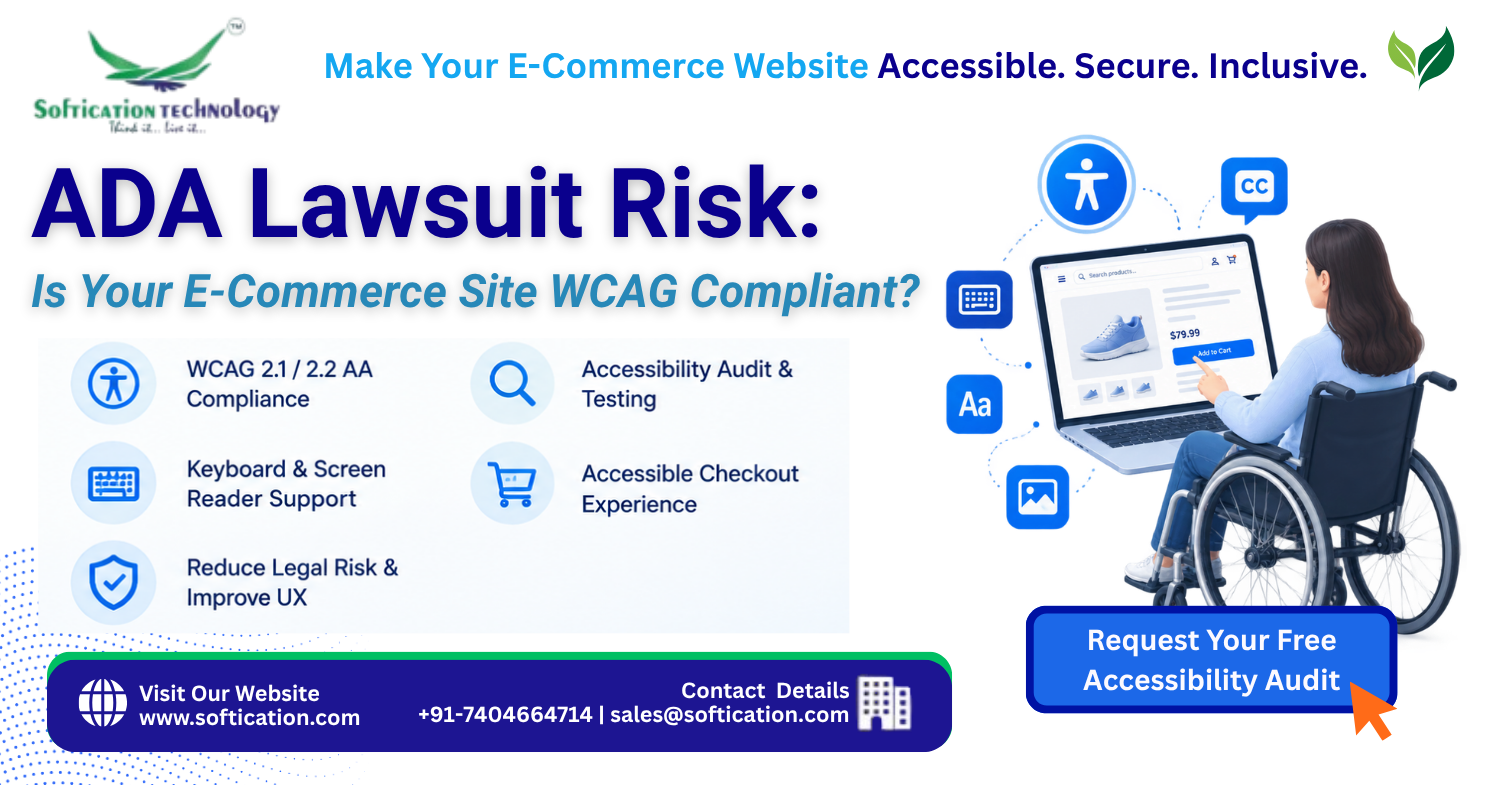
Website accessibility lawsuits have become one of the fastest-growing categories of legal action against e-commerce businesses in the United States. Thousands of companies — from small stores to major retailers — get hit with demand letters or lawsuits every year, often without ever having gotten a warning first.
If your site isn't built with accessibility in mind, you're carrying legal risk you may not even know exists — and losing a meaningful segment of potential customers in the process. Here's what's actually at stake, and what compliance looks like in practice.
The Problem: Most E-Commerce Sites Aren't Built for Every User
Web accessibility means a site can be used by people with disabilities — including those using screen readers, keyboard-only navigation, or assistive technology for visual, motor, or cognitive impairments. Most e-commerce sites, built without this in mind, fail in common and predictable ways:
- Images without alt text, making product photos meaningless to screen reader users
- Low color contrast between text and background, making content difficult to read for users with visual impairments
- Forms and checkout flows that don't work with keyboard-only navigation, locking out users who can't use a mouse
- Missing or incorrect ARIA labels, so screen readers can't properly announce buttons, menus, or form fields
- Videos without captions or transcripts, excluding users who are deaf or hard of hearing
- Inconsistent heading structure, making it difficult for assistive technology to help users navigate the page logically
- Time-limited interactions (like session timeouts) with no way to extend them, creating barriers for users who need more time
These issues are rarely intentional — they're simply what happens by default when accessibility isn't a specific part of the design and development process.
The Business Consequence: Legal Risk and Lost Customers, Not Just a Compliance Checkbox
Accessibility gaps have consequences on two fronts — legal exposure and lost revenue.
ADA lawsuit exposure. In the U.S., the Americans with Disabilities Act has been interpreted by courts to apply to websites, and e-commerce businesses are a frequent target for accessibility lawsuits and demand letters, often filed with little to no prior warning.
Settlement and legal costs. Even when lawsuits don't proceed to trial, responding to a demand letter or settling a claim typically involves legal fees and settlement costs that far exceed what proactive compliance would have cost.
Repeat litigation risk. Businesses that fix the specific issue named in one complaint without a broader compliance review often get targeted again for a different accessibility gap on the same site.
Excluded customers. A meaningful share of the population has some form of disability that affects how they use the web. An inaccessible site doesn't just create legal risk — it actively turns away paying customers who simply can't complete a purchase.
Brand and reputation impact. Accessibility lawsuits are public record, and being named in one can affect brand perception well beyond the direct legal cost.
Accessibility isn't just a "nice to have" from a legal or ethical standpoint — it's a business risk with a clear, quantifiable downside.
The Solution: WCAG-Based Accessibility Compliance
The Web Content Accessibility Guidelines (WCAG) are the internationally recognized standard for web accessibility, and they're the benchmark most ADA-related legal claims and settlements reference. Getting genuinely compliant involves:
- A full accessibility audit against WCAG 2.1 or 2.2 AA standards — the level most commonly required in legal settlements
- Remediation of identified issues — alt text, color contrast, keyboard navigation, ARIA labeling, and form accessibility fixes
- Accessible checkout and forms so users relying on assistive technology can complete a purchase without barriers
- Caption and transcript support for video and audio content
- Ongoing accessibility testing built into future development, so new features don't reintroduce old problems
- An accessibility statement published on the site, showing a documented, good-faith compliance effort
Compliance isn't a one-time fix — it's an ongoing practice, since new pages, features, and content can reintroduce accessibility gaps if they're not tested along the way.
SoftiCation's Capability: We Audit, Fix, and Maintain Genuine Accessibility Compliance
At SoftiCation, we approach accessibility as both a compliance requirement and a real usability improvement — not a checkbox exercise. Our capability includes:
- WCAG 2.1/2.2 AA compliance audits — using both automated scanning tools and manual testing with assistive technology to catch what automated tools miss
- Full remediation development — fixing identified issues across navigation, forms, media, and content structure
- Accessible checkout flow redesign — ensuring the entire purchase journey works with screen readers and keyboard-only navigation
- Developer training and process integration — helping your team build accessibility into future updates, not just fix the current site
- Ongoing monitoring — periodic re-audits to catch new issues introduced by site updates or new content
- Documentation and accessibility statements — providing the documentation that demonstrates a genuine, ongoing compliance effort
We aim to reduce your legal exposure while genuinely improving the experience for every visitor to your site.
Proof: What This Looks Like in Practice
Consider a mid-sized online retailer that received a demand letter citing accessibility violations under the ADA — specifically, inaccessible checkout forms and missing alt text across product images. Beyond the immediate legal concern, an internal review revealed the issues extended well beyond what the letter specifically named, including poor color contrast on key call-to-action buttons and a checkout flow that couldn't be completed using keyboard navigation alone.
A full WCAG 2.1 AA audit was conducted covering the entire site, not just the pages referenced in the complaint. Remediation focused first on the checkout flow, rebuilding form fields and navigation to work correctly with screen readers and keyboard-only input, followed by systematic fixes across product pages — adding proper alt text, correcting contrast ratios, and fixing heading structure for consistent screen reader navigation.
The retailer resolved the existing legal matter with documented evidence of a genuine remediation effort, and ongoing periodic audits were put in place to catch accessibility issues introduced by future site updates before they became a legal liability. Beyond resolving the immediate risk, the business reported that customers using assistive technology were now able to complete purchases that had previously been impossible on the site.
This reflects the real value of a proper accessibility program: it isn't only about avoiding legal risk, it's about removing barriers that were quietly turning away paying customers all along.
Is Your Site Exposed to Accessibility Risk?
Waiting for a demand letter is the most expensive way to discover an accessibility gap. A proactive audit costs a fraction of what a legal settlement typically does — and it opens your store to customers who currently can't use it.
Request a Free Accessibility Audit and find out exactly where your site stands against WCAG standards, and what it would take to close the gaps.