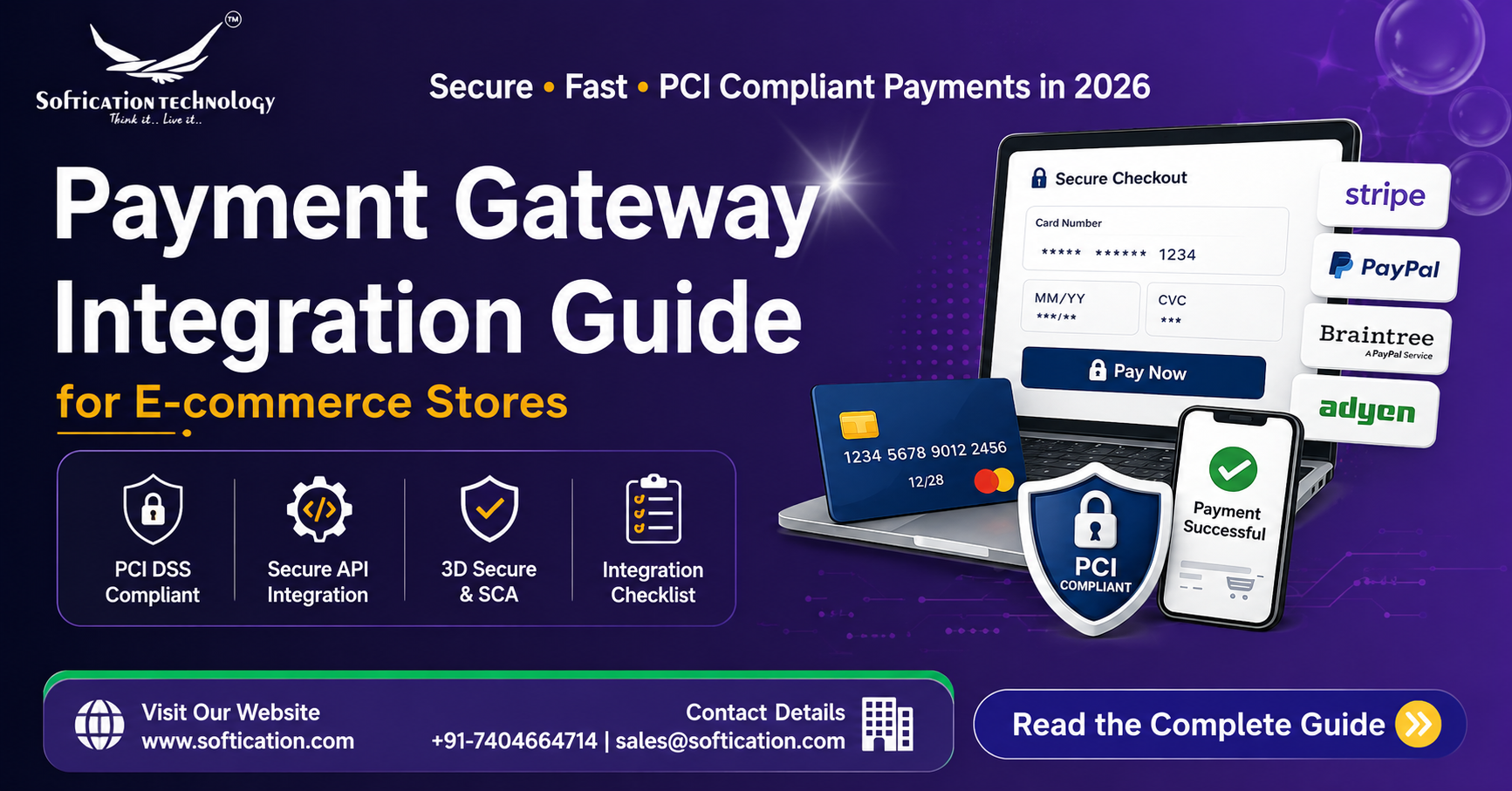
Payment processing is the one part of an e-commerce store where mistakes have immediate, tangible consequences — a broken integration means lost sales, and a poorly secured one means real compliance and fraud risk. This guide walks through how payment gateways actually work, how to choose between the major options, and what a proper integration involves in 2026.
For a broader look at how payment integration fits into overall store development cost and timeline, see our guides on e-commerce development cost in 2026 and how long e-commerce development takes — this guide focuses specifically on the payment layer itself.
How Payment Gateways Actually Work
A payment gateway is the technology layer that securely transmits payment information between your store, the customer's bank, and your business's bank, authorizing (or declining) the transaction in real time. It's distinct from a payment processor, though the two terms get used interchangeably — the gateway handles the secure transmission and authorization request, while the processor handles the actual movement of funds between banks. Many providers today, like Stripe and Square, combine both functions into a single integrated service.
The basic flow of a transaction:
- Customer enters payment details at checkout
- The gateway encrypts this data and sends an authorization request to the customer's card network and issuing bank
- The bank approves or declines based on available funds, fraud checks, and account status
- The gateway relays that response back to your store in real time
- If approved, funds are later settled into your merchant account, typically within 1–3 business days depending on the provider
Choosing a Payment Gateway: The Major Options
Stripe Widely used for its clean API, strong documentation, and broad feature set — subscription billing, marketplace payment splitting (Stripe Connect), and support for a wide range of payment methods including Apple Pay, Google Pay, and buy-now-pay-later options. A strong default choice for most standard and custom e-commerce builds.
PayPal Offers high customer trust and recognition, particularly valuable for stores where checkout conversion benefits from a familiar, established brand. Slightly less flexible for complex custom integrations compared to Stripe, but remains one of the most widely used payment options for consumer trust reasons alone.
Braintree (owned by PayPal) A strong middle ground offering both PayPal and card processing through a more developer-friendly API than PayPal's standalone integration, often used by businesses wanting PayPal's trust factor with more integration flexibility.
Adyen Common among larger, multi-region businesses due to strong international payment method support and unified reporting across markets — generally more relevant for enterprise-scale stores than small-to-mid-sized businesses.
Platform-native options (Shopify Payments, WooCommerce Payments) For businesses on Shopify or WooCommerce, using the platform's native payment processing often simplifies setup and can reduce transaction fees compared to connecting a third-party gateway, though it ties you more closely to that specific platform.
Key Factors When Choosing a Gateway
- Transaction fees — typically 2.5–3.5% plus a small fixed fee per transaction, though rates vary by provider, volume, and negotiated terms at scale
- Supported payment methods — cards, digital wallets, buy-now-pay-later, and bank transfers each have different levels of support across providers
- International support — multi-currency processing and region-specific payment methods (iDEAL in the Netherlands, for example) matter significantly for businesses selling across multiple countries
- Integration complexity — some providers offer simple, largely pre-built checkout embeds, while others offer more customizable but more development-intensive integration paths
- Payout timing — how quickly funds settle into your business account, which can matter meaningfully for cash flow, especially for newer businesses
PCI Compliance: What Every Store Needs to Know
Any business accepting card payments needs to comply with PCI DSS (Payment Card Industry Data Security Standard), which governs how card data is handled, transmitted, and stored. The good news for most businesses: using a hosted checkout or embedded payment form from a major provider (Stripe Elements, PayPal Checkout) shifts most of the compliance burden onto the provider, since sensitive card data never actually touches your own servers.
Building a fully custom checkout form that directly handles raw card data significantly increases your own PCI compliance scope and is generally not recommended unless there's a specific, well-justified business reason for it. For most stores, using a provider's pre-built, PCI-compliant checkout components is both the safer and the faster path to a compliant integration. We cover this in more depth in our dedicated guide on e-commerce security and PCI compliance.
Common Integration Mistakes to Avoid
Not testing every payment method in the sandbox environment before launch Each supported payment method (cards, digital wallets, buy-now-pay-later) should be tested individually in the provider's sandbox environment, since a working card integration doesn't guarantee a working Apple Pay integration.
Ignoring webhook reliability Payment gateways use webhooks to notify your system of events like successful payments, refunds, or disputes. A store that doesn't properly handle webhook failures or retries can end up with orders that are paid but not marked as such in the system — a data integrity problem that's difficult to catch without deliberate testing.
Skipping 3D Secure / Strong Customer Authentication setup Particularly relevant for stores selling into the EU and UK, where Strong Customer Authentication (SCA) requirements mean additional verification steps are often legally required for card payments. Skipping proper 3D Secure configuration can result in unexpectedly high decline rates for European customers.
Hardcoding currency or region assumptions Stores that expand internationally after launching with single-currency assumptions baked into the payment integration often face a more expensive retrofit than if multi-currency support had been considered during initial development, even if it wasn't needed immediately.
Not planning for refunds and disputes from day one Refund and chargeback handling should be built into the integration from the start, not added reactively after the first dispute arrives — this includes both the technical refund flow and the internal process for reviewing and responding to disputes.
A Practical Integration Checklist
Before launch, confirm:
- Every supported payment method has been tested end-to-end in sandbox, not just cards
- Webhook handling is in place for payment success, failure, refund, and dispute events, with retry logic for failed webhook deliveries
- 3D Secure / SCA is properly configured if selling into regions where it's required
- PCI compliance scope has been confirmed with the payment provider based on your specific integration approach
- Refund and dispute workflows are documented and functional, not just theoretically supported by the provider
- Transaction fee structure has been reviewed against expected sales volume to confirm the chosen provider remains cost-effective at scale
The Bottom Line
Payment integration is one of the highest-stakes technical decisions in e-commerce development — errors here directly cost revenue and carry real compliance exposure. Choosing a well-documented provider, using pre-built PCI-compliant checkout components rather than building custom card handling, and testing thoroughly across payment methods and regions before launch are the fundamentals that prevent the most common and most costly integration mistakes. For the broader picture of how payment integration fits into a full e-commerce build, our complete guide to e-commerce website development covers the full scope of what a store needs at launch.
FAQ: Payment Gateway Integration
What's the difference between a payment gateway and a payment processor? A payment gateway securely transmits payment data and handles authorization requests between your store and the customer's bank. A payment processor handles the actual movement of funds between banks. Many modern providers, like Stripe, combine both functions into a single integrated service.
Which payment gateway is best for a new e-commerce store? Stripe is a strong default for most stores due to its documentation, feature set, and broad payment method support. PayPal offers strong customer trust recognition, and platform-native options (Shopify Payments, WooCommerce Payments) can simplify setup for stores already built on those platforms.
Do I need to worry about PCI compliance if I use Stripe or PayPal? Using a hosted checkout or embedded payment form from a major provider significantly reduces your PCI compliance burden, since sensitive card data doesn't touch your own servers directly. Building a fully custom checkout that handles raw card data increases compliance scope substantially.
What is 3D Secure and do I need it? 3D Secure is an additional authentication step for card payments, often legally required under Strong Customer Authentication (SCA) rules for stores selling into the EU and UK. Skipping proper configuration can result in higher decline rates for customers in those regions.
How much do payment gateways typically charge in fees? Most providers charge roughly 2.5–3.5% plus a small fixed fee per transaction, though exact rates vary by provider, payment method, transaction volume, and any negotiated enterprise terms.