If a manager on your team spends part of every week building, adjusting, and re-adjusting the employee schedule by hand, that's not just an operational inconvenience — it's a recurring cost that rarely gets measured, but adds up fast.
Manual employee scheduling was manageable when teams were small and simple. As businesses grow — more employees, more shifts, more locations, more last-minute changes — manual scheduling stops being a minor task and starts becoming a genuine drain on time, money, and staff morale. Here's exactly why, and what automated employee scheduling software actually fixes.
The Problem: Manual Scheduling Doesn't Scale With Your Business
Manual scheduling — whether it's spreadsheets, whiteboards, or basic calendar tools — relies entirely on a manager's time, memory, and ability to juggle competing constraints. That works fine for a handful of employees. It breaks down predictably as complexity increases:
- Hours spent building and rebuilding schedules every week, especially when availability, time-off requests, and demand fluctuate
- Shift swaps and coverage gaps handled through group chats, texts, or phone calls, with no central system tracking who's actually confirmed
- No visibility into labor cost while building the schedule, so managers often don't realize they're over budget until payroll runs
- Double-booking and understaffing errors from manually cross-referencing availability, time-off, and skill requirements
- Last-minute call-outs creating scrambles with no fast, reliable way to find available replacement coverage
- Inconsistent scheduling across multiple locations or departments, with no standardized process managers can rely on
- Labor law and overtime rules tracked manually (or not at all), creating compliance risk alongside the operational headache
None of this is a failure of the people doing it — it's simply what happens when a fundamentally manual process is asked to handle a level of complexity it was never built for.
The Business Consequence: Manual Scheduling Has a Real, Measurable Cost
Manual scheduling isn't just a time-consuming task — it directly affects labor costs, staffing quality, and employee retention.
Wasted management hours. Every hour a manager spends manually building a schedule is an hour not spent on customer service, operations, or higher-value work — and this repeats every single week.
Overtime and labor cost overruns. Without real-time visibility into scheduled hours against budget, overtime frequently isn't caught until after payroll processes — by which point the cost is already locked in.
Understaffing and overstaffing. Manual processes are prone to human error, and the cost of getting coverage wrong cuts both ways — understaffing hurts customer experience and employee workload, while overstaffing wastes labor budget.
Employee turnover. Inconsistent, last-minute, or unfair scheduling is one of the most commonly cited frustrations among hourly and shift-based employees, and it's a direct contributor to turnover — which carries its own significant cost in hiring and training.
Compliance risk. Overtime thresholds, mandatory break rules, and predictive scheduling laws vary by region and are easy to miss when tracked manually, creating exposure to fines and legal claims.
Lost productivity from coverage gaps. When a last-minute call-out has no fast resolution process, the operational impact — reduced service quality, overworked remaining staff — extends well beyond the single shift affected.
Businesses that rely on manual scheduling often don't realize how much it's costing them, because the cost is spread across many small, hard-to-track inefficiencies rather than one obvious line item.
Curious what manual scheduling might actually be costing your business? [Get a Free Scheduling Cost Assessment →]
The Solution: Automated Employee Scheduling Software
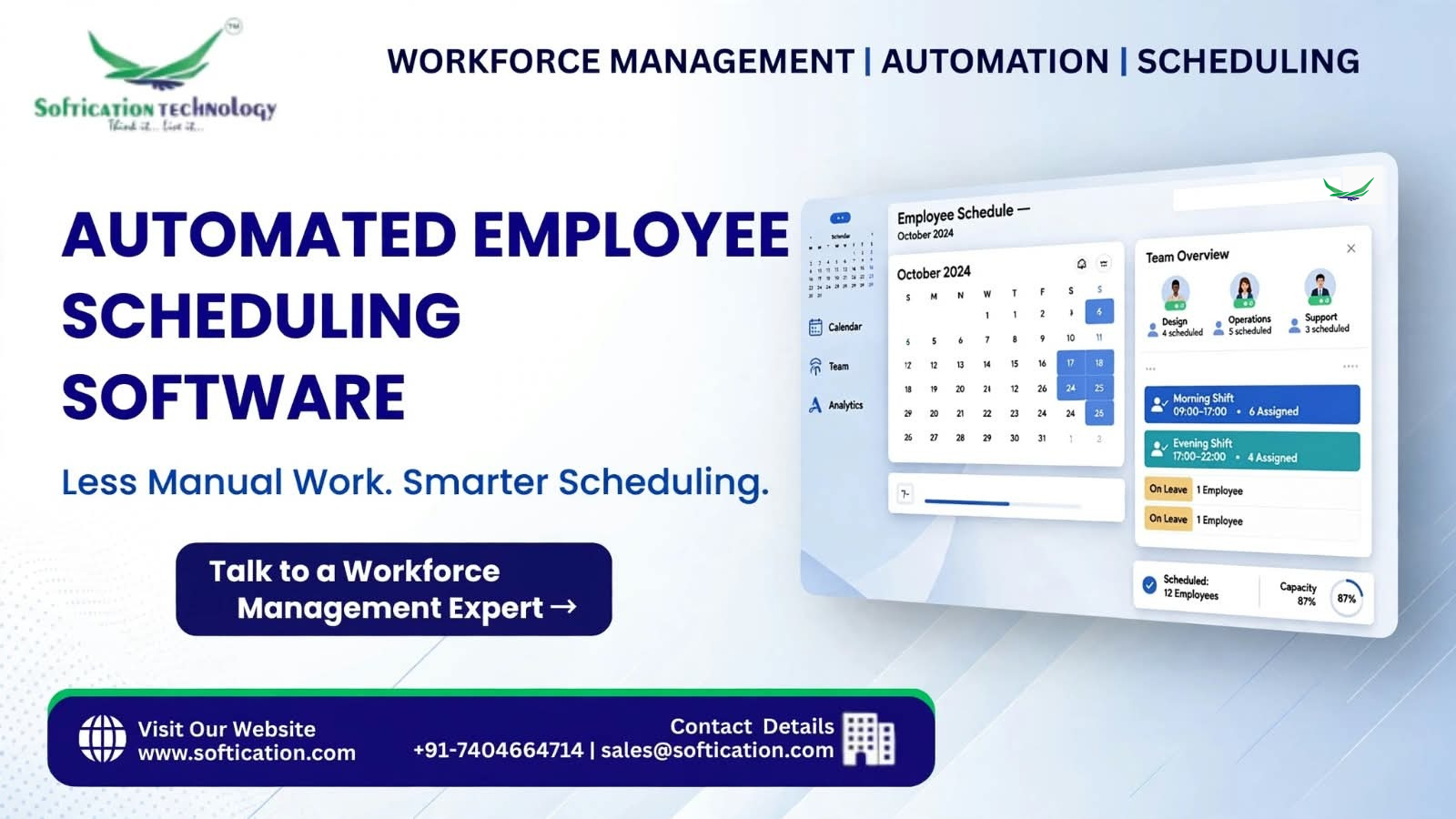
Automated scheduling software replaces manual, error-prone processes with a system that builds, adjusts, and manages schedules intelligently — based on real data, not guesswork. A proper system typically includes:
- Automated schedule generation based on employee availability, skills, labor rules, and forecasted demand
- Self-service shift swapping, where employees can trade shifts within manager-approved rules without back-and-forth messaging
- Real-time labor cost tracking, showing managers exactly what a schedule costs against budget while they're building it
- Instant notifications for schedule publishing, shift changes, and open shift alerts
- Built-in compliance rules, automatically flagging overtime risk, missed breaks, or scheduling law violations before they happen
- Open shift coverage tools, allowing available employees to claim last-minute openings instantly instead of managers making individual calls
- Multi-location and multi-role scheduling support, standardizing the process across an entire organization
- Mobile access, so employees can view schedules, request changes, and pick up shifts from anywhere
The shift from manual to automated scheduling isn't just about saving time — it's about removing the errors, blind spots, and inefficiencies that manual processes inherently create.
SoftiCation's Capability: We Build Scheduling Systems Around How Your Business Actually Runs
At SoftiCation, we don't force your business into a rigid, generic scheduling template. We build automated scheduling systems designed around your specific shift patterns, staffing rules, and operational complexity. Our capability includes:
- Custom scheduling engine development — built around your actual business rules, from simple shift patterns to complex multi-role, multi-location requirements
- Labor law and compliance rule integration — automated overtime, break, and predictive scheduling law enforcement specific to your region
- Real-time labor cost dashboards — giving managers live visibility into scheduling costs as they build and adjust shifts
- Employee self-service and mobile app development — letting employees manage availability, swaps, and shift pickups without manager bottlenecks
- Integration with time tracking and payroll systems — so scheduled hours flow directly into attendance and payroll without manual re-entry
- Multi-location scheduling architecture — standardizing scheduling processes across every site your business operates
We build the exact scheduling logic your operations need — not a generic tool you have to work around.
Want to see what a custom scheduling system would look like for your team? [Talk to a Workforce Management Specialist →]
Proof: What This Looks Like in Practice
Consider a multi-location service business where each site manager built weekly schedules manually using spreadsheets, spending several hours per week on the task alone. Shift swaps were handled through group text messages with no central tracking, which occasionally led to shifts going uncovered when a swap fell through without anyone noticing until the shift started. Payroll reported recurring, unplanned overtime that managers weren't aware of until after each pay period closed.
An automated scheduling system was built around the business's specific staffing rules, with real-time labor cost tracking visible to managers while building schedules, and automated overtime alerts flagging potential violations before shifts were published. Employees gained self-service access to request shift swaps and claim open shifts directly through a mobile app, with all changes automatically tracked and reflected in the master schedule.
Within the first few weeks, weekly time spent on manual schedule-building was reduced by the large majority of hours previously required, unplanned overtime dropped significantly due to real-time cost visibility, and uncovered shifts from failed swaps were largely eliminated since all changes were now centrally tracked and confirmed. Managers reported being able to redirect the time previously spent on scheduling toward other operational priorities.
This reflects the core value of automated scheduling: the time and cost savings aren't theoretical — they come directly from removing a manual, error-prone process and replacing it with a system that handles the complexity automatically.
Ready to stop losing hours to manual scheduling? [Get Your Free Scheduling Software Demo →]
Is Manual Scheduling Quietly Costing Your Business?
If your team is still building schedules by hand, the cost isn't always obvious — but it's there, in wasted management hours, unplanned overtime, understaffing, and employee turnover. Automated scheduling software fixes the root cause, not just the symptoms.
Get a Free Scheduling Software Consultation and find out exactly how much manual scheduling is costing your business, and what an automated system built for your operations would look like.
[Get Your Free Scheduling Consultation →]
Or reach out directly — we're happy to walk you through it. 📞 Call/WhatsApp us to discuss your scheduling challenges today.