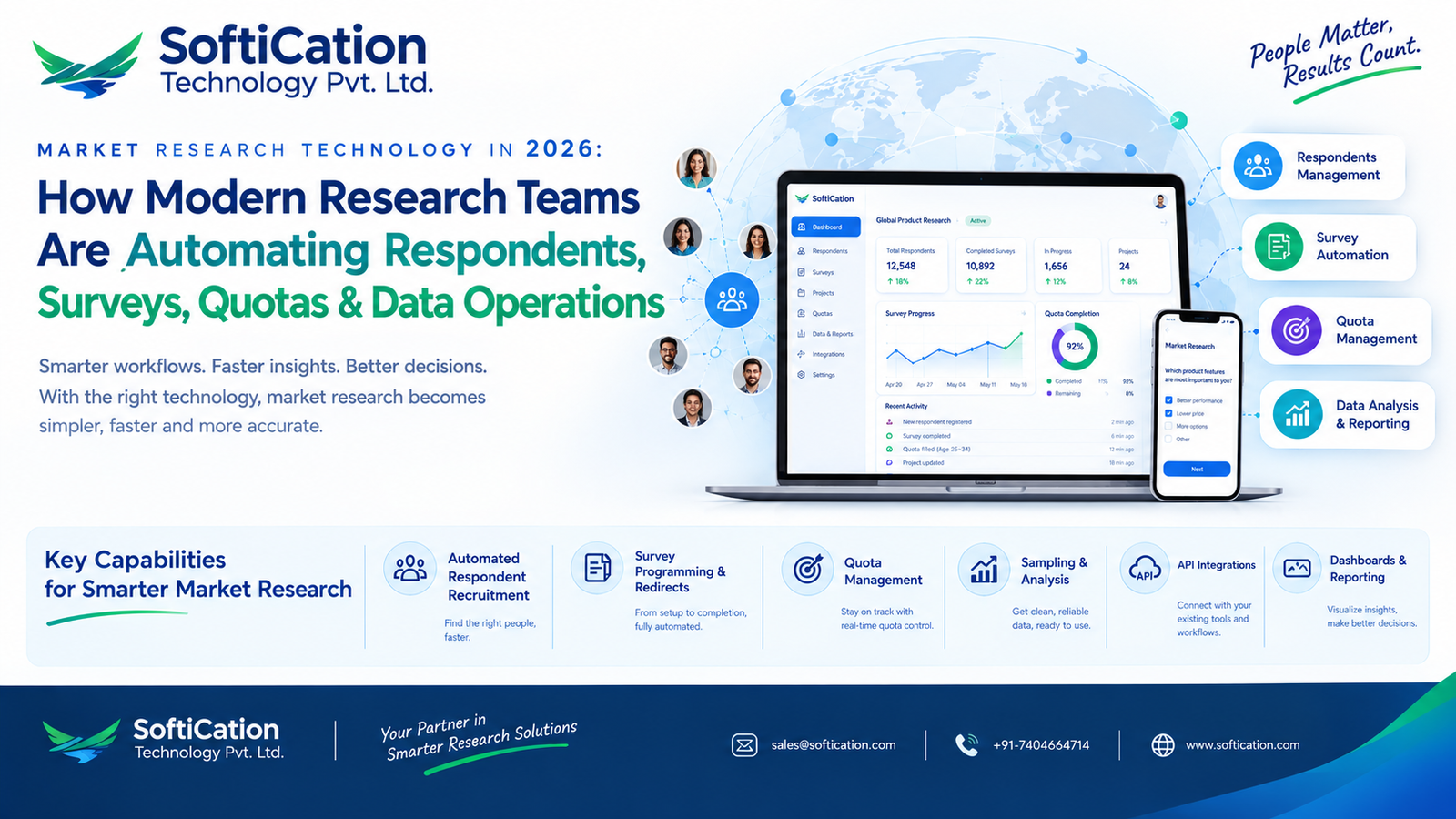
Market Research Technology in 2026: How Modern Research Teams Are Automating Respondents, Surveys, Quotas & Data Operations
Market research has always depended on good questions, reliable respondents, accurate data, and strong analysis.
But modern research operations are becoming much more complex.
A single research project may involve respondent recruitment, panel management, survey programming, screening, quotas, survey routing, redirects, vendors, APIs, data validation, reporting, and client communication—all at the same time.
When these activities are managed manually or across disconnected tools, research teams can spend more time managing operations than focusing on research itself.
This is where market research technology is becoming increasingly important.
Modern research platforms are bringing these workflows together and using automation, integrations, dashboards, and AI-assisted processes to make research operations faster, more scalable and easier to manage.
What Is Market Research Technology?
Market research technology refers to the software, platforms, tools, and integrations used to plan, execute, manage and analyze market research projects.
Depending on the organization, this can include:
- Respondent management
- Panel management
- Survey programming
- Survey routing
- Survey redirects
- Quota management
- Vendor management
- Sample management
- Research project management
- Data collection
- API integrations
- Research dashboards
- Reporting and analytics
- Quality-control workflows
- AI-assisted research operations
The objective isn't simply to replace people with software.
The objective is to remove repetitive operational work so research professionals can focus on research quality, insights, and decision-making.
Why Market Research Operations Are Becoming More Complex
Research projects today often need to support:
- Multiple countries
- Multiple languages
- Multiple respondent sources
- Complex screening criteria
- Multiple quotas
- Different vendors
- Different survey platforms
- Real-time sample monitoring
- API-based integrations
- Automated redirects
- Fraud and quality checks
- Detailed reporting
For a small number of projects, spreadsheets and disconnected tools may be sufficient.
As volume increases, however, operational complexity increases rapidly.
A research organization may have to answer questions such as
Which respondents entered the project?
Which quota is filling fastest?
Which vendor supplied the respondent?
Where should a respondent be redirected?
Which respondents completed the survey?
Which respondents should be terminated?
How many completes are still required?
Which sample source is performing best?
Without a centralized system, answering these questions can require significant manual effort.
1. Respondent Management
Respondents are at the center of most research projects.
A respondent management system can help teams manage information such as:
- Respondent profiles
- Demographics
- Recruitment source
- Panel membership
- Survey participation
- Project eligibility
- Survey status
- Completion history
- Termination status
- Incentive information
- Quality indicators
Centralizing respondent information makes it easier to understand the complete respondent journey.
Instead of maintaining information across spreadsheets, emails, and multiple systems, research teams can manage respondent activity through a structured platform.
2. Survey Programming
Survey programming is one of the most important technical components of modern research.
A research survey may include:
- Screening questions
- Skip logic
- Branching
- Display logic
- Quotas
- Randomization
- Termination rules
- Completion rules
- Multilingual content
- Custom variables
- External integrations
- Redirects
As survey complexity increases, manually managing these rules becomes difficult.
Modern survey technology allows research teams to define and manage these workflows systematically.
The goal is not simply to make surveys look better.
It is to make the logic behind the survey reliable, testable, and scalable.
3. Survey Routing and Redirects
Respondent routing is another area where automation can make a significant difference.
A respondent might need to be:
- Sent to a specific survey
- Redirected based on eligibility
- Terminated based on screening criteria
- Sent to a quota-specific destination
- Redirected after completion
- Returned to a panel provider
- Sent to an external system through an API
When these rules are managed manually, even a small configuration mistake can affect data quality or respondent flow.
A centralized routing system can make these rules easier to configure, test, and monitor.
4. Quota Management
Quotas are essential for many research projects.
For example, a study might require:
- 500 total respondents
- 250 male and 250 female respondents
- Specific age groups
- Specific geographic distribution
- Certain combinations of demographic attributes
As respondents enter the study, quota counts change continuously.
A quota management system can provide real-time visibility into:
Target → Completed → Remaining → Status
This allows research teams to identify under-filled or over-filled segments before they become operational problems.
5. Panel Management
Research organizations working with panels need to manage large volumes of respondent information.
Panel technology can support:
- Panel registration
- Respondent profiles
- Eligibility
- Survey invitations
- Participation history
- Panel segmentation
- Activity tracking
- Quality monitoring
- Sampling workflows
A well-designed panel management platform can become the operational foundation connecting respondents with research projects.
6. Vendor Management
Many research organizations work with multiple sample providers and vendors.
That introduces another layer of complexity.
Teams may need to track:
- Vendor
- Project
- Sample allocation
- Respondents supplied
- Completes
- Terminations
- Costs
- Performance
- Status
- API activity
A centralized vendor management system can provide a clearer view of supplier performance across projects.
Instead of asking:
“Can someone check the spreadsheet?”
Teams can access the information directly through the platform.
7. Research Operations Dashboards
Data is useful only when people can understand it.
Research operations dashboards can provide real-time visibility into:
- Active projects
- Respondent activity
- Quota status
- Vendor performance
- Survey progress
- Completes
- Terminations
- Sample allocation
- Project status
- Operational alerts
For managers, this can significantly reduce the need to manually consolidate information from multiple sources.
The dashboard becomes the single operational view of the research ecosystem.
8. API Integrations
Modern research platforms rarely operate in isolation.
They often need to communicate with:
- Survey platforms
- Panel providers
- Sample suppliers
- CRM systems
- Client systems
- Reporting platforms
- Payment systems
- Internal databases
APIs make these connections possible.
For example, a respondent may enter through one platform, be routed to another, complete a survey, and then have the completion information automatically returned to the originating system.
The more research operations scale, the more important reliable integrations become.
9. Automation Is Becoming a Core Capability
Automation can reduce repetitive operational work.
Examples include:
Automated respondent allocation
Automated quota updates
Automated survey routing
Automated completion redirects
Automated vendor status updates
Automated notifications
Automated data synchronization
Automated reporting
Instead of having employees repeatedly perform the same operational tasks, software can execute predefined workflows consistently.
This doesn't eliminate the need for research professionals.
It allows them to spend more time on higher-value activities.
10. Where AI Fits Into Market Research Technology
AI is also creating new opportunities.
AI can potentially assist with:
- Research planning
- Survey question suggestions
- Text classification
- Open-ended response analysis
- Data summarization
- Research reporting
- Respondent segmentation
- Anomaly detection
- Operational alerts
- Knowledge search
- Automated communication
However, AI should not be treated as a replacement for research methodology or human judgment.
The strongest implementations combine:
Human expertise + structured research workflows + automation + AI assistance.
That combination is more practical than simply adding an AI chatbot to an existing research platform.
11. Data Quality Still Comes First
Automation is useful only when the underlying process is reliable.
Research technology should therefore consider:
- Duplicate detection
- Respondent validation
- Quality checks
- Fraud indicators
- Inconsistent responses
- Speeding
- Quota accuracy
- Source tracking
- Survey logic validation
- Audit trails
A faster research operation is not necessarily a better research operation.
The goal should be
Faster operations without compromising research quality.
12. What a Modern Market Research Platform Should Connect
A mature research technology ecosystem can look something like this:
Client
↓
Research Project
↓
Sampling / Vendors
↓
Respondents / Panels
↓
Survey Programming
↓
Routing & Quotas
↓
Data Collection
↓
Quality Control
↓
Dashboard & Analytics
↓
Reporting
The value comes from connecting these processes rather than treating each one as a separate activity.
Build vs. Buy: What Should Research Organizations Consider?
Not every organization needs a completely custom platform.
The right approach depends on:
- Research volume
- Existing technology
- Workflow complexity
- Number of vendors
- Number of respondents
- Integration requirements
- Security requirements
- Reporting requirements
- Budget
- Long-term product strategy
Some organizations can use existing SaaS products.
Others have workflows that are sufficiently specialized that custom market research software development becomes more practical.
A custom platform can be designed around the organization's actual operational model rather than forcing the team to adapt to a generic workflow.
What SoftiCation Builds for Market Research Teams
At SoftiCation Technology, we work on software solutions for research operations and related business workflows.
Our capabilities include solutions around:
- Respondent management
- Panel management
- Survey programming
- Survey redirects
- Survey routing
- Quota management
- Vendor management
- Research operations
- Market research dashboards
- Sampling workflows
- API integrations
- Custom research platforms
The right solution depends on the organization's existing workflow and requirements.
For example, a research organization may need a centralized platform connecting clients, projects, vendors, respondents, surveys, quotas and reporting.
Another organization may only need a specialized respondent management or survey-routing solution.
The technology should be designed around the actual research operation.
The Future of Market Research Operations
The future of market research isn't simply about collecting more data.
It is about making the entire research operation more connected, automated, and intelligent.
Research organizations that modernize their operational infrastructure can potentially reduce repetitive work, improve visibility, scale projects more efficiently and give research teams more time to focus on insights.
The winning combination will likely be
Research expertise
Reliable technology
Automation
Integrations
Data quality
AI-assisted workflows
The important question for research organizations is therefore no longer only
“How do we collect more responses?”
It is also
“How can we build a research operation that scales without increasing operational complexity at the same rate?”
That is where modern market research technology can make a real difference.
Planning a Market Research Technology Platform?
If you're building or modernizing a platform for respondents, panels, surveys, quotas, vendors, research operations or analytics, SoftiCation can help with the product architecture, UI/UX, development, integrations, and deployment.
Have a research technology idea or existing platform that needs modernization?
Let's discuss your requirements.