
"Headless" has become one of those words that gets attached to a project as a signal of technical sophistication, regardless of whether the underlying business case actually supports it. Stripped of the buzzword status, headless commerce is a specific architectural trade-off — more flexibility and performance ceiling, in exchange for more engineering investment and ongoing maintenance responsibility. Here's how to evaluate that trade-off honestly for your own project.
This post is part of our Web & E-Commerce Development: The Complete Technical Playbook for 2026, which covers the full range of technical decisions involved in building and scaling a modern web presence.
What Headless Actually Means, Technically
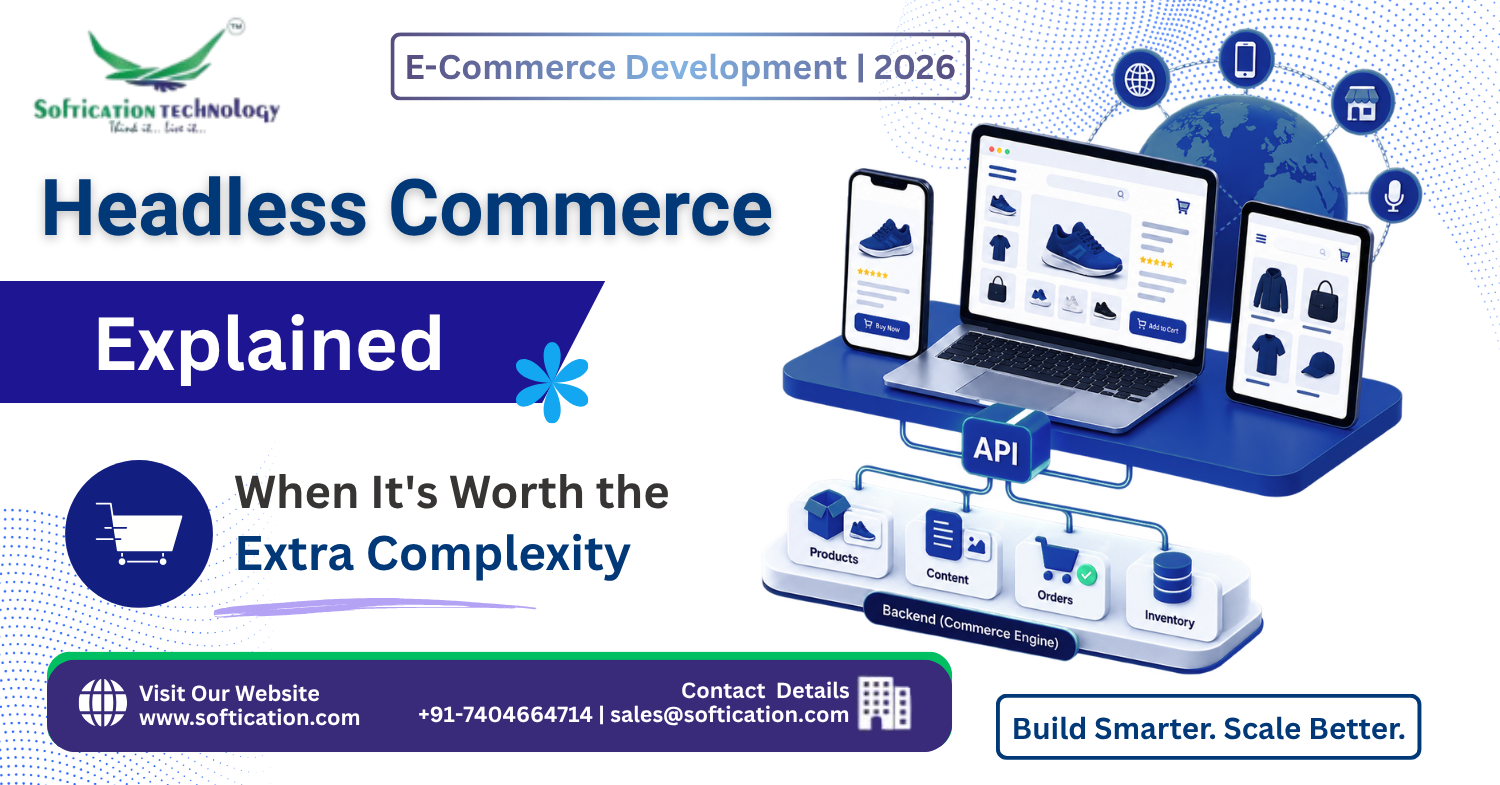
In a traditional, monolithic setup, the system that manages your content or product data also generates and serves the pages your visitors see — the frontend and backend are bundled together, typically through the platform's own templating system. Headless architecture separates these two layers: the backend continues managing data (products, content, orders, inventory), but instead of also rendering pages, it exposes that data through APIs. A separately built frontend then consumes those APIs to construct the actual user experience.
This separation is what enables headless architecture's core advantages — but it's also precisely what introduces its added complexity, since you're now building and maintaining two distinct systems connected by an API layer, rather than one integrated platform.
The Real Benefits of Going Headless
Frontend performance and flexibility beyond template constraints Because the frontend isn't built within a platform's theming system, it can be built using modern frameworks optimized specifically for speed and interaction design, often achieving meaningfully better Core Web Vitals scores than a themed, monolithic setup.
True omnichannel capability A single headless backend can power multiple distinct frontends — a website, a mobile app, in-store displays, even voice interfaces — all reading from the same underlying data, without maintaining separate, disconnected systems for each channel.
Freedom to use best-in-class tools for each layer Headless setups let you choose the best backend for data management and the best frontend framework for user experience independently, rather than being constrained to whatever combination a single platform bundles together.
Easier long-term evolution Because frontend and backend are decoupled, either layer can be substantially reworked or replaced later without necessarily requiring a full rebuild of the other — a meaningful advantage for businesses anticipating significant growth or pivots.
The Real Costs of Going Headless
Meaningfully higher initial development investment Building a custom frontend from scratch, rather than customizing an existing platform theme, requires substantially more design and engineering work upfront — this is the most immediate, unavoidable cost of the architectural choice.
Ongoing engineering maintenance burden A themed platform store can often be maintained by someone comfortable with theme settings and app configuration. A headless frontend requires ongoing frontend engineering resources — this isn't a one-time cost, it's a standing operational commitment for as long as the site exists.
Loss of platform-bundled conveniences Traditional platforms bundle functionality — one-click app installs, built-in analytics, pre-integrated marketing tools — that often need custom building or separate integration work in a headless setup.
Longer time to launch Without a pre-built theme as a starting point, headless projects generally take meaningfully longer to reach initial launch than an equivalent project built on a traditional platform.
A Practical Decision Framework
Question 1: Is your current platform's templating system an actual, demonstrated constraint — not just a general preference for something more custom? If you haven't genuinely hit a wall with what your current platform's theming or app ecosystem can deliver, headless is very likely solving a problem you don't actually have yet.
Question 2: Do you need to serve genuinely distinct frontend experiences from the same underlying data — multiple channels, multiple brands, or highly differentiated user experiences for different audiences? This is one of headless's clearest, most defensible use cases. If your need is a single, standard website or store, this advantage doesn't apply to your situation.
Question 3: Do you have (or can you realistically budget for) dedicated frontend engineering resources for the life of the project, not just the initial build? If the honest answer is no, headless architecture will likely become difficult to maintain properly after launch, regardless of how well it's built initially.
Question 4: Is the performance ceiling of your current or a standard platform setup a genuine, measured business problem — demonstrably affecting conversion or engagement — rather than a hypothetical concern? Headless's performance advantages are real, but they only matter if your current performance is genuinely constraining business outcomes, not just theoretically improvable.
If you answered "no" to most of these, a well-optimized traditional or platform-based setup is very likely the more appropriate choice — not a lesser one, just a better match for the actual requirements.
Middle-Ground Options Worth Knowing About
The decision isn't strictly binary. Several approaches offer partial headless benefits without full commitment to the architecture:
Platform-native composable frontends (like Shopify Hydrogen) let you build a custom frontend on top of a managed platform's backend, offering some of headless's frontend flexibility while retaining a managed, less operationally burdensome backend.
Hybrid rendering approaches, where specific high-traffic or performance-critical pages are built with more custom, optimized approaches while the rest of the site remains on a standard platform setup, can address specific performance bottlenecks without a full architectural overhaul.
These middle paths are worth evaluating specifically when you're genuinely torn between the benefits and costs outlined above, rather than clearly falling on one side of the decision framework.
The Bottom Line
Headless commerce solves real, specific problems — true omnichannel delivery, freedom from platform templating constraints, and a higher performance ceiling — but it solves them at a real, ongoing engineering cost that's easy to underestimate when evaluating the architecture in the abstract rather than against your specific situation. The businesses that get genuine value from headless are the ones that have already demonstrated a concrete need for it, not the ones adopting it because it signals technical sophistication. For the broader context of how this decision fits into a complete web and e-commerce technical strategy, see our complete technical playbook for 2026.
FAQ: Headless Commerce
What is headless commerce in simple terms? Headless commerce separates the customer-facing frontend from the backend systems that manage products, content, and orders, connecting the two through APIs rather than running them as one bundled platform.
Is headless commerce worth it for a small or early-stage business? Usually not yet. Headless's advantages — omnichannel delivery, freedom from templating constraints, higher performance ceiling — matter most for businesses that have already outgrown a standard platform's capabilities. Early-stage businesses typically benefit more from launching quickly on a traditional platform first.
What's the biggest ongoing cost of a headless architecture? The ongoing need for dedicated frontend engineering resources to maintain and evolve the custom frontend, which is a standing operational commitment rather than a one-time development cost.
Can I get some headless benefits without a fully custom build? Yes. Platform-native composable frontend frameworks (like Shopify Hydrogen) and hybrid rendering approaches for specific high-traffic pages can address particular performance or flexibility needs without committing to a fully custom, fully decoupled architecture.
How do I know if my business has genuinely outgrown a standard platform? Look for concrete, demonstrated limitations — specific features you can't build within your platform's app or theming ecosystem, measured performance issues affecting conversion, or a genuine need to serve multiple distinct frontend experiences from the same data — rather than a general sense that something more custom would be better.