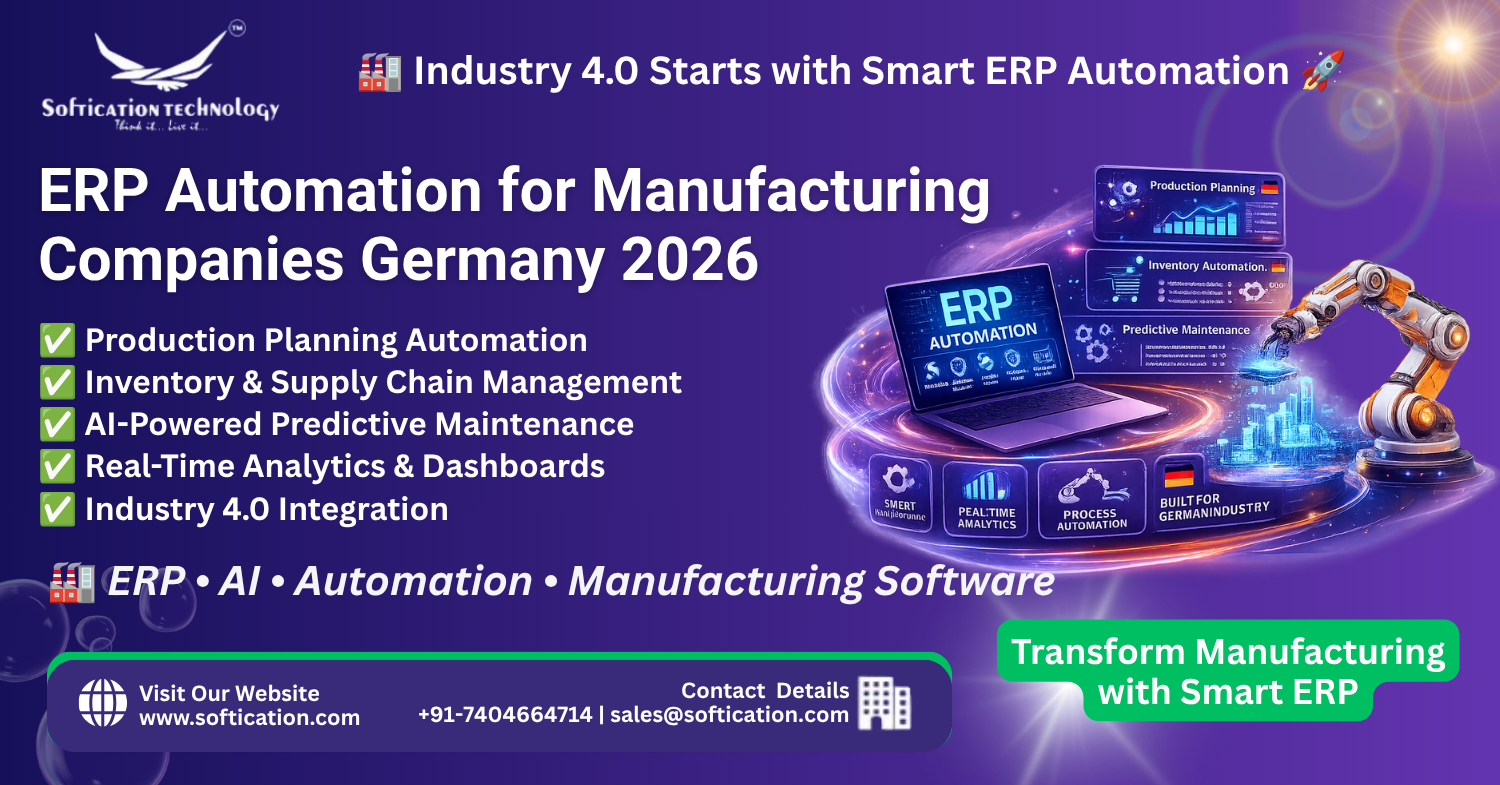
Germany remains a global leader in manufacturing, engineering, and industrial innovation. As Industry 4.0 continues to reshape the manufacturing landscape, companies are increasingly investing in ERP automation to streamline operations, improve productivity, and gain real-time visibility across their businesses.
In 2026, ERP automation is no longer just a digital upgrade—it's a strategic necessity. From production planning and inventory management to procurement and financial reporting, automated ERP systems help German manufacturers reduce costs, eliminate inefficiencies, and make data-driven decisions faster.
This guide explores how ERP automation is transforming manufacturing companies in Germany, its key benefits, implementation strategies, emerging trends, and why it is becoming a critical component of modern industrial operations.
Why ERP Automation Is Essential for German Manufacturers
Manufacturing businesses face growing challenges such as:
- Rising operational costs
- Supply chain disruptions
- Labor shortages
- Increasing customer demands
- Complex compliance requirements
- Production inefficiencies
ERP automation addresses these challenges by integrating business processes into a centralized platform and automating repetitive tasks.
Key Benefits
✅ Real-Time Operational Visibility
✅ Improved Production Efficiency
✅ Reduced Manual Errors
✅ Better Inventory Control
✅ Faster Decision-Making
✅ Lower Operational Costs
For German manufacturers embracing Industry 4.0, ERP automation is becoming a foundation for digital transformation.
What Is ERP Automation?
ERP (Enterprise Resource Planning) automation refers to the use of software systems that automate and integrate core business functions.
Modern ERP systems connect:
- Production
- Inventory
- Procurement
- Finance
- Sales
- Human Resources
- Supply Chain Management
By eliminating manual processes and data silos, ERP automation improves business efficiency and productivity.
How ERP Automation Supports Industry 4.0
Industry 4.0 focuses on smart factories, connected systems, and data-driven manufacturing.
ERP automation plays a critical role by:
- Connecting production systems
- Integrating IoT devices
- Automating workflows
- Providing real-time analytics
- Supporting predictive maintenance
Manufacturers gain greater control over operations while improving agility and competitiveness.
1. Automated Production Planning
Production planning is one of the most important manufacturing processes.
ERP automation helps businesses:
- Schedule production automatically
- Allocate resources efficiently
- Monitor production performance
- Optimize machine utilization
Benefits
✅ Reduced downtime
✅ Faster production cycles
✅ Improved resource utilization
German manufacturers use ERP systems to improve production accuracy and efficiency.
2. Inventory Management Automation
Inventory management directly impacts profitability.
ERP automation enables:
- Real-time stock monitoring
- Automated inventory updates
- Demand forecasting
- Stock replenishment alerts
Advantages
- Lower inventory costs
- Reduced stock shortages
- Better warehouse management
- Improved forecasting accuracy
Accurate inventory control helps manufacturers avoid costly disruptions.
3. Supply Chain Automation
Supply chains have become increasingly complex.
ERP systems automate:
- Supplier management
- Procurement workflows
- Purchase order generation
- Shipment tracking
Key Benefits
✅ Improved supply chain visibility
✅ Faster procurement processes
✅ Better vendor collaboration
Supply chain automation helps manufacturers respond quickly to market changes.
4. Financial Process Automation
Finance departments spend significant time on manual tasks.
ERP automation simplifies:
- Invoice processing
- Expense management
- Budget tracking
- Financial reporting
- Tax calculations
Benefits
- Reduced administrative workload
- Improved accuracy
- Faster reporting cycles
- Better financial visibility
This helps management make informed business decisions.
5. Quality Control & Compliance Automation
German manufacturing companies operate under strict quality standards and regulations.
ERP automation helps manage:
- Quality inspections
- Compliance documentation
- Audit trails
- Product traceability
Advantages
✅ Improved quality assurance
✅ Reduced compliance risks
✅ Better operational transparency
Automation ensures consistency across manufacturing processes.
6. Predictive Maintenance Integration
Unexpected equipment failures can lead to significant losses.
Modern ERP systems integrate with IoT sensors to support predictive maintenance.
ERP platforms can:
- Monitor machine performance
- Detect anomalies
- Schedule maintenance automatically
- Reduce downtime
Benefits
- Increased equipment lifespan
- Lower maintenance costs
- Improved production reliability
Predictive maintenance is a major Industry 4.0 trend in Germany.
7. Real-Time Analytics & Business Intelligence
Data-driven decision-making is essential for modern manufacturers.
ERP automation provides:
- Live dashboards
- Production analytics
- Inventory insights
- Financial reports
- Performance monitoring
Benefits
✅ Faster business decisions
✅ Improved forecasting
✅ Greater operational visibility
Executives can monitor performance across multiple departments from a single platform.
8. AI-Powered ERP Automation
Artificial Intelligence is becoming a major component of ERP systems.
AI can:
- Forecast demand
- Optimize inventory
- Predict production bottlenecks
- Analyze operational data
- Improve resource planning
AI-powered ERP solutions help manufacturers become more agile and efficient.
Top ERP Trends for German Manufacturing in 2026
Cloud ERP Adoption
Manufacturers are increasingly moving from legacy systems to cloud-based ERP platforms.
Benefits
- Scalability
- Remote access
- Lower infrastructure costs
- Faster deployment
AI & Machine Learning Integration
AI-driven ERP systems provide predictive insights and intelligent automation.
IoT Connectivity
Connected machinery and sensors improve operational visibility.
Mobile ERP Access
Manufacturers increasingly rely on mobile dashboards and real-time reporting.
Advanced Analytics
Data analytics continues to play a central role in manufacturing optimization.
Challenges of ERP Automation
While ERP automation offers significant advantages, businesses may encounter challenges such as:
- Implementation complexity
- Employee training requirements
- Legacy system integration
- Initial investment costs
- Change management
Working with experienced ERP implementation partners helps reduce these risks.
How to Successfully Implement ERP Automation
Step 1: Assess Current Processes
Identify inefficiencies and automation opportunities.
Step 2: Define Business Objectives
Set clear goals for productivity, cost reduction, and operational improvements.
Step 3: Select the Right ERP Platform
Choose a scalable solution that supports manufacturing requirements.
Step 4: Integrate Systems
Connect ERP with production, inventory, and business systems.
Step 5: Monitor Performance
Track KPIs and continuously optimize processes.
Why German Manufacturers Are Investing in ERP Automation
Germany's manufacturing sector is becoming increasingly digital.
Businesses are investing in ERP automation to:
✅ Improve productivity
✅ Reduce operational costs
✅ Support Industry 4.0 initiatives
✅ Increase competitiveness
✅ Enable data-driven decision-making
ERP automation provides the foundation for modern, connected manufacturing operations.
Final Thoughts
ERP automation is transforming manufacturing companies across Germany in 2026.
By automating production planning, inventory management, procurement, finance, quality control, and maintenance processes, manufacturers can significantly improve efficiency and profitability.
As Industry 4.0 continues to evolve, ERP systems integrated with AI, IoT, and analytics will play an even greater role in helping businesses remain competitive in a rapidly changing market.
For German manufacturers looking to modernize operations and drive long-term growth, ERP automation is no longer optional—it is essential.
Frequently Asked Questions (FAQs)
What is ERP automation in manufacturing?
ERP automation uses software to automate and integrate manufacturing processes such as production planning, inventory management, procurement, and finance.
Why is ERP important for manufacturing companies?
ERP improves efficiency, reduces costs, enhances visibility, and supports data-driven decision-making.
How does ERP support Industry 4.0?
ERP connects systems, automates workflows, integrates IoT devices, and provides real-time analytics for smart manufacturing.
Can ERP systems integrate with AI?
Yes. Modern ERP platforms use AI for demand forecasting, predictive maintenance, and operational optimization.
Is cloud ERP suitable for manufacturers?
Yes. Cloud ERP provides scalability, flexibility, lower infrastructure costs, and remote access to business data.
Strong SEO Keywords
Primary Keywords:
- ERP Automation Germany
- ERP Automation for Manufacturing Companies
- Manufacturing ERP Software Germany
- Industry 4.0 ERP Solutions
- ERP Systems for Manufacturers
Secondary Keywords:
- Cloud ERP Germany
- Manufacturing Process Automation
- ERP Implementation Germany
- Smart Manufacturing Software
- AI ERP Solutions
- Industrial Automation Germany
- ERP Digital Transformation
- Inventory Management ERP
- Production Planning Software
- Manufacturing Analytics Software
CTA
🚀 Optimize Manufacturing Operations with Smart ERP Automation
Industry 4.0 • AI Integration • Real-Time Analytics • Cloud ERP Solutions
🌍 Partner with SoftiCation Global to Build Future-Ready Manufacturing Software