Order fulfillment is where an e-commerce business's technical infrastructure meets physical reality — and it's one of the areas where manual processes stop scaling long before founders expect. A store doing 20 orders a day can manage fulfillment manually without much friction. The same manual process at 200 orders a day becomes a genuine operational liability. Here's what actually goes into automating fulfillment and shipping, and how to think about the integration work involved.
This post is part of our Web & E-Commerce Development: The Complete Technical Playbook for 2026, which covers the broader technical decisions involved in building and scaling e-commerce infrastructure.
Why Fulfillment Automation Becomes Necessary
Manual order fulfillment — a team member checking new orders, manually creating shipping labels, updating tracking information by hand — works fine at low volume but breaks down predictably as order volume grows:
- Error rates increase with volume. Manual data entry between systems (order details, shipping addresses, product SKUs) introduces mistakes that compound as the number of orders processed daily grows.
- Response and processing time slows. What takes minutes per order manually becomes hours of daily labor at meaningful volume, delaying shipment and directly affecting customer experience.
- Inventory accuracy degrades. Without automated syncing between orders and inventory counts, overselling and stockout surprises become increasingly common as manual reconciliation can't keep pace with order volume.
- Scaling requires proportional headcount growth, rather than the more efficient scaling automated systems allow, where additional order volume doesn't require a proportional increase in manual labor.
The specific volume threshold where this becomes worth solving varies by business, but the pattern is consistent: manual processes that felt manageable become the primary operational bottleneck as growth continues, and it's considerably easier to build automation before the pain becomes acute than to retrofit it during a genuine operational crisis.
The Core Components of Fulfillment Automation
Order Management System (OMS) integration An OMS centralizes order data from your storefront (and potentially multiple sales channels) into a single system, providing the coordination layer between sales, inventory, and fulfillment. For growing businesses selling across multiple channels — a website plus marketplaces like Amazon or Etsy — this centralization prevents the same product from being oversold across channels due to disconnected inventory tracking.
Inventory management integration Real-time inventory synchronization between your storefront, any additional sales channels, and your actual physical stock prevents overselling and provides accurate availability information to customers. This typically requires an API-based integration between your e-commerce platform and either a dedicated inventory management system or your OMS, depending on architecture.
Warehouse Management System (WMS) integration For businesses fulfilling from their own warehouse rather than through a third-party logistics provider, a WMS coordinates picking, packing, and shipping workflows within the physical warehouse, and typically needs to integrate with both the OMS and inventory systems to function as an automated pipeline rather than a series of disconnected manual handoffs.
Shipping carrier API integration Direct API integration with shipping carriers (or shipping aggregation platforms like ShipStation, Shippo, or EasyPost that connect to multiple carriers through a single interface) automates label generation, rate shopping across carriers, and tracking number generation — removing what would otherwise be a manual, per-order task.
Third-party logistics (3PL) integration For businesses using a 3PL rather than self-fulfilling, integration typically involves automatically transmitting order data to the 3PL's system and receiving fulfillment status and tracking updates back, rather than manually forwarding order information.
How the Integration Pipeline Typically Works
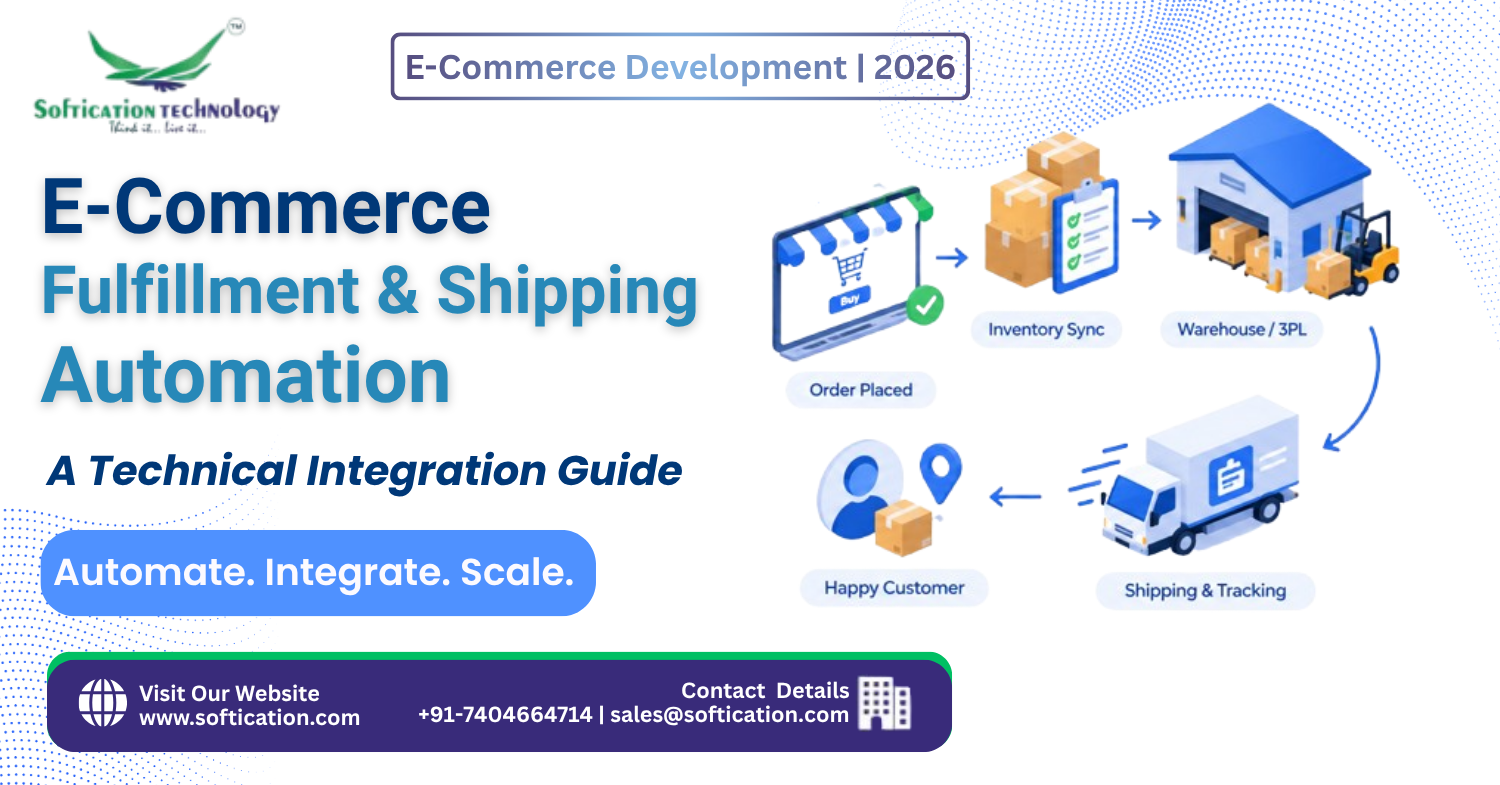
A well-automated fulfillment flow generally follows this sequence:
- Order placed on the storefront, triggering an automated event
- Order data transmitted to the OMS or fulfillment system via API or webhook, typically within seconds of order placement
- Inventory automatically decremented across all sales channels to prevent overselling
- Fulfillment triggered — either routed to a WMS for in-house fulfillment or transmitted to a 3PL's system
- Shipping label generated automatically, often with rate shopping across carriers to select the most cost-effective option meeting delivery requirements
- Tracking information automatically synced back to the storefront and communicated to the customer, typically via automated email or SMS
- Order status updated across all connected systems, closing the loop without manual intervention at any step
The specific tools and platforms involved vary by business size and complexity, but the underlying pattern — automated data flow between order placement and fulfillment completion, without manual re-entry at each step — is consistent across well-built systems.
Common Integration Challenges
Inconsistent data formats across systems Different platforms and carriers often expect data in different formats or structures, requiring transformation logic in the integration layer rather than a simple direct pass-through of data between systems.
Real-time vs. batch synchronization trade-offs Some integrations sync in real-time (immediately upon order placement), while others operate on a batch schedule (every few minutes or hours). Real-time sync reduces the window for overselling but requires more robust, reliable API connections; batch sync is simpler to implement but introduces a delay window where inventory data can be temporarily inaccurate.
Handling partial fulfillment and split shipments Orders containing multiple items that ship separately, or orders only partially fulfillable due to stock issues, require more sophisticated logic than straightforward, single-shipment orders — this is a common area where fulfillment automation projects underestimate complexity during initial scoping.
Returns and exchanges integration Fulfillment automation often focuses primarily on the outbound shipping flow, but returns processing — restocking inventory, issuing refunds, managing exchange logistics — needs its own integration consideration, since it's a meaningfully different workflow than initial order fulfillment.
Multi-channel inventory reconciliation For businesses selling across multiple channels, ensuring inventory counts stay accurately synchronized across all of them in near-real-time is one of the more technically demanding aspects of fulfillment automation, particularly as channel count grows.
Choosing Between Build vs. Buy for Fulfillment Tools
Most growing e-commerce businesses are better served by integrating established fulfillment and shipping platforms (ShipStation, Shippo, established OMS platforms) rather than building custom fulfillment infrastructure from scratch, since these tools have already solved most of the common integration challenges listed above across many similar businesses.
Custom-built fulfillment logic becomes more justified when:
- Your fulfillment workflow has genuinely unusual requirements that established platforms don't support well
- You're operating at a scale where established platforms' pricing models become less cost-effective than custom infrastructure
- You need tight integration with proprietary internal systems that don't have existing connectors to standard fulfillment platforms
For most businesses below significant scale, the engineering investment required to build and maintain custom fulfillment infrastructure is rarely justified compared to integrating mature, purpose-built tools that already handle the complexity reliably.
The Bottom Line
Fulfillment and shipping automation isn't a single integration — it's a coordinated pipeline connecting your storefront, inventory, warehouse or 3PL, and shipping carriers into a system that moves orders through without manual re-entry at each step. Getting this right prevents the error rates, delays, and scaling limitations that manual fulfillment processes inevitably hit as order volume grows, and for most businesses, integrating established platforms rather than building custom infrastructure is both the faster and more reliable path. For the broader technical foundation this fits within, see our complete web and e-commerce development playbook for 2026.
FAQ: E-Commerce Fulfillment and Shipping Automation
When should an e-commerce business automate order fulfillment? There's no universal volume threshold, but manual fulfillment processes typically become an operational bottleneck as order volume grows, evidenced by rising error rates, slower processing times, and increasing overselling incidents. It's generally easier to automate before these problems become acute rather than during a crisis.
What's the difference between an OMS and a WMS? An Order Management System (OMS) centralizes order data across sales channels and coordinates the overall fulfillment process. A Warehouse Management System (WMS) specifically manages picking, packing, and shipping workflows within a physical warehouse, and typically integrates with the OMS to function as part of the broader automated pipeline.
Should I build custom fulfillment integration or use an existing platform? Most growing e-commerce businesses are better served integrating established platforms like ShipStation or Shippo, since these tools have already solved common integration challenges. Custom infrastructure is generally only justified at significant scale or for genuinely unusual fulfillment requirements.
How does shipping carrier integration actually work technically? Integration typically happens through the carrier's API, or through a shipping aggregation platform that connects to multiple carriers through a single interface, automating label generation, rate comparison across carriers, and tracking number generation without manual per-order work.
What's the biggest technical challenge in fulfillment automation? Multi-channel inventory reconciliation is often the most technically demanding aspect, particularly for businesses selling across multiple sales channels, since inventory counts need to stay accurately synchronized in near-real-time to prevent overselling across channels.