From Website to Business Platform: How Digital Transformation Connects Your Online Presence With CRM
A modern business website should do more than explain what a company offers.
For many growing businesses, the website is the first step in a much larger digital journey—one that can include lead generation, CRM, client management, workflow automation, reporting and business operations.
When these systems are planned together, a company can move from having a website that simply generates enquiries to having a connected digital platform that supports the customer journey from the first interaction through ongoing client management.
This was the approach SoftiCation followed while delivering a digital transformation solution for a Canadian Salesforce consulting company, combining a professional website with Lead CRM and Client Management CRM.
What Is Digital Transformation for a Growing Business?
Digital transformation is not simply replacing an old website with a modern design.
It involves using technology to improve how a business:
Attracts prospects
Captures leads
Communicates with customers
Manages client information
Tracks business activities
Automates repetitive processes
Connects different systems
Makes operational information easier to access
For a growing company, this could mean connecting its public-facing website with internal business applications.
Instead of:
Website → Email → Spreadsheet → Manual Follow-up
The process can become:
Website → Lead → CRM → Follow-up → Opportunity → Client → Relationship Management
That difference can have a significant impact on how efficiently a business manages its growth.
Why a Website Alone May Not Be Enough
A professional website is essential for establishing credibility and communicating a company's services.
But once a visitor submits an inquiry, another question begins:
What happens to that lead?
If the answer involves manually checking emails, updating spreadsheets, or remembering follow-ups, the website and business operations remain disconnected.
A more structured approach is to connect the website experience with a lead CRM.
This creates a digital workflow where inquiries can be captured and managed systematically.
Connecting the Website with Lead Management
A lead CRM can help businesses organize information generated through their digital channels.
Depending on the business requirements, a lead CRM may manage:
Lead details
Contact information
Company information
Lead source
Requirements
Lead status
Sales activities
Follow-up dates
Internal notes
Communication history
The important point is that the CRM should be designed around the company's actual sales process.
There is no single CRM workflow that works perfectly for every organization.
From Lead Management to Client Management
The customer journey does not end when a lead becomes a client.
Once a business begins working with a customer, it may need to manage additional information such as:
Client contacts
Company information
Communication history
Activities
Requirements
Projects
Follow-ups
Internal notes
Relationship history
This is where a client management CRM can become an important part of the digital infrastructure.
Instead of keeping client information across multiple tools, the organization can create a centralized system around its own business processes.
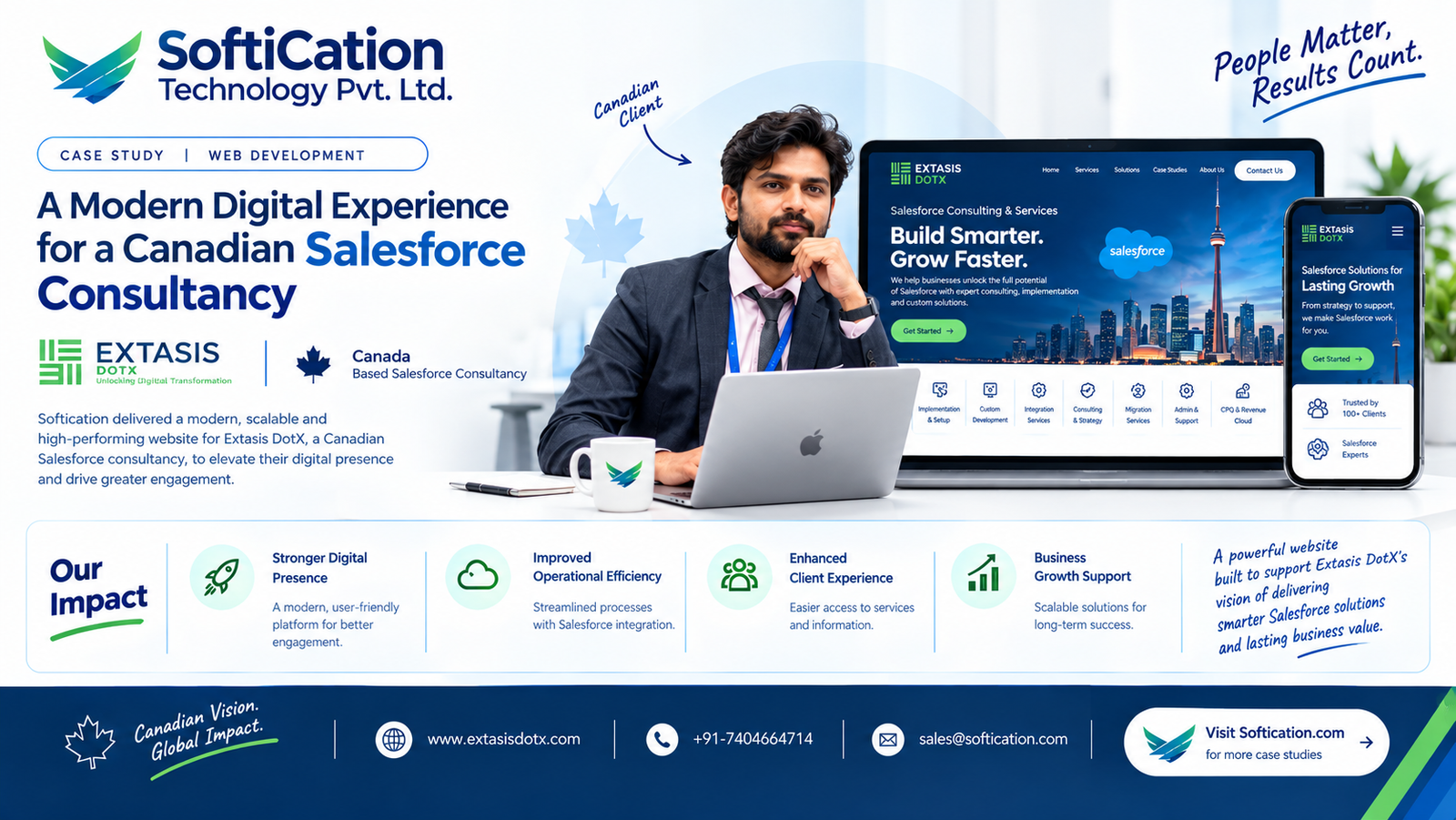
The Extasis DotX Digital Transformation Project
For Extasis DotX Inc., a Canadian Salesforce services and consulting company, the requirement extended beyond creating a professional corporate website.
The company needed a digital experience capable of communicating its Salesforce consulting and digital transformation capabilities while also supporting its lead and client management processes.
SoftiCation approached the engagement as a broader digital transformation project.
The solution included:
1. Professional Digital Presence
A modern website designed around the company's Salesforce consulting and enterprise technology positioning.
2. Lead CRM
A structured environment for managing leads, requirements, statuses, and follow-up activities.
3. Client Management CRM
A centralized system for organizing client information and relationship-related activities.
4. Business Workflow
A connected approach between the company's digital presence, lead generation, and client management.
Research Before Design
One of the most important stages of the project happened before development.
SoftiCation researched:
Salesforce consulting websites
Enterprise technology companies
Service presentation patterns
User expectations
Content hierarchy
Navigation structures
CTA placement
Technology communication
Industry terminology
Digital transformation positioning
The purpose was not to copy an existing website.
The objective was to understand how a technology consulting company should communicate complex services while maintaining a premium and professional user experience.
Designing the User Experience
After the research phase, we translated the business requirements into the website's information architecture and UI direction.
The design needed to balance two potentially conflicting requirements:
Technical depth
and
Simple user experience
A consulting company may offer dozens of technologies and services, but visitors should not have to understand the entire technology stack before understanding what the company can do for them.
Therefore, the interface was structured around clear categories, visual hierarchy, and progressive information.
Why Motion and Visual Design Matter
The client also wanted a visually engaging website with graphics and animations.
Our approach was not to add animations simply to make the website look impressive.
Motion was used to support:
Visual storytelling
Section transitions
User attention
Technology presentation
Service discovery
Overall interaction quality
The goal was to create a modern experience while maintaining the professional tone expected from an enterprise technology consultancy.
Development: From UI to Production
After requirements, research, and UI direction were established, the development process moved through multiple stages.
Requirement Analysis
Understanding the business objectives and operational requirements.
Research
Studying the industry, audience, and digital experience expectations.
Information Architecture
Structuring services, content, and user journeys.
UI/UX
Creating the visual experience and interaction patterns.
Website Development
Converting the approved design into a responsive production website.
CRM Development
Building a Lead CRM and Client Management CRM around the client's operational requirements.
Testing
Reviewing functionality, responsiveness, UI consistency, and workflows.
Refinement
Addressing feedback and improving the final experience.
Launch
Deploying the completed solution within the agreed project timeline.
Quality and Delivery
For SoftiCation, quality is not limited to whether a website or application technically works.
We review the complete experience.
This includes:
UI → UX → Responsiveness → Functionality → Workflow → Content → Interaction → Final Delivery
For CRM systems, the workflow itself becomes particularly important.
A technically functional CRM can still be difficult to use if the workflow does not reflect the way the business actually operates.
That is why understanding the business requirement before development is an important part of our process.
The Bigger Picture
The Extasis DotX project demonstrates how a digital transformation project can connect multiple technology components.
Instead of thinking about each system independently:
Website
Lead CRM
Client CRM
The project can be viewed as one connected digital ecosystem:
Digital Presence → Lead Capture → Lead Management → Client Conversion → Client Management
This approach can help businesses create a more structured foundation for digital growth.
Digital Transformation Is Different for Every Business
There is no universal digital transformation package.
For one business, it may mean:
Website + CRM
For another:
SaaS + API + Automation
For another:
AI Application + Cloud Infrastructure
And for another:
Research Platform + Survey Programming + Respondent Management
The technology should follow the business requirement—not the other way around.
How SoftiCation Approaches Digital Transformation
Our approach is built around:
Understand
Understand the business, users, processes, and objectives.
Research
Research the industry, competitors, users, and technology requirements.
Design
Create an experience that communicates the business clearly.
Develop
Build the required website, application, CRM, SaaS, or custom software.
Integrate
Connect systems and workflows where required.
Test
Validate the product from both technical and user perspectives.
Deliver
Launch the solution within the agreed project scope and timeline.
Final Thoughts
A website can be the front door of a business.
But the technology behind that front door can determine how efficiently the business manages the opportunities that come through it.
The Extasis DotX project demonstrates how website development, CRM development, and business workflow design can be brought together as one digital transformation initiative.
For businesses planning their next technology project, the important question is not only
“What website should we build?”
It can also be
“What should happen after someone visits our website?”
That question often leads to a much more valuable technology solution.
Looking to Transform Your Digital Operations?
SoftiCation Technology Pvt. Ltd. works with startups, SMBs, and growing businesses to design and develop:
Professional business websites
Custom CRM systems
Lead management platforms
Client management systems
SaaS applications
AI-powered applications
Custom software
Cloud and DevOps solutions
Business automation platforms
From idea and research to design, development, and delivery—we build technology around your business requirements.
People matter. Results count.
📧 sales@softication.com
📞 +91-7404664714
🌐 www.softication.com