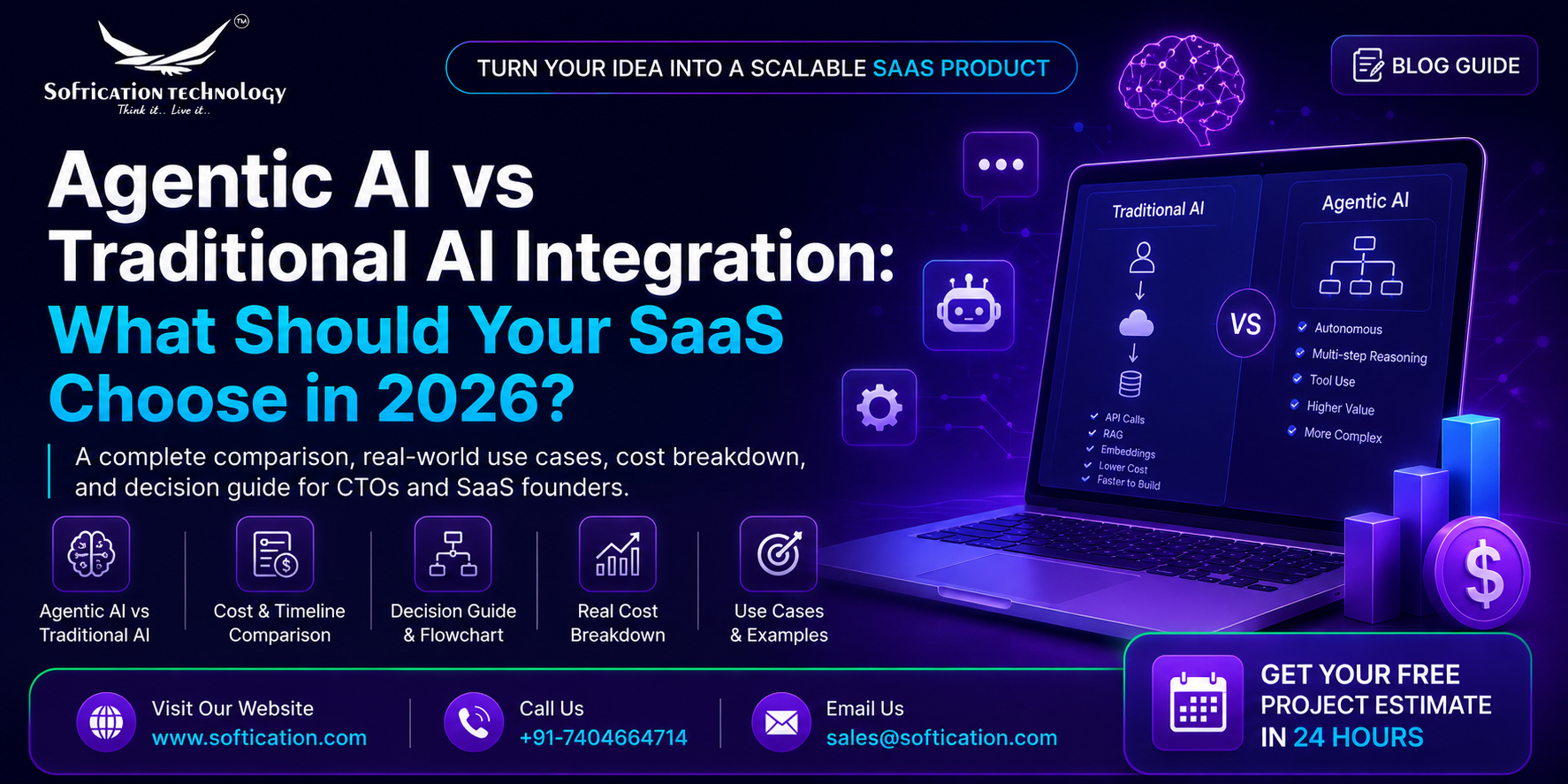
Everyone wants AI agents now. But 70% of SaaS products don't need them — and building one when you don't need it will cost you 4x more and deliver half the value. Here's how to know which one your product actually needs.
Every CTO conversation in 2026 seems to start the same way: "Should we build an agent for this?" It's the right question to ask and the wrong one to answer by default. Agentic AI and traditional AI integration solve different problems, and picking the wrong one is one of the most expensive mistakes a SaaS team can make this year.
This post breaks down what each approach actually is, what it costs, and how to figure out which one your product needs — with real numbers from builds we've shipped on both sides.
What Is Agentic AI — Plain English for Non-AI Founders
A traditional AI feature answers a question. An agentic AI feature completes a job.
If you ask a traditional AI integration "summarize this ticket," it summarizes the ticket and stops. If you give an agent the goal "resolve this ticket," it can look up the customer's account, check order status, decide whether a refund applies, issue it, and send a confirmation email — without a human choosing each of those steps.
The defining traits of agentic AI:
- Multi-step reasoning — it plans a sequence of actions, not just one response
- Tool use — it can call APIs, query databases, or trigger actions in other systems
- Autonomy within guardrails — it decides which tools to use and when, based on context
- Memory across steps — it tracks what it's already done within a task
That autonomy is the whole value proposition — and also the whole reason it costs more and takes longer to build safely.
Traditional AI Integration: What It Costs and When to Use It
Traditional AI integration covers the stuff most SaaS products actually need: a single API call to a model, retrieval-augmented generation (RAG) over your own data, or embeddings-based search and recommendations.
What it typically looks like:
- A support ticket comes in → an API call summarizes it → a human decides what to do next
- A user searches your knowledge base → embeddings retrieve the most relevant docs → the model drafts an answer
- A form gets submitted → the model classifies or tags it → your existing workflow takes over
What it costs: For most SaaS products, a well-scoped traditional AI feature — a RAG-based search assistant, a summarization tool, a classification pipeline — runs $6,000–$20,000 to build and integrate, depending on how much of your data needs cleaning and indexing first.
When it's the right call: If a human is still going to review or approve the output, or if the task is genuinely single-step (summarize, classify, retrieve, draft), traditional integration gets you 90% of the perceived value at a fraction of the cost and risk.
Agentic AI: When It Actually Makes Sense
Agentic AI earns its cost when the task involves a sequence of decisions that would otherwise require a human to move between systems.
Good agentic use cases:
- Customer support that needs to check three internal systems before resolving a ticket
- Internal ops workflows that pull data from a CRM, a billing system, and a spreadsheet to produce a report
- Sales tools that research a lead across multiple sources and draft a personalized outreach sequence
- DevOps agents that monitor logs, diagnose an issue, and open a ticket or roll back a deploy
What it costs: Because agentic systems require careful guardrails, error handling, and testing against unpredictable multi-step paths, realistic budgets run $25,000–$70,000+, depending on how many tools the agent needs access to and how much autonomy it's given.
The catch most founders miss: agents fail in more interesting ways than traditional AI. A bad RAG answer is a bad paragraph. A bad agent decision might be a wrong refund, a duplicate email, or an action taken on the wrong customer account. Every additional tool an agent can call is another failure mode you need to test and constrain — which is exactly why the cost curve isn't linear.
Decision Guide: Which Approach Is Right for Your Product?
Walk through these questions in order. The first one that applies gives you your answer.
1. Does a human review the output before anything happens? → Yes: you need traditional AI integration. Stop here.
2. Is the task genuinely a single step — summarize, classify, retrieve, draft, translate? → Yes: you need traditional AI integration.
3. Does completing the task require pulling from or acting across more than one system (CRM + billing + email, for example)? → No: traditional AI integration, possibly chained manually. → Yes: continue to question 4.
4. Can you clearly define the boundaries of what the AI is allowed to do without approval (e.g., refunds under $50, but not over)? → No: you're not ready for agentic AI yet — define your guardrails first, then revisit. → Yes: agentic AI is likely the right investment.
5. Do you have the budget and timeline for a longer build with more rigorous testing? → No: start with a traditional AI feature now and revisit agentic once you've validated the workflow manually. → Yes: build the agent.
If you land on "traditional" for now, that's not a consolation prize — it's very often the correct, defensible engineering decision in 2026, not just a budget compromise.
Real Cost Difference: We Built Both — Here's What We Found
To make this concrete, we recently built both approaches for two different clients solving adjacent problems, so the comparison is close to apples-to-apples.
Client A — Traditional AI integration: A support platform wanted AI-drafted responses to incoming tickets, with a human agent approving before sending. This was a RAG pipeline over their existing help docs plus a classification model to route tickets by category.
- Timeline: 5 weeks
- Team: 2 engineers, part-time
- Cost: $14,000
- Outcome: 40% reduction in average first-response drafting time
Client B — Agentic AI: A different support platform wanted the AI to actually resolve simple tickets end-to-end — check order status, verify refund eligibility, issue the refund, and close the ticket, escalating anything ambiguous to a human.
- Timeline: 13 weeks
- Team: 3 engineers, 1 dedicated to guardrail/testing work
- Cost: $52,000
- Outcome: ~30% of tickets fully auto-resolved, with the remaining 70% still requiring the same human-drafted flow as Client A
Client B's agent delivers more value per resolved ticket — but it took nearly 4x the budget and 2.5x the timeline to get there, and it only fully automated less than a third of the ticket volume. For Client A's use case, that trade-off wasn't worth it yet; for Client B, the ticket volume and repetitive nature of the task justified the investment.
The Bottom Line for 2026
Agentic AI isn't a status symbol — it's a specific tool for a specific kind of problem. If your workflow is genuinely multi-step, cross-system, and well-bounded, it can deliver real automation. If it's not, a traditional AI integration will get you most of the value in a quarter of the time, at a quarter of the cost.
The founders getting the most out of AI in 2026 aren't the ones building the fanciest agent — they're the ones who scoped the problem honestly before choosing the architecture.
Not sure which one your product needs? Get a free technical scoping call — Book a call
FAQ: Agentic AI vs Traditional AI Questions Founders Ask Us
What's the difference between agentic AI and traditional AI integration? Traditional AI integration responds to a single request — summarizing, classifying, or retrieving information — and a human decides what happens next. Agentic AI plans and executes a sequence of steps on its own, including calling tools and taking actions, within defined guardrails.
How much does it cost to build an AI agent? A well-scoped agentic AI feature typically costs $25,000–$70,000+, depending on how many systems it needs to access and how much autonomy it's given. Simpler traditional AI integrations run $6,000–$20,000.
Does my SaaS product need AI agents in 2026? Only if your workflow genuinely requires multiple decisions across multiple systems without human review at each step. Most single-step tasks — summarizing, drafting, classifying — are better and cheaper solved with traditional AI integration.
Why do AI agents cost more than a simple API integration? Agents require additional engineering for guardrails, error handling, and testing against unpredictable multi-step decision paths. Every tool an agent can call adds another failure mode that needs to be tested and constrained, which is why costs don't scale linearly.
Can I start with traditional AI and upgrade to agentic AI later? Yes, and it's often the smarter path. Validating a workflow manually or with a traditional AI feature first lets you confirm the value before investing in the more expensive guardrail and testing work that agentic AI requires.