
A poorly programmed survey doesn't just look unprofessional — it produces bad data. Skip logic that breaks, translations that don't render correctly, or branching that sends respondents down the wrong path can quietly compromise an entire study before a single response is analyzed. Here's what every research team should know about survey programming fundamentals in 2026.
Survey programming often gets treated as the "technical afterthought" of a research project — something handled after the questionnaire is designed, rather than something that shapes the quality of the data itself. In practice, the two are inseparable. A well-designed questionnaire executed with weak programming logic will still produce messy, unreliable results. This post breaks down the three pillars that matter most: logic, branching, and multilingual survey support.
Why Survey Programming Quality Directly Affects Data Quality
Before getting into the specifics, it's worth being clear about why this matters beyond aesthetics. Programming errors don't just create a clunky respondent experience — they directly corrupt data:
- A broken skip pattern can show irrelevant questions to respondents who should have been routed elsewhere, inflating "not applicable" responses or forcing guesses
- Incorrect piping (carrying an earlier answer into a later question) can confuse respondents or make follow-up questions nonsensical
- A translation error can shift the meaning of a question just enough to make cross-country comparisons invalid
- Inconsistent randomization can introduce order bias that undermines statistical validity
Getting programming right isn't a finishing touch on research design — it's part of research design.
Survey Logic: The Foundation
Survey logic refers to the rules that determine what a respondent sees, in what order, and under what conditions. The core logic types every research team should understand:
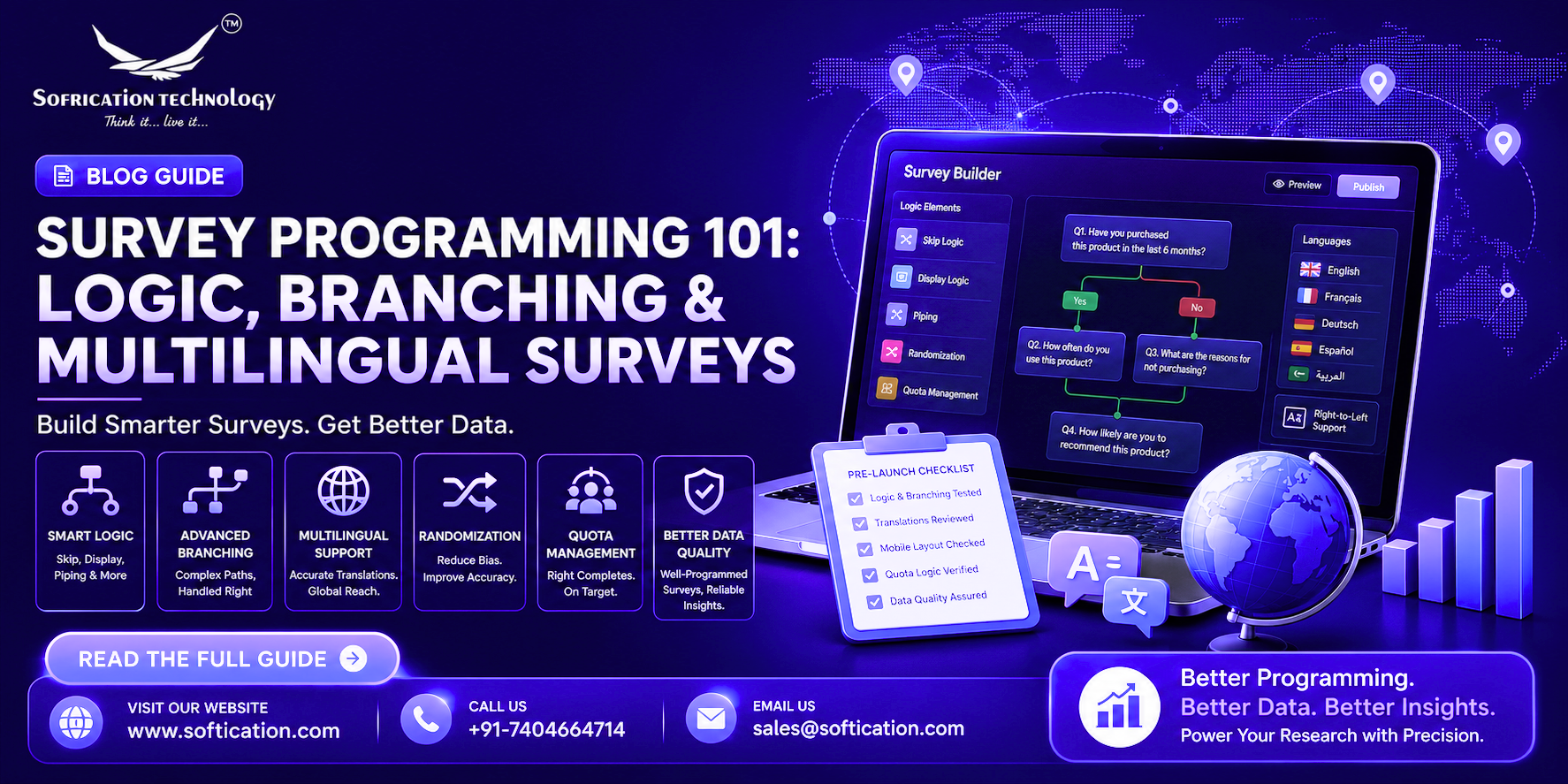
Skip logic Determines which questions a respondent sees based on prior answers — for example, skipping detailed product-usage questions for respondents who indicated they've never used the product category.
Display logic Controls whether a specific question, answer option, or piece of text appears at all, based on conditions elsewhere in the survey — useful for showing brand-specific follow-ups only to respondents who mentioned that brand.
Piping Carries a respondent's earlier answer into later question text, so a survey can ask "You mentioned [Brand X] — how likely are you to recommend it?" instead of a generic, less personalized version.
Randomization Rotates the order of answer options or question blocks to reduce position bias, which is especially important in longer surveys where fatigue affects later answers more than earlier ones.
Quota logic Automatically closes off specific demographic or behavioral segments once their target sample size is reached, preventing overfill in easy-to-reach groups while quotas for harder-to-reach segments remain open.
Each of these needs to be tested against every possible respondent path before launch — not just the "expected" path a researcher has in mind.
Branching: Getting Complex Paths Right
Branching goes a step further than basic skip logic — it's what happens when a survey has multiple distinct paths a respondent could follow depending on a combination of answers, not just one.
Common branching structures:
- Simple binary branching — one question sends respondents down one of two paths (e.g., "Have you purchased in the last 6 months?" Yes/No)
- Nested branching — a path itself splits further based on a subsequent answer, creating a tree of possible routes through the survey
- Matrix-dependent branching — answers within a grid or matrix question determine which follow-up questions appear, which is common in brand tracking studies with many products evaluated at once
Where branching commonly breaks:
- Overlapping conditions that create a logical conflict — two skip rules that could both apply, sending the respondent to an undefined state
- Missing "catch-all" paths for respondents who don't fit any programmed condition cleanly
- Branches that were tested individually but never tested in combination with each other
The single most common branching failure in real projects isn't a coding mistake — it's insufficient testing of path combinations before field launch. A survey with even five conditional questions can have dozens of possible respondent paths, and each one needs to be walked through, not just spot-checked.
Multilingual Surveys: Where Most Programming Errors Actually Happen
Multi-country and multi-language studies introduce an entirely different category of programming risk, because logic errors and translation errors can compound each other.
Key considerations for multilingual survey programming:
- Text expansion and contraction — translated text can be significantly longer or shorter than the source language, which can break layout, especially in mobile-optimized surveys or grid questions
- Character encoding — languages using non-Latin scripts (Arabic, Mandarin, Cyrillic) require proper encoding support throughout the platform, not just at the display layer
- Right-to-left (RTL) language support — surveys in Arabic or Hebrew need layout logic that mirrors correctly, not just translated text placed into a left-to-right template
- Piping and logic that references translated text — if piping logic pulls a respondent's earlier answer into later question text, that logic needs to work correctly across every language version, not just the source language
- Translation review in context, not in isolation — a translated question can be linguistically correct but still confusing when seen in the actual survey flow, which is why translations should be reviewed inside the live survey, not just in a spreadsheet of source and translated text side by side
Agencies running global studies should treat translation QA as a distinct testing phase, separate from general survey logic testing — the two failure modes are different, and reviewing them together often means one gets less attention than it needs.
A Practical Pre-Launch Checklist
Before any survey goes live, especially a multilingual or heavily branched one, it's worth walking through:
- Every skip and display logic condition tested individually
- Combinations of conditions tested together, not just in isolation
- Quota logic verified to close correctly once targets are met
- Piped text checked across every language version, not just the source
- Layout checked on mobile for every language, since text length varies
- RTL languages checked for correct mirroring, not just translated text
- A full "walkthrough" of at least one respondent path per major branch, completed end-to-end in each language
Skipping this step to save a day or two of timeline is one of the more common ways agencies end up cleaning avoidable errors out of a dataset after fieldwork has already closed.
The Bottom Line
Survey programming is where research design either holds up or quietly breaks down. Logic and branching determine whether respondents see the right questions in the right order; multilingual support determines whether that same logic holds true across every market a study runs in. Getting this right before launch is significantly cheaper — in both time and data quality — than trying to explain away anomalies in the dataset afterward.
FAQ: Survey Programming Fundamentals
What is the difference between skip logic and branching in survey programming? Skip logic typically refers to simple rules that determine whether a respondent sees or skips a single question. Branching describes more complex paths, often involving multiple conditions or nested decisions, that route respondents through entirely different sequences of questions.
Why do multilingual surveys have more programming errors than single-language surveys? Translated text can vary significantly in length, requires proper character encoding, and in some languages needs right-to-left layout support — all of which can break logic or layout that worked correctly in the source language if not tested separately in each language version.
How should branching logic be tested before a survey goes live? Every individual condition should be tested on its own, but just as importantly, combinations of conditions should be tested together by walking through complete respondent paths end-to-end, not just spot-checking isolated questions.
What is piping in survey programming? Piping carries a respondent's earlier answer into the text of a later question, allowing surveys to reference previous responses directly rather than asking generic follow-up questions.
Can translation errors affect data quality even if the survey logic is correct? Yes. A question that is logically routed correctly but poorly or ambiguously translated can still produce unreliable answers, which is why translation review should happen inside the live survey flow, not just in a source-to-translation spreadsheet comparison.