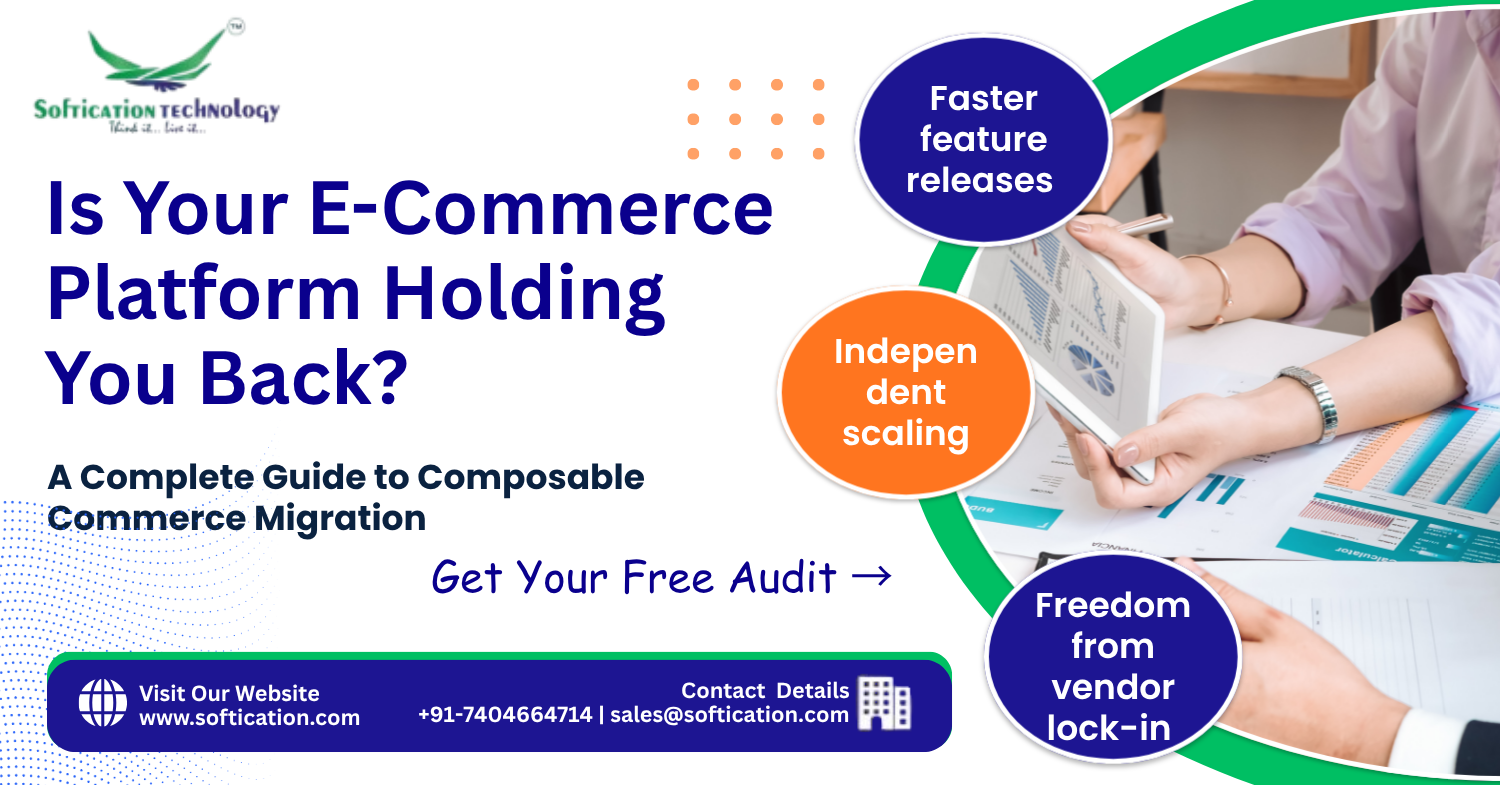
If every new feature on your online store takes weeks instead of days, and every small change requires touching the entire codebase, the problem usually isn't your team. It's your architecture.
Most growing e-commerce businesses start on a monolithic platform — everything from catalog to checkout to CMS bundled into one tightly coupled system. It works fine when you're small. But as you scale, that same architecture starts working against you.
This guide breaks down what composable commerce actually is, when migrating to it makes sense, and what the process realistically looks like.
The Problem: Your Platform Wasn't Built to Move Fast
A monolithic e-commerce platform bundles your front-end, back-end, catalog, checkout, and business logic into a single, tightly connected system. On the surface, this feels simpler — one platform, one vendor, one login.
But underneath, it creates real friction:
- Adding a new payment method means touching core platform code, not just plugging in an API.
- A/B testing a new checkout flow requires a full deployment, not a quick swap.
- Your marketing team wants a new landing page experience, but it's blocked by a platform release cycle.
- One buggy plugin or third-party extension can bring down your entire storefront.
- Scaling traffic for one part of the site (say, checkout during a sale) means scaling the entire platform, even the parts that don't need it.
Developers end up spending more time working around the platform than building on top of it.
The Business Consequence: Slow Platforms Cost You Revenue, Not Just Time
This isn't just a technical inconvenience — it shows up directly on your P&L.
Slower time-to-market. While your team waits weeks to ship a feature, competitors on flexible architectures ship in days. In e-commerce, that gap compounds fast — especially around seasonal campaigns and promotions where timing is everything.
Rising development costs. Monolithic systems require specialized, platform-specific expertise for even small changes. Simple requests turn into expensive, multi-week engineering efforts.
Lost conversions from a rigid checkout. If your platform doesn't let you easily test or customize checkout, you're stuck with whatever conversion rate your current setup gives you — even if a few UX changes could recover meaningful revenue.
Fragile scaling. A platform-wide outage during a high-traffic sale doesn't just cost you that day's revenue — it damages customer trust in a way that's hard to win back.
Vendor lock-in. Many monolithic platforms make it difficult (and expensive) to switch payment providers, search tools, or CMS systems down the line, leaving you dependent on decisions made years ago.
The longer a growing business stays on an inflexible platform, the more expensive it becomes to eventually leave it.
The Solution: Composable, API-First Architecture
Composable commerce breaks your e-commerce stack into independent, best-in-class components — catalog, search, checkout, CMS, payments — that communicate through APIs instead of being locked into one monolithic codebase.
Instead of one vendor controlling your entire stack, you choose the best tool for each function and connect them together. Want to swap your search provider without touching checkout? You can. Want your marketing team to update content without waiting on a dev deploy? They can, through a headless CMS.
This is often referred to as MACH architecture — Microservices, API-first, Cloud-native, and Headless. It's the approach used by many fast-scaling e-commerce brands that need to move quickly without breaking what already works.
When composable commerce is worth it
Composable isn't the right move for every business. It generally makes sense when:
- You're shipping frequent updates and your current platform slows that down
- You need to scale specific parts of your stack independently (e.g., checkout during peak traffic)
- You're expanding into multiple channels — web, mobile app, marketplaces — from one back-end
- Your current platform is limiting integrations with tools you need (ERP, CRM, custom pricing engines)
- You've outgrown off-the-shelf plugins and are now maintaining heavy customizations on top of them
When it's not worth it (yet)
If you're a smaller store with simple, stable requirements and infrequent changes, a monolithic platform may still be the more cost-effective choice. Composable architecture adds flexibility, but it also adds complexity — it's worth it when the flexibility is actually needed.
SoftiCation's Capability: We Migrate You Without Breaking What Already Works
Migrating from a monolithic platform to a composable architecture isn't a rebuild — it's a careful, phased transition. At SoftiCation, our approach typically includes:
- Architecture audit — mapping your current platform's dependencies, integrations, and pain points before touching anything
- Component-by-component migration planning — identifying which parts of your stack (catalog, search, checkout, CMS) benefit most from decoupling first
- API-first integration — connecting best-in-class tools for each function through clean, well-documented APIs
- Headless CMS and front-end implementation — using modern frameworks (React, Next.js) to give your team full control over the customer experience
- Zero-downtime migration strategy — moving traffic incrementally so your store stays live and stable throughout the transition
- Post-migration support — monitoring, optimization, and documentation so your internal team can confidently manage the new architecture
Our goal isn't to sell you a specific stack — it's to help you build the right composable architecture for your business's actual scale and roadmap.
Proof: What This Looks Like in Practice
Consider a mid-sized fashion retailer running on a legacy monolithic platform. Every new promotion required a developer to modify the same core template used across the entire site, which meant even simple seasonal campaigns took two to three weeks to go live. During peak sales events, a spike in checkout traffic would slow down the product catalog and search as well, since all three shared the same infrastructure. Adding a new regional payment provider had been on the roadmap for over a year, stuck behind the platform's limited integration options.
A phased migration to a composable setup addressed each bottleneck individually rather than forcing a full rebuild. The product catalog and search were decoupled first and moved behind dedicated APIs, since they carried the heaviest traffic load. Checkout was migrated next, integrated with a modern payment gateway that supported the regional providers the business had been waiting to add. The CMS was replaced with a headless solution, so the marketing team could publish new campaign pages without engineering involvement.
The result was a store where campaign pages could go live in days instead of weeks, checkout stayed stable even when catalog traffic spiked, and the business was finally able to launch region-specific payment options that had been blocked for over a year. None of this required shutting the store down or migrating everything at once — each component was moved independently, with the old and new systems running in parallel until each piece was verified stable.
This is the practical value of composable architecture: it doesn't just make a platform more "modern," it removes the specific bottlenecks that are quietly costing a growing business time, engineering budget, and revenue.
Is Your Platform Ready for a Change?
If your team spends more time fighting your platform than building on it, it might be time for an honest architecture review — not necessarily a full migration, but at least a clear picture of what's possible.
Get a Composable Commerce Audit and find out exactly where your current platform is holding you back, and what a phased migration path could look like for your business.