
Ask five researchers whether a project needs qualitative or quantitative data, and you'll often get five different justifications for the same instinct. In 2026, with faster field timelines and clients expecting both speed and depth, knowing exactly when to reach for hard data, soft data, or both isn't optional anymore — it's the difference between a study that answers the client's real question and one that just produces numbers or opinions without context.
The terms "hard" and "soft" data get used loosely across the industry, sometimes interchangeably with quantitative and qualitative. That's close, but not quite precise — and the distinction matters for how you scope a project, choose a methodology, and set client expectations. This post breaks down what each type of data actually offers, where each one falls short on its own, and how to decide which approach a given research question actually needs.
What "Hard" Data Actually Means
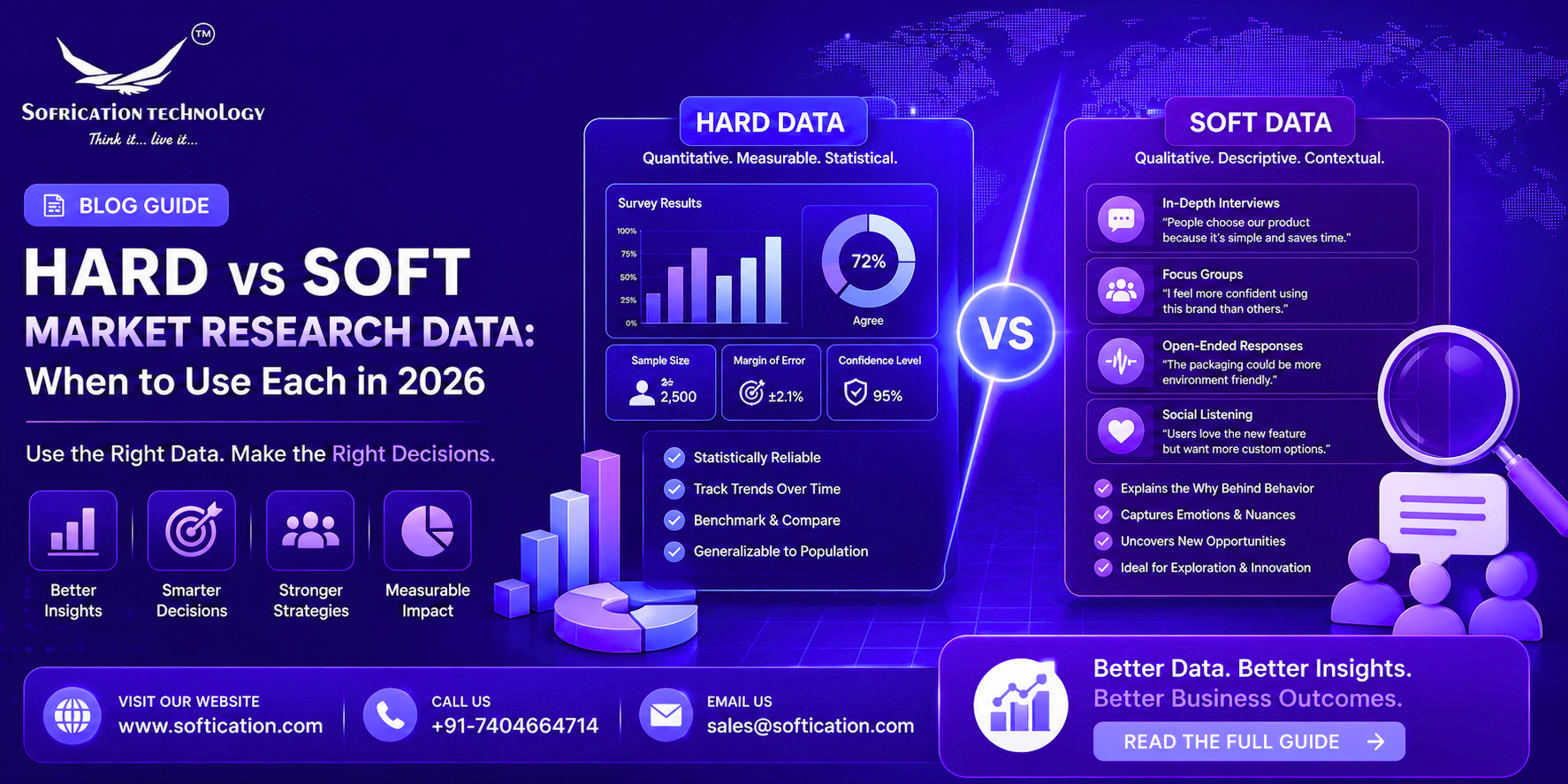
Hard data refers to structured, numerical, statistically analyzable information — the output of quantitative research methods. It's designed to answer questions like "how many," "how much," and "how often."
Common sources of hard data:
- Structured surveys with closed-ended questions (multiple choice, scales, rankings)
- Sales and transaction data
- Website and app analytics
- A/B test results
- Panel-based tracking studies
What hard data is good at:
- Statistical confidence — with a large enough sample, findings can be generalized to a broader population with a known margin of error
- Trend tracking over time — repeated waves of the same structured survey make it possible to measure whether a metric like brand awareness or purchase intent is moving up or down
- Benchmarking and comparison — numbers make it straightforward to compare segments, regions, or competitors against each other
- Client-ready reporting — charts, percentages, and statistical significance are easy to present clearly to stakeholders who need a fast, defensible answer
Where hard data falls short:
Structured data tells you what is happening but rarely tells you why. A drop in purchase intent shows up clearly in the numbers, but the number itself doesn't explain whether it's driven by pricing, a competitor's campaign, a product issue, or something else entirely.
What "Soft" Data Actually Means
Soft data refers to unstructured, descriptive, non-numerical information — the output of qualitative research methods. It's designed to answer questions like "why," "how," and "in what way."
Common sources of soft data:
- In-depth interviews (IDIs)
- Focus groups
- Open-ended survey questions
- Social listening and sentiment analysis
- Ethnographic or observational research
What soft data is good at:
- Explaining motivation and context — soft data surfaces the reasoning behind a behavior or opinion, not just the fact that it exists
- Uncovering issues researchers didn't think to ask about — open-ended formats let respondents raise concerns or ideas outside a pre-set list of answer options
- Emotional and attitudinal nuance — tone, hesitation, and phrasing often reveal more than a 1-10 scale rating can capture
- Early-stage exploration — when a research question isn't well-defined yet, soft data helps map out what's actually worth measuring quantitatively later
Where soft data falls short:
Qualitative findings are difficult to generalize with statistical confidence. A pattern that emerges across eight interviews might be genuinely important — or might reflect the particular eight people who happened to be in the room. Soft data also takes longer to analyze rigorously, since it requires thematic coding rather than a straightforward tabulation.
The Real Question: What Decision Is the Client Trying to Make?
The most useful way to decide between hard and soft data isn't "which methodology do we prefer" — it's "what decision is this research meant to support."
Reach for hard data when:
- The client needs to track a metric over time (brand awareness, NPS, purchase intent)
- The decision requires statistical defensibility — pricing changes, market sizing, go/no-go launch decisions
- You need to compare performance across multiple segments, regions, or competitors
- The research question is already well-defined and the "what" matters more than the "why" at this stage
Reach for soft data when:
- The client needs to understand the reasoning behind a number that's already been observed
- The research question is still being defined, and you need to identify what's even worth asking
- You're testing early-stage concepts, messaging, or creative where nuance and reaction matter more than a numeric score
- The topic involves sensitive, emotional, or complex attitudes that don't reduce cleanly to a rating scale
Why 2026 Is Pushing Agencies Toward Combining Both
A few shifts in the industry have made pure hard-or-soft approaches less common than they used to be:
- Clients want speed and depth simultaneously. A quant-only study that shows a metric moved, without explaining why, often generates a follow-up request anyway — building in a qualitative component upfront can save a second engagement later.
- AI-assisted analysis has made mixed-method studies more practical. Thematic coding of open-ended responses and interview transcripts, once a slow manual process, can now be done faster without sacrificing analytical rigor — making it easier to justify including a qualitative layer even on tighter timelines.
- Sequential mixed-method designs have become more standard: a small qualitative phase to identify what matters, followed by a larger quantitative phase to measure it at scale, or the reverse — a quant study followed by targeted qualitative follow-up on the segments or results that need explanation.
The practical implication for agencies: scoping a project as strictly "quant" or "quali" by default, rather than by what the client's underlying decision actually requires, is an increasingly outdated way to structure a proposal.
A Simple Framework for Scoping
When a new research request comes in, three questions help clarify which data type — or combination — fits:
- Does the client need a defensible number, or an explanation? A number → lean hard data. An explanation → lean soft data. Often both → mixed method.
- Is the research question already well-defined, or still being explored? Well-defined → hard data can measure it directly. Still exploring → soft data first, to figure out what's worth measuring.
- How will this be used downstream? A board presentation or pricing decision usually needs statistical backing. A creative or messaging decision usually benefits more from qualitative reaction and nuance.
The Bottom Line
Hard and soft data aren't competing approaches — they answer fundamentally different questions, and the best research design starts from the client's actual decision rather than a default methodology preference. In 2026, with faster timelines and better tools for analyzing qualitative data at scale, there's less reason than ever to force a project into a purely quantitative or purely qualitative box when the underlying question calls for both.
FAQ: Hard vs Soft Market Research Data
What is the difference between hard and soft data in market research? Hard data is structured, numerical information from quantitative methods like surveys and analytics, used to measure "how many" or "how much." Soft data is unstructured, descriptive information from qualitative methods like interviews and open-ended responses, used to understand "why" or "how."
Which is more reliable — hard data or soft data? Neither is inherently more reliable; they serve different purposes. Hard data offers statistical confidence and generalizability with a large enough sample. Soft data offers depth and context that numbers alone can't capture, but is harder to generalize across a broader population.
Can hard and soft data be used together in the same study? Yes, and it's increasingly common in 2026. A typical approach uses a smaller qualitative phase to identify what matters, followed by a larger quantitative phase to measure it at scale — or a quantitative study followed by targeted qualitative follow-up to explain specific results.
When should a research project prioritize soft data over hard data? When the research question isn't well-defined yet, when the topic involves nuanced or emotional attitudes, or when the client needs to understand the reasoning behind a trend rather than just confirming that it exists.
Has AI changed how agencies use qualitative (soft) data? Yes. AI-assisted thematic coding and analysis of open-ended responses and interview transcripts has made qualitative analysis significantly faster, making it more practical to include a qualitative component even on tighter project timelines.